
How to Improve First-Time Fix Rate: A Field Service Manager’s Guide

What Is First-Time Fix Rate and Why Does It Matter?
First-time fix rate (FTFR) measures the percentage of service calls resolved on the first visit — no return trips needed. It’s one of the most important KPIs in field service because it directly impacts:
- Customer satisfaction — Nobody wants to take a second day off work waiting for a technician
- Revenue per truck — Every return trip is a job that could have been a new billable call
- Technician morale — Techs hate going back to jobs they thought were done
- Profit margins — Return trips carry full labor cost but zero additional revenue
The industry average FTFR is 70-75%. Top-performing contractors consistently hit 85-90%. That gap — 15 to 20 percentage points — can mean the difference between a profitable year and a break-even one.
What Causes a Low First-Time Fix Rate?
Before you can improve FTFR, you need to understand why technicians are making return trips. The most common causes:
- Wrong parts — Technician arrives without the right part and has to order it
- Misdiagnosis — Initial diagnosis was wrong; the real problem surfaces after the first “fix”
- Incomplete job history — Technician didn’t know about previous repairs on the same equipment
- Skill mismatch — Junior tech dispatched to a complex job requiring senior expertise
- Inadequate tools/equipment — Technician didn’t bring the right tools for the specific job
- Poor customer communication — Customer’s description of the problem was vague or misleading
7 Strategies to Improve Your First-Time Fix Rate
1. Get Better Information Before Dispatch
The fix starts before the technician leaves the shop. When a customer calls with an issue, your intake process should capture:
- Equipment make, model, and age
- Specific symptoms (not just “it’s broken”)
- Any error codes displayed
- Has this happened before?
- When did it start?
With HVAC management software or plumbing business software like TackOn FSM, this information lives in the customer record. When the same customer calls back about the same unit, the technician sees every past visit, part installed, and note recorded — before they even pull out of the driveway.
2. Stock Your Trucks Smarter
“Wrong parts” is the #1 FTFR killer. Fix it with data-driven truck stocking:
- Analyze your top 20 parts — Which parts do your technicians use most frequently? Those should always be on every truck
- Match truck inventory to the day’s jobs — If Tuesday’s schedule has three heat pump calls, make sure heat pump parts are loaded
- Track parts usage by technician — Some techs burn through capacitors; others use more thermostats. Customize stock by truck
- Set reorder points — Never let a critical part hit zero on any truck
TackOn FSM’s integrated inventory management tracks parts across all trucks and warehouses in real time, alerting you when stock drops below your threshold.
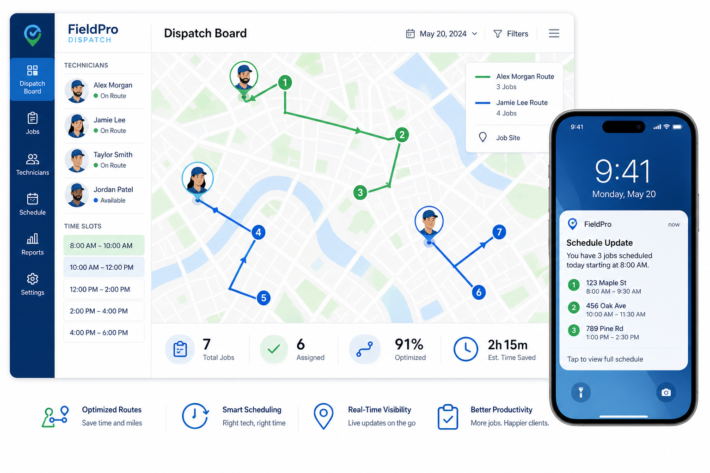
3. Dispatch the Right Technician for the Job
Smart dispatch means more than sending the closest truck. Factor in:
- Skill level — Tag technicians with their certifications and specialties
- Equipment expertise — Who has experience with Carrier vs. Trane vs. Lennox?
- Job complexity — Route complex diagnostics to senior techs; simple maintenance to apprentices
- Customer history — If a tech handled this customer before, send them back — they already know the system
4. Give Technicians Access to Knowledge in the Field
Your technicians can’t carry every wiring diagram, installation manual, and troubleshooting guide in their head. Give them mobile access to:
- Equipment manuals and spec sheets
- Step-by-step troubleshooting guides for common issues
- Photos and notes from previous visits to the same location
- A way to call or video-chat a senior tech for real-time support
A field service mobile app that stores job history, equipment details, and documentation is essential. When a tech can pull up the wiring diagram for a 2019 Carrier 24ACC636 on their phone, they solve the problem instead of scheduling a return trip.
5. Implement Pre-Visit Checklists
Before leaving for each job, technicians should verify:
- ☑️ Reviewed job details and customer history
- ☑️ Checked required parts are on the truck
- ☑️ Confirmed customer will be home / access instructions
- ☑️ Loaded any relevant manuals or documentation
- ☑️ Brought appropriate tools for the job type
This takes 2 minutes and prevents 20% of return trips.
6. Track and Review Every Return Trip
When a return trip happens, capture the reason. Build a simple classification:
- Parts — didn’t have the right part
- Diagnosis — misdiagnosed the issue
- Skills — job required expertise the tech didn’t have
- Access — couldn’t reach the equipment or customer wasn’t home
- Scope — additional issues discovered
Review these monthly. If 60% of your return trips are parts-related, your truck stocking process needs work. If it’s diagnosis-related, invest in training.
7. Invest in Ongoing Technician Training
Equipment evolves. New refrigerants, smart thermostats, tankless water heaters, heat pumps — your technicians need to keep up. The best contractors dedicate:
- 2-4 hours per month to manufacturer training
- Quarterly ride-alongs where senior techs mentor junior techs
- Post-mortem reviews on complex callbacks
Measuring Your First-Time Fix Rate
The formula is simple:
FTFR = (Jobs completed on first visit ÷ Total jobs) × 100
Track it weekly and set improvement targets:
- Below 70%: Urgent — you’re losing money on every fourth call
- 70-80%: Average — focus on parts and dispatch improvements
- 80-85%: Good — fine-tune with training and knowledge tools
- 85%+: Excellent — maintain with continuous process improvement
Use the TackOn FSM Savings Calculator to see how improving your FTFR translates to real dollar savings for your operation.
Start Improving Your First-Time Fix Rate Today
TackOn FSM gives your team the tools to fix more jobs on the first visit: complete customer history at their fingertips, real-time inventory tracking, smart dispatch, and mobile access to everything they need in the field.