Plumbing Job Management Software: Boost Your Business Efficiency
If you're running a plumbing business, you know the daily chaos. It’s a constant juggle of whiteboards, sticky notes, phone calls, and maybe a few spreadsheets that are never quite up-to-date. Plumbing job management software is designed to replace that entire mess with a single, reliable digital hub.
What Is Plumbing Job Management Software and Why It Matters Now
Think of your business as a complex machine. Right now, are you spending your days just trying to keep the gears from grinding to a halt? That’s what it feels like when you're caught in a constant fire drill of scheduling mix-ups and chasing down paperwork.
Plumbing job management software acts as the central command center for your entire operation. It's not just another app; it’s the system that connects your office staff with your technicians in the field, making sure everyone is on the same page.

This kind of platform bridges the gap between your dispatcher and your crew, eliminating the small but costly headaches that eat into your profits. Lost invoices, misquoted jobs, technicians showing up late because they got the wrong address—these little frustrations add up, turning your workday into a reactive marathon of putting out fires.
A dedicated platform shifts your business from a reactive mode into a proactive, growth-focused engine. You stop just fixing today's problems and start building a more profitable, scalable company for tomorrow.
Moving Beyond Manual Methods
For a long time, the standard way to run a plumbing shop involved a patchwork of disconnected tools. You had a whiteboard for scheduling, a pile of invoice books in each truck, and maybe a clunky spreadsheet to track jobs if you found a spare moment. The problem is, this approach separates information, and critical details inevitably fall through the cracks.
This is exactly where plumbing job management software steps in. By bringing all your operations into one place, it ensures everyone—from the person answering the phones to the apprentice out on a call—is working with the same real-time information.
To see the difference, let’s compare the old way with the new.
Manual vs Software-Powered Plumbing Operations
| Business Area | Manual Method (Paper & Spreadsheets) | With Plumbing Job Management Software |
|---|---|---|
| Scheduling | Whiteboards, phone tag, potential double-bookings. | Drag-and-drop calendar, real-time tech availability. |
| Dispatch | Calling multiple techs to find who is closest and free. | GPS map shows all tech locations for instant dispatch. |
| Job Info | Scribbled notes, forgotten details, calls back to the office. | Full job history, notes, and site photos on a mobile app. |
| Invoicing | Messy carbon copies, delayed billing, lost paperwork. | On-site digital invoicing and immediate email to customer. |
| Payments | Waiting for checks, manual credit card entry at the office. | Instant credit card processing in the field. |
| Customer Data | Filing cabinets, scattered records, no service history. | Centralized customer database with complete job history. |
This table clearly shows how a centralized system doesn't just make things a little easier—it completely changes how work gets done, plugging leaks in your workflow and your revenue.
How It Works in the Real World
Let's walk through a typical scenario. A homeowner calls with a burst pipe. Instead of yelling across the office or frantically calling your techs one by one, your dispatcher simply:
- Looks at a digital map showing every technician's live location and current job status.
- Assigns the job to the closest available plumber with a quick drag-and-drop.
- Instantly, the tech's phone pings with a notification containing all the job details, the customer's service history, and turn-by-turn directions.
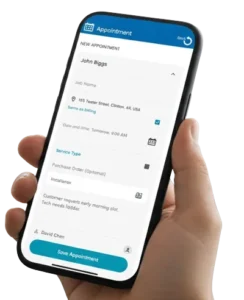
Once on-site, the plumber can update the job status, snap photos of the completed work, pull parts used from their van's digital inventory, and create an invoice. The customer can sign off and pay with a credit card right there on the spot. What used to be a dozen disconnected steps now happens in one smooth, trackable process.
This shift isn't just a "nice-to-have" anymore. The industry is moving fast, and these tools are becoming essential for staying competitive. The plumbing service software market grew from $1.66 billion in 2025 and is on track to hit $1.85 billion in 2026. Projections show it reaching $2.91 billion by 2030, a surge driven by the undeniable need for better efficiency. With 78% of entry-level plumbers already comfortable with digital tools, old-school methods are quickly becoming a liability. You can discover more about why field service management software matters.
The same principles apply across the trades; looking at how a solution like HVAC business management software organizes a similar industry shows how powerful this model is. Ultimately, this software gives you a clear, organized framework for running your entire business. In the rest of this guide, we'll break down the key features that make this possible and show you how to build a stronger, more resilient plumbing company.
What Are the Core Features That Actually Make You Money?
Let's move past the big-picture ideas and get into the nuts and bolts of what plumbing job management software really does. These aren't just fancy digital versions of your old clipboards and binders. They are specific tools designed to plug the leaks in your process where profits often drain away. When they work together, they transform the daily chaos of running a plumbing business into a smooth, money-making operation.
Think of it like this: you can run a business out of a standard pickup truck, but it’s messy. Tools get lost, you make extra trips to the supply house, and time is wasted just trying to find what you need. This software is the equivalent of outfitting a custom work van. Everything has its place, you know what you have, and you can get to work faster. These features bring that same level of organization to your entire business.
Smart Scheduling and Dispatching
One of the first things you'll notice is how this software changes your scheduling from a frantic game of Tetris into a real strategic advantage. You can finally wipe down that smudged whiteboard for good and stop the constant phone tag with your techs. Instead, you get a clean, visual dispatch board.
With a simple drag-and-drop calendar, you can see your whole team’s day at a glance—who's available, who's on a job, and where they are. This isn't just about plugging the next call into an open slot; it's about making the entire day more productive.
- Route Optimization: The system can automatically map out the quickest routes between jobs. This small change slashes fuel costs and drive time, often giving a technician enough time to squeeze in one more paying job before the end of the day.
- Skill-Based Dispatch: Got a tricky boiler replacement that needs a senior tech? You can filter your crew by their skills and certifications, making sure you always send the most qualified person for the job, preventing costly mistakes or callbacks.
- Real-Time Updates: As soon as a tech marks a job complete on their phone or tablet, the main dispatch board updates instantly. Your office staff knows immediately who is free to take that emergency call that just came in.
This kind of coordination makes your dispatcher the quarterback of your field team, not just a reactive call-taker. You’re no longer just sending bodies to addresses; you're strategically deploying your most valuable assets—your technicians' time.
Accurate Estimates and Quick Invoicing
Doing quotes and invoices by hand is a classic way to lose money. Forgetting to add a part, miscalculating labor, or losing an invoice in the truck can easily erase the profit from a job. Good plumbing job management software comes with powerful tools to make sure you bid jobs correctly and, more importantly, profitably. There's a whole world of plumbing estimating software out there, but the best ones are integrated right into your main platform.
Modern estimating tools are built right on top of your pricebook. Instead of guessing prices or thumbing through a catalog, your team can build a professional, accurate quote in minutes using your pre-set parts, labor rates, and markups.
Once the customer approves the quote—often with a quick digital signature on the spot—the system turns it into a work order with a single click. All the job details, from the parts list to the customer's address, transfer over automatically. No more mistakes from re-typing information.
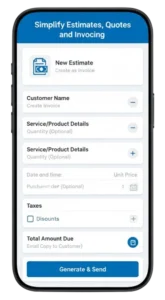
Then, when the work is finished, that same data flows straight into the final invoice. The tech can show it to the customer on their tablet, take a credit card payment right then and there, and email a receipt instantly. This "quote-to-cash" process is a game-changer for your cash flow, ending the painful cycle of chasing down payments weeks or even months after the job is done. The industry is clearly moving this way; the market for specialized plumbing estimating software is expected to grow from $30.25 million in 2025 to $58.95 million by 2032. This growth is driven by the need to prevent the manual entry errors that kill margins.
Protecting Profits with Inventory Management
Finally, let’s talk about one of the sneakiest ways plumbing businesses lose money: inventory. Every single fitting, valve, or spare part that isn't tracked and billed to a job is cash right out of your pocket. Software with built-in inventory tracking acts as your watchdog.
This feature gives you a live look at every part you own, from the moment it hits your shop shelf to the second it's installed in a customer's home. You can learn more about how to simplify your estimates and invoicing process.
Here’s a simple breakdown of how it works:
- A Central Parts List: All your inventory is logged in one place with your costs and current quantities.
- Tracking Van Stock: Each work van is treated like a mini-warehouse. When a tech uses a part, they log it in the app, and it's automatically subtracted from their van's stock and added to the customer's invoice.
- Automatic Reordering: You can set minimum stock levels for common parts. When a van or the main shop runs low, the system automatically flags it for reorder, stopping those last-minute, time-wasting runs to the supply house.
This tight grip on your materials ensures that every part used is a part billed. It cuts down on shrinkage (lost or stolen parts), stops you from giving away materials for free, and gives you a crystal-clear picture of how profitable each job truly is.
Calculating the True Return On Your Investment
Whenever you consider a new tool for your shop, it all comes down to one question: "What's the return?" With plumbing job management software, the answer isn't just about saving a bit of time here and there. It's about making real, measurable changes to your bottom line. So, let's get down to brass tacks and look at the numbers.
Think of this software less like an expense and more like hiring the most efficient office manager you've ever had—one who works 24/7 to find hidden revenue and plug the profit leaks you might not even know you have. The real ROI comes from two places: earning more and wasting less.
Turning Wasted Time into New Revenue
The first and fastest return you'll see is by tightening up your schedule. We’ve all been there—drive time between poorly routed jobs, last-minute runs to the supply house, and awkward gaps in the day. Every one of those moments is lost earning potential. What if you could get that time back?
Let's run a simple scenario for a 3-truck plumbing business. Say that with smarter scheduling and route planning, each of your three technicians can fit in just one extra job per week. We're not talking a major repipe, just a standard $400 service call.
The math on that is surprisingly powerful:
- 1 extra job/week per tech means 3 extra jobs per week for the business.
- 3 jobs/week x $400/job adds up to $1,200 in new weekly revenue.
- $1,200/week x 52 weeks comes out to a whopping $62,400 in new annual revenue.
This isn't about running your crew ragged. It's about giving them the tools to work smarter. The software finds those pockets of inefficiency and turns them into billable hours, boosting your income without adding a single truck or technician to your payroll.

As you can see, it’s the combination of smart scheduling, faster quoting, and accurate parts tracking that really drives profit. By getting these three things working together, the software creates an engine for growth, turning small daily wins into major yearly gains.
Eliminating Waste and Protecting Your Margins
The other side of the ROI coin is just as important: cost savings. After all, profit isn't just what you make, it's what you keep. In the plumbing world, common profit killers are everywhere—inventory shrinkage, parts that never make it onto an invoice, and disputed work orders.
Picture a 5-technician team. With paper invoices and messy van stock, it's easy for a few parts to "disappear" each month. Maybe they were used but not billed, lost in the shuffle, or just plain unaccounted for. Let's be conservative and say it’s just $200 worth of parts per tech, per month.
- $200/month in lost parts per tech x 5 technicians = $1,000 per month.
- $1,000/month x 12 months = $12,000 in annual savings.
That's real money going straight back into your pocket. By using a system that tracks every fitting from the warehouse to the van to the final invoice, you slam the door on that financial leak. This is about more than saving a few bucks on parts; it's about building a culture of accountability that protects your margins on every single job.
The 'Soft' Returns That Fuel Long-Term Growth
Finally, some of the most valuable returns aren't measured in dollars and cents, but they have a massive impact on your business's health and future.
- Reduced Owner Stress: Imagine the peace of mind that comes from knowing exactly where every job stands, that inventory is under control, and that payments are flowing in on time. That alone is priceless.
- Higher Technician Morale: Techs want clear instructions, organized schedules, and less paperwork—not more. A happy, organized crew is a productive crew that sticks around.
- A Better Customer Experience: When you send automated reminders, professional digital invoices, and your techs show up on time, customers notice. That's how you get five-star reviews, and those reviews become your best marketing tool, driving referral business that costs you nothing to acquire.
These "soft" benefits create a powerful cycle. A less-stressed owner has more energy to focus on growth. Happy techs provide better service. And delighted customers become your biggest fans. When you add these advantages to the hard financial gains, the decision to adopt plumbing job management software stops being a question and starts becoming the obvious next step to building a stronger, more profitable business.
How to Choose the Right Software for Your Business
With dozens of options on the market, picking the right plumbing job management software can feel like a chore. On the surface, they all promise the world, making it tough to figure out which one will actually make a difference for your business.
The secret is to look past the slick marketing and focus on what your company really needs to run a tighter, more profitable ship.
Think of it like buying a new work van. You wouldn't just grab the shiniest one on the lot. You’d pop the hood, measure the cargo space, and make sure it has the right shelving for your tools and parts. Choosing software is the exact same deal. You need a system that fits your day-to-day workflow, helps your team do their best work, and solves your biggest operational headaches.
Start with a Clear Feature Checklist
First things first, you need to separate the "must-haves" from the "nice-to-haves." This is the best way to cut through the sales fluff and judge every platform by the same standard. While every plumbing business is a little different, the core essentials are usually the same across the board.
To help you get started, we've put together a checklist to guide your search. It breaks down the features that truly matter for plumbers in the field and in the office.
Essential Feature Checklist for Plumbing Software
| Feature | Must-Have or Nice-to-Have? | Why It's Important for Plumbers |
|---|---|---|
| Mobile App with Offline Mode | Must-Have | Techs are always in basements or on new construction sites with spotty service. The app has to work without a signal, period. |
| Integrated Quoting & Invoicing | Must-Have | Turning a quote into a job and then an invoice without re-typing anything is a massive time-saver and eliminates costly errors. |
| Real-Time Scheduling & Dispatch | Must-Have | A drag-and-drop calendar with GPS tracking is the command center for any efficient plumbing operation. |
| Inventory & Parts Management | Must-Have | You have to track parts from the shop to the van to the customer's invoice. If you don't, you're just giving away money. |
| Customer Database & Job History | Must-Have | Pulling up a customer's entire history—past jobs, installed equipment, old notes—is key to providing 5-star service. |
| QuickBooks Integration | Nice-to-Have (but close to a must!) | Automatically sending invoices and payments to your accounting software saves hours of mind-numbing data entry. |
| Customer Communication Tools | Nice-to-Have | Automated appointment reminders and "tech on the way" texts cut down on no-shows and give customers peace of mind. |
Treat this list like a scorecard when you're watching demos. A platform might have a hundred bells and whistles, but if it fails on a must-have like offline mode, it’s not built for the realities of a plumbing business.
Critical Questions to Ask Every Vendor
Once you have your checklist ready, it’s time to talk to vendors. Don't just sit back and watch their canned presentation. You need to show up with specific questions that get to the heart of what it will actually be like to use their software and work with their company.
Here are a few questions you absolutely have to ask:
- Pricing: "Is this price all-inclusive, or am I going to get hit with extra fees for setup, training, support, or moving my data over?"
- Mobile App: "Can your app work completely offline? What happens to the data a tech enters when they finally get back into a service area?"
- Onboarding: "What's your process for getting a new company set up? Do you help with migrating my customer list and price book?"
- Support: "It's 7 AM on a Monday and my dispatcher can't log in. What does your support look like? Am I talking to a real person who can help, or am I stuck with a chatbot?"
The answers to these questions will tell you far more than the demo ever will.
Transparent pricing, a mobile-first design, and robust support are non-negotiable. A low monthly price can quickly become expensive if you’re hit with hidden fees for essentials like getting your data into the system.
At TackonFSM, we built our platform specifically to solve these problems. Our pricing is straightforward and all-inclusive—no hidden setup fees. We even offer free assisted data migration from competitors like Jobber or your own QuickBooks spreadsheets.
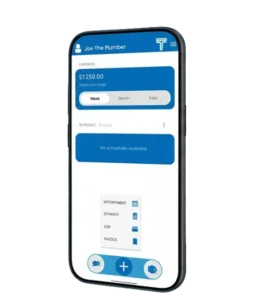
Most importantly, our mobile app was designed from the ground up for technicians in the field, making sure it works reliably with or without a perfect signal. A huge part of that is efficiently planning your team's day, and you can see how field service scheduling software that saves time directly boosts your bottom line. By focusing on these practical needs, you can choose the right plumbing software with confidence, knowing you’ve found a true partner for your business's growth.
Your Step-By-Step Implementation Guide
Let’s be honest: the thought of switching up your entire business process can be overwhelming. Many plumbing contractors stick with paper invoices and clunky spreadsheets simply because they dread the chaos of a transition. It’s a classic case of "better the devil you know."
But here's the thing: moving to a modern plumbing job management software isn't about pulling the rug out from under your team. It’s a planned, step-by-step process.

Think of it less like a frantic office move and more like outfitting a brand-new work van. You wouldn't just toss your old tools in the back. You’d plan where every wrench and fitting goes, label the bins, and show your crew how the new layout makes finding what they need faster. A good software rollout works the exact same way.
Step 1: Get Your Data in Order
Before you can import anything, you need to know what you have. The first real step is rounding up all your critical business information and getting it into a clean, simple digital format. This data is the foundation of your new system.
While most software companies, including TackonFSM, can guide you through this, doing a bit of prep work yourself will speed everything up significantly.
- Customer List: Get all your customer names, service addresses, phone numbers, and emails into a single spreadsheet.
- Price Book: Create a digital catalog of your services, parts, and materials. Include both your cost and the final price for the customer. This is what will make your estimates and invoices work from day one.
- Active Jobs: Make a clear list of any current projects or appointments already on the calendar. This ensures nothing gets lost in the shuffle.
This part feels a bit like doing homework, I know. But trust me, it's the most crucial step for a smooth and accurate launch.
Step 2: Configure the System to Your Business
With your data cleaned up and ready, it’s time to start building out your new digital headquarters. This is where you configure the software to match how your plumbing business actually runs. A good provider will be right there with you. At TackonFSM, for instance, we offer free assisted data migration to take care of the heavy lifting.
This stage is all about customization:
- User Accounts: You’ll create individual logins for your office staff and every technician in the field, setting permissions so they only see what they need to.
- Company Settings: This is the simple stuff—adding your business info, uploading your logo so it appears on invoices, and plugging in your local tax rates.
- Integrations: You’ll link the software to your accounting platform, like QuickBooks, so invoices and payments flow between the systems automatically.
This is the point where the platform stops being just "software" and starts feeling like your software, built around your team and your way of doing things.
Step 3: Train the Team and Win Them Over
A new tool is useless if nobody wants to use it. The final, and arguably most important, step is getting your team comfortable and, ideally, excited about the new system. Expect a little pushback—change is hard. The key is to show them what's in it for them personally.
Instead of presenting it as a new rule from the top, frame the software as a tool you’re giving them to make their day-to-day work less of a headache.
Focus on the pain points you're solving for each person. Show your office manager how automated job reminders mean fewer confirmation calls. Walk your techs through creating a professional invoice and taking payment right on their tablet—no more driving back to the shop with a pile of messy paperwork after a long day.
Providers like TackonFSM offer detailed onboarding to make sure everyone feels ready to go. By addressing their concerns directly and showing them how this makes their job easier, you can turn that initial hesitation into genuine enthusiasm for the future.
Got Questions About Plumbing Job Management Software? Let's Get Real.
Alright, you've seen the features and heard the promises. But now it’s time to talk about the practical stuff—the questions that pop up when you’re actually thinking about pulling the trigger on a new system for your business.
We get it. It’s a big decision. So, let’s cut through the jargon and get straight to the answers you really need.
How Much Is This Actually Going to Cost Me?
This is always question number one, and for good reason. The truth is, it depends on how the company structures its pricing. You'll usually run into two main approaches, and knowing the difference is key to not getting hit with surprise bills later.
Per-User Pricing: A lot of platforms charge you a monthly fee for every single person using the software, from the dispatcher in the office to the tech on-site. This can look cheap when you're a one-person shop, but the costs can balloon quickly as your team grows.
Flat-Rate Pricing: Other companies, like us, offer a flat monthly fee that covers a certain number of users. Maybe you get up to five users for one fixed price. This makes your monthly costs predictable, which is a huge help for budgeting as you bring on more staff.
Don't just look at the sticker price. Always ask about hidden fees for things like setup, moving your data over, or getting support. A cheap plan can get expensive fast if all the essentials are add-ons.
At TackonFSM, we stick to clear, all-inclusive pricing. You’ll find no setup fees and no long-term contracts, so you know exactly what you're paying every month. No games, no surprises.
Will It Talk to My Accounting Software?
Yes, and honestly, this is where you'll feel one of the biggest sighs of relief. Manually punching invoice details from one system into another is a soul-crushing task that’s just begging for mistakes. It's a huge headache for office managers everywhere.
Good plumbing management software is built to kill that headache by connecting directly with accounting tools like QuickBooks.
This connection creates a perfect, automated flow of your financial info:
- Your tech closes out an invoice on their tablet in the field. Boom, it instantly appears in QuickBooks.
- They take a payment from the customer. That payment is automatically synced, and the invoice in QuickBooks is marked as paid.
- This simple sync can give your office staff back hours every week and ensures your books are always 100% accurate.
How Long Will It Take to Get My Team Up to Speed?
Nobody wants to grind their business to a halt for a week of complicated training. That’s a legitimate fear. The good news is that modern field service software is built for busy people who don't have time for a steep learning curve.
For a typical small or mid-sized plumbing company, here's what you can realistically expect:
- Office Staff (1-3 Days): Your dispatchers and office managers are the power users. Give them a day or two to really get the hang of the scheduling, dispatching, and billing workflows.
- Technicians (1-2 Hours): The mobile app is where the magic happens, and it’s designed to be dead simple. Usually, one solid training session is all it takes for techs to learn how to get their jobs, update their progress, add notes, and process payments.
The trick to a quick and painless launch is picking a software partner that actually helps you. At TackonFSM, we provide free, assisted onboarding. We’ll help you move your data and walk your team through the setup so everyone feels ready and confident from day one.
What Happens if My Techs Are in a Dead Zone with No Cell Service?
This is the ultimate deal-breaker. Your techs work in basements, new construction sites, and rural properties where a good signal is a luxury, not a guarantee. If the app dies when the signal does, your tech is stuck.
That's why a solid offline mode isn't just a nice-to-have; it's essential. Here’s how it should work:
- At the start of the day, the mobile app downloads all the job info while the tech has Wi-Fi or a cell signal.
- Out in the field, they can view every detail, add notes, snap photos, and even build an entire invoice with zero connection.
- The moment their phone or tablet finds a signal again, the app automatically syncs everything they did back to the office.
This means the workflow never stops, and you never lose a piece of information, no matter how remote the job site is.
Plumbing contractors are already proving how much of a difference this kind of connectivity makes. In 2023, 45% of U.S. plumbers started using smart water meters, which let them diagnose issues through an app and cut diagnostic times by an average of 40%. Adopting job management software is how you bring that same efficiency to your entire operation. Discover more insights on the latest plumbing industry statistics.
At the end of the day, all these questions point to one thing: the right software is built for the messy, unpredictable reality of running a plumbing business.
Ready to see how a modern, all-in-one platform can solve these challenges for your business? TackonFSM replaces disconnected tools with a single system to schedule jobs, manage inventory, and get paid faster. Start your free 14-day trial today and see the difference for yourself.