

Your Guide to a Journeyman Electrician License in 2026
Earning your journeyman electrician license is a huge moment in your career. It’s the official step that takes you from being an apprentice to a recognized pro who can work without direct supervision. This credential is what validates your expertise, opens the door to much better pay, and gives you the authority to take on more complex jobs.
Your Roadmap to a Journeyman License
Think of this journey as a multi-year commitment with a clear path. It’s not something you can rush, but if you put in the work, the payoff is well worth it. You'll move from an apprenticeship, logging thousands of hours of hands-on training, to hitting the books to pass your exam and finally navigating your state’s licensing requirements.
Here’s a great visual that breaks down the typical timeline. It really simplifies the progression.

As you can see, it's a marathon, not a sprint. The whole process is designed around a mix of real-world experience and classroom theory.
Key Requirements and Timeline
The foundation of your journeyman license is built on two things: time on the tools and time in the classroom. Most electricians get there through a 4-5 year apprenticeship program, which is the most structured way to guarantee you meet all the requirements for taking your exam.
This commitment pays off directly in your wallet. According to the U.S. Bureau of Labor Statistics, the median annual wage for electricians was $62,350 as of May 2024. That breaks down to about $29.98 per hour. But in busy markets or for those with specialized skills, it’s not uncommon for top-tier journeymen to pull in over $120,000 a year. That’s the power of having that license in your back pocket.
Key Takeaway: Your journeyman license is more than just a certificate. It's a direct line to higher earnings and the professional respect that comes with being a trusted expert in the trade. The strict requirements are there for a reason—they ensure quality and safety.
To give you a clearer picture, this table breaks down what you can expect to invest in terms of time and effort.
Journeyman License at a Glance: Key Requirements and Timeline
Here’s a quick summary of the major milestones you'll need to hit on your path to becoming a licensed journeyman electrician.
| Requirement | Typical Duration / Hours | Key Outcome |
|---|---|---|
| Apprenticeship Program | 4-5 years | Blends critical on-the-job training with classroom learning. |
| On-the-Job Training | ~8,000 hours | Develops hands-on skills pulling wire, bending conduit, and installing systems. |
| Classroom Instruction | ~900 hours | Teaches you electrical theory, code compliance, and safety rules. |
| Licensing Exam | 1-2 months of prep | Proves your mastery of the National Electrical Code (NEC) and theory. |
| State Application | Varies by state | The final step to officially verify your hours and exam success. |
Each of these steps is a building block, ensuring you’re fully prepared not just for the exam, but for a long and successful career.
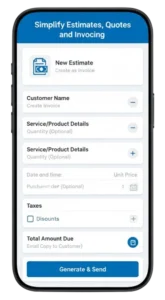
Once you’re licensed and working, you’ll find that tools designed to simplify estimates, quotes, and invoicing are a lifesaver for keeping the business side of things running smoothly.
Building Your Foundation Through Apprenticeship
Your journey to becoming a journeyman electrician really begins the moment you step onto a job site as an apprentice. This is where the textbook theories—all the math and physics—start to click into place. It’s where you finally get your hands dirty and build the practical skills that no classroom can fully teach.
But before you can even land a spot in a program, you’ll need to have a few things squared away. Most programs require a high school diploma or a GED, and you absolutely must have a decent handle on algebra.

Don't just brush off the math requirement. Algebra isn't just a box to check; it’s the language of our trade. You’ll use it every day for things like load calculations, applying Ohm’s law, and making sense of complex circuits. Without it, you'll be lost.
Choosing Your Apprenticeship Path
Once your basic qualifications are in order, you’ve got a big decision to make: union or non-union? Both are legitimate paths to a journeyman license, but they operate very differently.
A union apprenticeship is typically run through the International Brotherhood of Electrical Workers (IBEW) in partnership with the National Electrical Contractors Association (NECA). These programs are highly structured, with standardized pay scales, great benefits, and a clear career ladder. The union hall dispatches you to jobs with signatory contractors, which means your work assignments can vary widely.
The alternative is a non-union (or "open-shop") apprenticeship, often managed by groups like the Independent Electrical Contractors (IEC) or Associated Builders and Contractors (ABC). Here, you’re hired directly by an electrical contractor. This route can offer more flexibility and allows you to build a long-term relationship with one company, but your pay and benefits can vary more than in the union model.
I’ve known great electricians who came up through both the IBEW and open-shop programs. The IBEW route is known for its rock-solid, uniform training and benefits. Non-union shops, like those with the IEC, can offer a more direct path with a single employer. One isn’t better than the other; it’s about finding the right fit for you.
What to Expect from Your Training
No matter which path you take, the end goal is the same: racking up thousands of hours of real-world work and classroom study. State licensing boards are very specific about these requirements before they’ll even let you sit for your journeyman exam.
Here’s the typical breakdown you can expect over four or five years:
- On-the-Job Training (OJT): You'll need to complete around 8,000 hours of paid work. This is the heart of your apprenticeship, where you’ll learn directly from licensed journeymen and master electricians.
- Classroom Instruction: You’ll also spend about 900 hours in a classroom setting, covering everything from electrical theory and the National Electrical Code (NEC) to blueprint reading and critical safety procedures.
These aren't just arbitrary numbers. They represent years of dedication. One week you might be pulling wire on a new commercial high-rise, and the next you could be troubleshooting a tricky residential service call. This variety is what shapes you into a competent, well-rounded electrician.
Documenting Your Hours and Making an Impression
Here's a piece of advice I give every new apprentice: treat your logbook like gold. Your state licensing board will demand proof of every single one of those 8,000 training hours, often broken down by the type of work you did. Messy or incomplete records are one of the top reasons journeyman applications get delayed or denied.
Start a detailed log from day one. Seriously. For each entry, write down the date, the name of your supervising electrician, the hours worked, and what you did—be specific, like "installed 20-slot residential panel" or "ran conduit for commercial lighting." Get your journeyman to sign off on it weekly or monthly. You’ll thank yourself four years from now.
Your employer also has to keep these records straight for compliance, which is a major reason why field service management software matters in modern contracting—it helps track everyone’s hours and certifications automatically.
Finally, your attitude on the job site is everything. Be the person who asks good questions, has the next tool ready without being asked, and helps clean up. A good work ethic gets you noticed. Experienced electricians will take you under their wing and trust you with more challenging tasks, which is the fastest way to prepare yourself for that journeyman electrician license exam.
Strategies for Passing the Journeyman Exam

The journeyman exam is the last hurdle between you and your license, and it trips up a lot of good electricians. But here's the secret: it's not really a test of what you know. It’s a test of how well you can find information when the clock is ticking.
Success isn't about memorizing the entire National Electrical Code (NEC). It’s an open-book test for a reason. The real skill is being able to navigate that book fast and accurately.
Let's build your game plan. We’ll break down how to make that codebook your best friend, which topics to hammer down on, and how to use practice exams to walk into the test center feeling prepared, not panicked.
Master Your Codebook Before Anything Else
Your NEC book is the single most important tool you’ll have in that exam room. I've seen it time and time again: the people who fail aren't the ones who lack the knowledge; they're the ones who run out of time from flipping through the book aimlessly.
The first thing you need to do is tab your codebook. Exam prep courses often sell pre-printed, permanent tabs that line up with the key NEC articles, chapters, and tables. Get them. They are a massive time-saver.
Pro Tip: Don't just stick the tabs on and call it a day. Use them. For weeks leading up to the exam, have someone quiz you. Get them to call out random topics—"grounding electrode conductor sizing" or "feeder tap rules"—and time how long it takes you to find the answer.
This kind of practice builds muscle memory. The goal is to hear a question about motors and have your hand instinctively flip to Article 430 without even thinking about it.
Know the Core Exam Topics
While every state’s exam has its quirks, they all center on the same core principles from the NEC. You need to focus your study time on the areas that carry the most weight. Don't waste energy trying to become an expert on every obscure rule.
Put your effort into these heavy hitters:
- Calculations: This is a huge portion of the exam. You have to be solid on load calculations for single-family homes and multi-family dwellings. You'll also see questions on conductor ampacity and voltage drop.
- Motors and Motor Controls: Article 430 is dense, confusing, and always on the test. Make sure you know how to size conductors, overcurrent protection, and overload heaters for motor circuits.
- General Wiring and Protection: This covers the fundamentals, from branch circuits (Article 210) and feeders (Article 215) to overcurrent protection (Article 240).
- Grounding and Bonding: Article 250 is arguably one of the most critical and complex sections. You must understand the difference between system grounding and equipment grounding.
A classic mistake is spending hours on niche topics like swimming pools (Article 680) but being shaky on the fundamental load calculations that show up over and over again.
Simulate the Real Test with Practice Exams
Just reading the codebook is passive. Taking practice exams is where the real learning happens. The goal isn't just to get a good score on a practice test; it's to get used to the pressure and pacing of the actual journeyman exam.
You have to be strict with your timing. If the real exam is 100 questions in four hours, you have about 2.4 minutes per question. If you're taking five or six minutes on a single practice question, you've found a problem. Figure out if you're slow with the calculator or if your code lookups are taking too long.
Here’s how to get the most out of practice tests:
- Take a full-length, timed test. Do this first to get your baseline score and see exactly where you're weak.
- Review every single question. Don’t just check the ones you got wrong. For every question, understand why the right answer is correct and, more importantly, why the wrong answers are decoys.
- Focus your studying. If you got crushed by motor calculations, you know what to do. Spend the next few days living in Article 430.
- Repeat. A week later, take another full-length exam and see if your score improves.
This cycle of testing, reviewing, and targeting your weak spots is what builds real confidence. It turns what feels like an impossible exam into a challenge you know how to beat.
Getting Your License: State Rules and Reciprocity
You’ve passed the exam, and it feels like the hard part is over. But hold on—there’s one last administrative hurdle that trips up more new journeymen than you'd think: the application itself. Getting the paperwork right is just as critical as knowing your codebook.
Think of your application as the final inspection on your entire apprenticeship. The state licensing board needs to see everything documented perfectly—every hour of experience, your exam score, and your background check. One missing signature or an incomplete form can send your application right back to you, putting your career on hold.
The Paperwork Can Make or Break You
Believe it or not, the number one reason for a delayed license isn't a failed test—it's a sloppy application. I’ve seen it happen time and again. Before you even think about putting that packet in the mail, go over it with a fine-tooth comb. Then, have someone else do it.
Make sure your supervising master electrician has signed off on your experience verification. Double-check that your logged hours perfectly match the state's minimum requirements.
For instance, if the board requires 8,000 hours on the job, don't submit a log with 7,950 hours and assume they'll let it slide. They won't. Your documentation has to be exact and provable, leaving no room for questions.
A Pro Tip from the Field: Treat your application with the same focus you'd bring to a complex panel installation. A tiny mistake can cause a major shutdown. Ask a mentor or a trusted master electrician to review your entire package before you send it off—a second set of eyes is invaluable.
A Patchwork of State-by-State Rules
One of the first things you learn in this trade is that there’s no such thing as a "national" journeyman license. Every single state makes its own rules, and the differences can be huge. What gets you licensed in Texas might not even get you in the door in California or Colorado.
This patchwork of regulations impacts everything:
- Experience Hours: While 8,000 hours is a common benchmark, it's far from universal. Some states demand more, while others might let you substitute some classroom hours for on-the-job training.
- Application Fees: The cost to get licensed can swing from less than $100 to several hundred dollars. Texas, for example, has separate fees for the application and the exam, while California's C-10 contractor license has a much higher, more bundled cost.
- Keeping Your License Active: This isn't a one-and-done deal. Most states require you to complete continuing education courses to renew your license every one to three years. It’s their way of making sure you’re staying up-to-date with the latest NEC changes.
To give you a real-world snapshot, here’s a quick comparison of how just a few states handle their journeyman requirements.
State Journeyman License Requirement Comparison
| State | Required On-the-Job Hours | Reciprocity Notes | Typical Application Fee |
|---|---|---|---|
| Texas | 8,000 hours under a master electrician. | Limited reciprocity; agreements with states like Arkansas, Idaho, and Oklahoma. | ~$30-$50 |
| California | 8,000 hours (as part of C-10 contractor license). | No direct reciprocity; experience must be verified. | ~$450+ (for contractor license) |
| Colorado | 8,000 hours, with 4,000 in commercial/industrial. | Has reciprocity agreements with a number of states. | ~$80-$200 |
| Florida | Varies by county; state certification is for contractors. | No statewide journeyman reciprocity. | Varies by jurisdiction. |
As you can see, where you get your license plays a huge role in your career path, especially if you ever plan on moving.
What You Need to Know About License Reciprocity
This brings us to a word you’ll hear a lot in your career: reciprocity. In simple terms, reciprocity is an agreement between states that lets an electrician licensed in one state get a license in another without having to retake the grueling journeyman exam. For electricians who want to move, it's a game-changer.
But here's the catch: these agreements are tricky and not universal. A state like Colorado might have reciprocity with a dozen other states, but it's rarely a simple swap. You'll still have to file an application, pay a fee, and prove that your experience and training meet the new state's standards.
Before you pack up your truck based on something you heard from another electrician, do your own homework. The only source of truth is the official website for the licensing board in the state you're moving to. Assuming your license is portable without checking first is a fast way to find yourself working illegally.
Your Career as a Licensed Journeyman Electrician

So you’ve passed the test and have that journeyman license in your wallet. Congratulations. This is a huge milestone, and it’s where your career really starts to take off. You’re no longer just the apprentice or the helper. You’re now a trusted professional who can lead a small crew, tackle tricky installations, and work on your own under a master electrician’s guidance.
Right away, you’ll notice a shift. Getting your license is the key that unlocks better jobs and, frankly, better pay. Companies are always on the lookout for licensed journeymen because they can send you to a job site without needing to hold your hand. That trust translates directly into a fatter paycheck and gives you real leverage when negotiating a new job or asking for a raise.
Making the Most of Your New License
Think of your journeyman card as solid proof of your skills. When you’re polishing up your resume, make sure that license is front and center. It immediately qualifies you for roles that were off-limits before, like being the lead on a residential project or a core team member for a big commercial build-out.
As you move up, knowing how to talk about your experience is key. It's not just about listing jobs; you'll want to check out some lists of skills for a CV relevant to construction and trades to get ideas. Your ability to read blueprints from cover to cover, manage materials, and train up the next generation of apprentices—those are the things that make you stand out.
Having your journeyman electrician license means you've proven you can work safely and competently. It tells a potential employer that you understand the NEC, can solve problems on your own, and are ready to be a productive member of the team from day one.
This new level of trust also lets you branch out into more specialized work. Maybe you'll find a niche in fire alarm systems, get deep into motor controls, or jump into the booming field of renewable energy, installing solar panels and battery storage systems. Your license is the foundation you'll build that specialized expertise on.
Staying Compliant and Competitive
The electrical world never sits still. The National Electrical Code (NEC) gets a major update every three years, and new tech is always just around the corner. To keep your journeyman license active, most states require you to complete a set number of continuing education (CE) hours. Don't think of this as a chore—it’s how you stay sharp, safe, and relevant.
These courses are incredibly practical and cover essential topics like:
- NEC Code Changes: Getting up to speed on the latest code updates is non-negotiable for compliant work.
- Safety Procedures: A good refresher on things like lockout/tagout can literally save your life.
- New Technologies: Get hands-on with smart home integrations, EV chargers, and energy-efficient lighting.
Let your CE requirements slide, and you could be looking at hefty fines or even a suspended license. It’s critical to stay on top of what your state demands. Besides just checking a box, this commitment to learning makes you a much more valuable electrician.
The timing couldn’t be better, either. The industry is staring down a massive labor shortage. With nearly 30% of union electricians aged 50-70, a huge wave of retirements is opening up a ton of spots. In fact, projections show that over 300,000 new electricians will be needed to handle demand from new sectors like AI data centers. For a newly minted journeyman, this is a golden opportunity.
How Modern Tools Help You Manage Your Career
As your responsibilities grow, staying organized is everything. For contractors running a crew, trying to manually track every journeyman’s license renewal date and CE credits can be a nightmare. This is exactly where modern software can be a game-changer.
Field service management (FSM) platforms like TackonFSM are built to handle these details. An FSM gives contractors one central hub to track it all. For example, a shop owner can set up automated reminders for every technician’s license expiration, making sure the whole team stays compliant without any last-minute panic. It’s worth looking into how field service scheduling software saves time and keeps everyone on the same page.
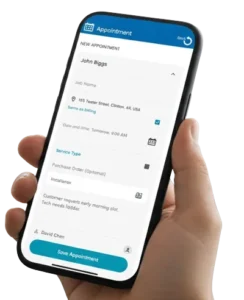
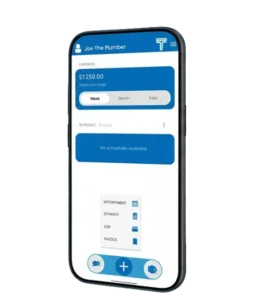
For you as a journeyman, this means less time buried in paperwork and more time focused on the tools. The system can manage your work orders, keep track of parts used from the van, and even help with invoicing, making your entire day run smoother.
Your Journeyman License Questions Answered
Even with a clear plan, getting your journeyman license brings up a lot of questions. I get it. You're putting in the hours, studying the code, and you want to know what to expect. Let's cut to the chase and answer some of the most common things I hear from electricians on their way up.
Think of this as a quick chat with someone who's been there. We'll cover everything from how long it really takes to what comes next after you've finally earned that license.
How Long Does It Really Take to Get Licensed?
Be prepared to invest 4 to 5 years in this process. This isn't a weekend course; it’s a serious career commitment. The bulk of that time is spent in your apprenticeship, where you’re logging those critical on-the-job hours and hitting the books for classroom instruction.
Once your apprenticeship is complete, you still need to budget a few months for serious exam prep and for the state board to do its thing and process your application. While every state is a little different, that four-year mark is a solid benchmark for completing the core training required for a journeyman license.
Can You Get Licensed Without an Apprenticeship?
Technically, some states allow it, but I almost always advise against it. It's a much harder road. This route usually forces you to document a massive number of work hours—often far more than an apprentice—under a licensed electrician's supervision to make up for the lack of structured schooling.
The real headache is that you're entirely on your own to prove every single one of those hours was legitimate.
A Word from Experience: The biggest thing you miss without a formal apprenticeship is the guaranteed curriculum. Those programs are designed to walk you through all the theory and code you need to know. It’s invaluable for passing the exam and, more importantly, for becoming a competent, well-rounded electrician.
For that reason alone, a registered apprenticeship is almost always the most reliable and respected path to getting your license.
What Are the Most Common Application Mistakes?
Believe it or not, the things that most often delay a journeyman license have nothing to do with skill. It’s the paperwork. I’ve seen countless applications get kicked back for simple, avoidable errors.
Watch out for these common pitfalls:
- Incomplete Forms: One blank field or a single missing signature is all it takes to get your application sent right back to you.
- Sloppy Hour Logs: A messy, unreadable logbook with missing signatures from your supervising electrician is a huge red flag. Boards won't give you the benefit of the doubt.
- Miscounting Your Time: If the state requires 8,000 hours, turning in a log with 7,990 is an automatic rejection. Be precise and double-check your math.
- Sending it to the Wrong Place: Navigating state government websites can be a pain. Make absolutely sure you’re sending your application to the correct licensing board or department.
Before you even think about sealing that envelope, review the entire package twice. Better yet, have your mentor or a master electrician give it a final look.
What Is the Next Career Step?
After you've worked as a licensed journeyman for a while—usually two to four years, depending on your state—the next big goal is earning your master electrician license. This is the highest level of certification in our trade.
Becoming a master electrician means passing another, tougher exam that dives deep into advanced code, electrical theory, and business management. Once you have that master license, you can finally:
- Pull your own permits for projects.
- Open and run your own electrical contracting business.
- Hire and supervise journeymen and apprentices.
As you step into a business owner role, you also have to get smart about the business side of things, like understanding what it means to be licensed, bonded, and insured. This isn't just jargon; it's fundamental to protecting your company and your customers.
Keeping your journeyman license, renewals, and continuing education credits straight is non-negotiable for staying compliant. If you’re a contractor managing a team, that admin work can quickly pile up. A field service management platform like TackonFSM gives you a single place to track everyone’s certifications and sends out automated reminders so a license never lapses. It lets you focus on the work, not the paperwork.