A Complete Guide to HVAC Service Business Software
If you've ever tried to run your HVAC business using a tangled mess of paper calendars, whiteboards, and sticky notes, you know the chaos. Now, imagine a single dashboard that handles everything from the moment a customer calls to the second their payment hits your account. That’s what HVAC service business software is all about.
It's not just a fancy calendar. Think of it as the central nervous system for your entire operation, connecting your office staff, your technicians in the field, and your customers in one seamless loop.
What Is HVAC Service Business Software?
At its core, this software is designed to untangle the daily operational knots that plague so many HVAC businesses. It replaces disjointed, manual tasks with a smooth, automated process that just works.
Instead of a dispatcher frantically calling technicians to find someone available for an emergency AC repair, the software can instantly identify the closest, best-qualified tech and send them all the job details directly to their phone. It takes the guesswork and the frantic phone tag out of your day.
Moving Beyond Manual Methods
For a small but growing shop, manual methods are a ceiling on your potential. Every service call becomes a gauntlet of paperwork and repetitive steps—scribbling down customer info, creating a work order, handing it to a tech, hoping it comes back legible, creating an invoice, and then chasing that invoice down for weeks. It's not just inefficient; it's costing you money and holding you back.
This software automates the entire journey of a job:
- First Contact: A customer's call comes in, and their complete service history, equipment records, and notes pop up instantly.
- Smart Scheduling: The job is added to a digital dispatch board that the whole team can see.
- Efficient Dispatch: The right technician gets assigned with a click and receives every detail—address, issue, customer history—on their mobile app.
- On-Site Execution: The tech completes the work, takes photos of the repair, and gets a digital signature right on their tablet.
- Instant Invoicing: A professional invoice is generated on the spot and can be emailed or texted to the customer for immediate online payment.
Let's look at a quick comparison to really see the difference.
Comparing Manual Methods to HVAC Software
See the operational differences between traditional manual processes and using integrated HVAC software to manage your business.
| Operational Area | The Manual Process | The HVAC Software Advantage |
|---|---|---|
| Scheduling | Whiteboards, paper calendars, constant phone calls to check availability. Prone to double-bookings and errors. | Drag-and-drop digital dispatch board. Real-time tech location and status. Automated scheduling suggestions. |
| Dispatching | Manually writing work orders, calling techs with job details, hoping they write it all down correctly. | Instant dispatch to a tech's mobile app. Includes job notes, customer history, and GPS directions. |
| Invoicing | Handwritten invoices, manual data entry back at the office, mailing paper copies, and waiting for checks. | On-the-spot invoice generation from the field. Customers can pay instantly online via credit card or ACH. |
| Customer History | Sifting through filing cabinets or messy spreadsheets to find past service records. | Complete customer and equipment history is available instantly, both in the office and on the tech's device. |
The move away from these old-school methods is why the industry is changing so fast. The Americas HVAC software market is expected to jump from USD 2.4 billion in 2025 to USD 4.9 billion by 2031. It’s not a fad; it’s a fundamental shift in how successful businesses operate.
To make this system even more powerful, many owners pair their software with a specialized answering service for HVAC technicians. This ensures that even when you're on a job or it's after hours, you never miss a customer call, creating a truly professional experience from start to finish.
The Core Features That Drive Business Growth
Knowing you need an all-in-one system is the first step. But the real magic happens when you see how the individual pieces work together to actually move your business forward. Think of your HVAC software less like a single tool and more like a high-performance engine. Each feature is a critical part—a piston, a gear, a spark plug—and they all have to fire in sync to generate the power and efficiency you need to grow.
When these components are humming along together, they don't just fix small, annoying problems. They create a powerful momentum that turns daily chaos into a well-oiled machine. Let's break down the essential features that make this happen.
This flowchart shows that transformation in action—how the right software brings order to the chaos and paves the way for real growth.
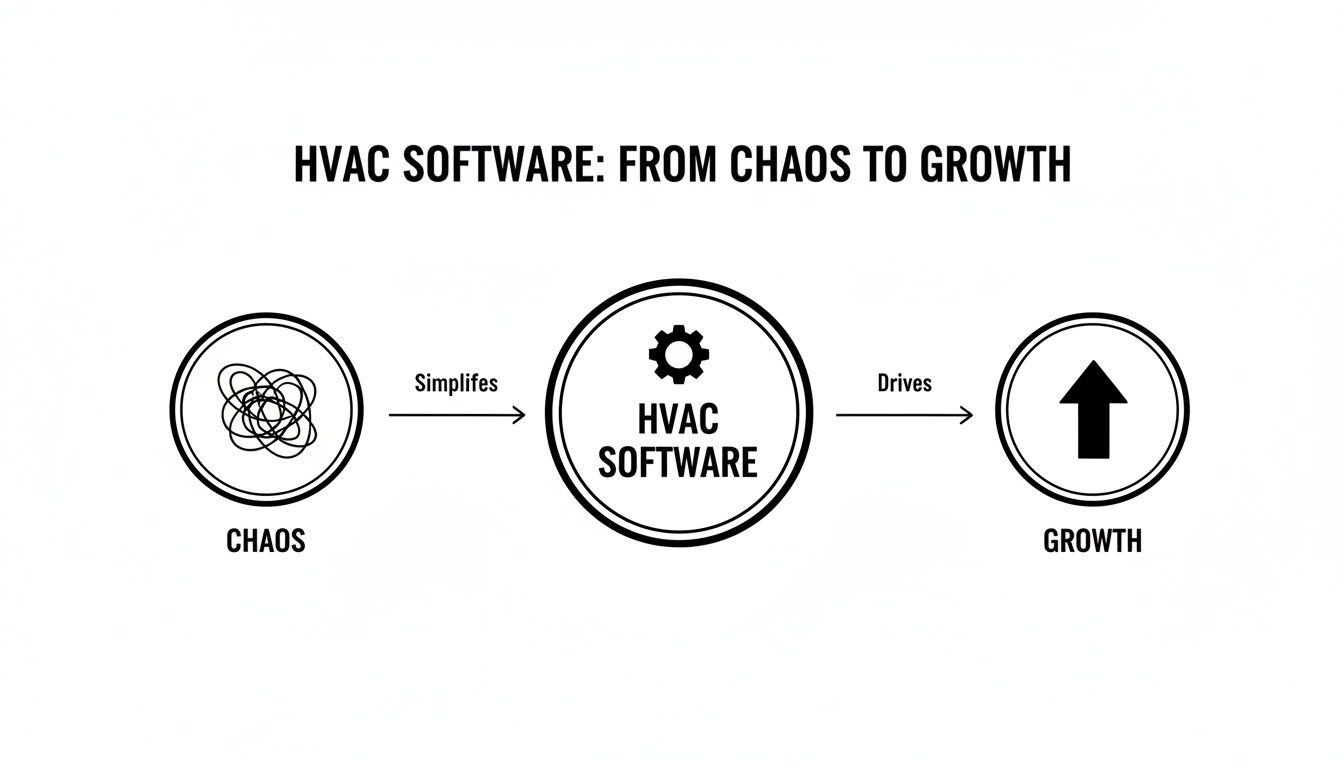
It’s all about creating a solid, structured foundation. Once you have that, scaling your business becomes a much more manageable goal.
Intelligent Scheduling and Dispatching
For most HVAC businesses, the dispatch board is the nerve center of the entire operation. If you're still using a physical whiteboard, you know the pain of scribbled notes, eraser marks, and constant confusion. It’s a recipe for missed appointments and wasted time.
Modern HVAC service business software rips that whiteboard off the wall and replaces it with a smart, digital command center.
Imagine a simple drag-and-drop calendar that shows you every tech’s schedule, their current location, and job status in real time. An emergency call comes in for a furnace that’s on the fritz. Instead of scrambling and guessing, the system instantly points you to the nearest qualified technician who has the right skills for that specific job.
This isn't just about making life easier; it's about being smarter with your resources.
- Route Optimization: The software figures out the most efficient routes for your techs, which means less time in traffic and more time on the job. The fuel savings alone can be substantial.
- Skill-Based Assignment: You can tag technicians with their specialties—like "commercial rooftop units" or "geothermal systems"—so you’re never sending a rookie to a complex job or a master technician to a simple filter change.
- Real-Time Flexibility: When a job runs late or a customer cancels, you can just drag and drop the next job to a different tech. They get an instant notification on their phone, and your schedule stays full.
This kind of control lets you fit more jobs into the day without overwhelming your team, which is a direct path to boosting your revenue.
A Powerful Mobile App for Technicians
Your techs are the face of your company when they're out in the field. Giving them the right tools doesn't just make their work easier; it completely changes the customer's experience for the better. A good mobile app turns their phone or tablet into their most important tool.
Forget the crumpled work orders and clipboards. With a mobile app, they have every single piece of information they need right in their pocket—customer name, address, job history, and specific notes about the problem.
Putting job details and customer history directly into your technicians' hands empowers them to solve problems faster and more confidently. This is how you start crushing your first-time fix rates and earning serious customer loyalty.
The best apps are more than just a place to view information; they are active tools for getting the work done. They let techs take photos, add notes, and build quotes on the spot. A clean, simple interface means your team will actually want to use it, getting you a return on your investment from day one.
Streamlined Quoting and Invoicing
Getting paid on time is the lifeblood of your business. Manual invoicing is slow, messy, and full of opportunities for errors, which all leads to delayed payments and a drain on your cash flow. HVAC software automates this entire cycle from start to finish.
Right there in the customer's home, your tech can build a professional, multi-option quote using your company's pricebook. They can easily present "good, better, best" choices, which is a proven way to increase the average ticket size. As soon as the customer gives a digital signature, that quote flips into a work order.
And when the job is done, getting paid is just as simple.
- On-the-Spot Invoicing: The moment your tech marks the job complete on their app, a detailed invoice is automatically generated and emailed or texted to the customer.
- Instant Payment Options: That invoice includes a secure payment link. Customers can pay with a credit card right then and there. No more "the check is in the mail."
- Automated Follow-ups: For any lingering unpaid invoices, the system can send out polite, automatic reminders so your office staff doesn't have to chase down money.
This smooth process dramatically shortens the time between finishing a job and having cash in the bank.
Integrated Inventory and Parts Management
"Do you have the part on the truck?" That one question can determine whether a job is profitable or not. Every extra trip to the supply house costs you fuel, labor, and a little bit of your customer's patience.
Integrated inventory management gives you a real-time view of your stock—both in the warehouse and on every single truck. When a technician uses a part, it’s automatically deducted from their truck's inventory count and added to the customer's invoice. Nothing gets forgotten or given away for free.
The industry is moving fast on this. With over 72% of HVAC companies running with fewer than 50 employees, the demand for this kind of efficient, scalable software is huge. Already, about 68% of U.S. HVAC firms use mobile dispatch, 41% are using AI-powered scheduling, and 36% track inventory in real time.
Ultimately, the biggest win comes from true business system integration. When your scheduling, mobile app, invoicing, and inventory all talk to each other, you finally have one single source of truth for your entire business. That’s when you can really start to grow.
Calculating the Real ROI of Your Software Investment
When you look at HVAC service business software, it's easy to see the monthly subscription fee as just another expense. But that's the wrong way to think about it. This isn't a cost; it's an investment, and a smart one at that. The real question is how those features translate into more money in your pocket.
The return on investment (ROI) here isn't some fuzzy, abstract concept. It's real, it's measurable, and it touches every single part of your operation. Think of it like swapping out a basic hand-tool kit for a fully-stocked service truck. Sure, the upfront cost is higher, but your ability to get more done, faster, and with better results starts paying you back from day one.
Let’s break down that payback into three clear financial wins you can actually take to the bank.

Driving More Revenue Every Day
The most direct way this software boosts your bottom line is by simply increasing your capacity to earn. This happens in two main ways: squeezing more jobs into a day and getting more value out of each job you do.
Smart scheduling and route optimization are the powerhouses here. Instead of your techs zig-zagging across town, burning fuel and wasting hours in traffic, the software lays out the most efficient route for the day. That time saved isn't just a nice-to-have; it's a new appointment slot you just created out of thin air.
For most HVAC businesses, this efficiency gain allows each tech to complete at least one extra high-value job per day. Let’s say an average profitable service call is worth $350. Adding just one more per day for a single technician translates to an extra $1,750 per week in pure revenue.
This isn’t about working your team into the ground. It’s about giving them the tools to work smarter. Cutting out that dead time between jobs is one of the quickest ways to grow your company’s earning potential without adding a single dollar to your overhead.
On top of that, the mobile app puts powerful sales tools right in your technicians' hands. When a tech can pull up a customer's full service history and present a "good, better, best" set of options on a tablet, the average ticket size naturally climbs.
Slashing Your Operational Costs
While you're bringing in more cash, the software is working behind the scenes to plug the little leaks that drain your profits. These seemingly small drips—a forgotten part on an invoice, an unnecessary trip back to the shop—add up to thousands of dollars over the year.
Here’s where you’ll see the savings pile up:
- No More Billing Errors: Manual invoicing is a recipe for mistakes. A tech forgets to add a part, or miscalculates labor, and you've just left money on the table. Automated invoicing ensures every single part and every minute of labor gets billed correctly, every time.
- Cutting Fuel and Travel Time: As we just covered, optimized routes directly slash your fuel bill and reduce wear and tear on your vehicles. Less mileage saves you money today and extends the life of your fleet tomorrow.
- Stopping Inventory "Shrinkage": With integrated parts management, every filter or capacitor that comes off a truck is tracked and tied to a specific job. This puts an end to lost parts and guarantees you're billing for everything you use.
These aren't just minor tweaks. They represent a fundamental improvement in your operational efficiency that fattens the profit margin on every single job.
Strengthening Your Financial Health
Finally, the right software gives a massive boost to your cash flow—the lifeblood of any service business. That painful gap between finishing a job and actually getting paid can put a serious strain on your finances, making it tough to meet payroll, order supplies, or plan for growth.
HVAC software attacks this problem from every angle. By letting technicians create and send an invoice from the field the second a job is done, you kill the delay. Even better, by including a secure online payment link right in that invoice, you make it incredibly easy for customers to pay you on the spot.
This one change can shrink your average accounts receivable from a painful 45 days down to just 15 days, or even faster. Getting paid sooner means you have more working capital on hand, which reduces your need for credit and gives you the financial stability to run your business with confidence.
How to Choose the Right HVAC Software for Your Business
Picking the software that will run your entire operation is a huge decision, but it doesn’t have to be a stressful one. The trick is to look past the slick sales pitches and get real about what your business actually needs to not just survive, but grow. With a clear plan, you can cut through the noise and find a true partner, not just another monthly subscription.
Think of it like buying a new work truck. You wouldn't just grab the one with the shiniest paint job. You'd pop the hood, kick the tires, and make sure it can handle your daily workload—and still have the power to tow more as you add more crews and equipment down the road.
Look for Scalability and Future Growth
The software you pick today can't become a roadblock tomorrow. It's a classic mistake: choosing a simple tool that works perfectly for your two-truck shop, only to find it completely breaks down when you hit ten. Your software has to be built to grow with you.
Don't be afraid to ask vendors the tough questions. How does the system perform with hundreds of jobs a day versus just ten? If you open a second location, can it handle multi-shop inventory? Picking a scalable platform now saves you the massive headache of having to switch everything over again in just a couple of years.
This kind of forward-thinking is essential, especially as the industry itself expands. The global HVAC software market is booming as more businesses demand tools that make them more agile and efficient. You can read the full research about the HVAC software market to see just how big this trend is. You want to choose a solution that’s riding that wave, not one that’s about to get left behind.
Prioritize Ease of Use and Team Adoption
The most powerful software on the planet is useless if your team hates using it. If your techs and office staff are constantly fighting a clunky, confusing system, you'll never see the results you were promised. The best software just feels right from the moment you log in.
Look for a clean interface and workflows that make sense. Can your dispatcher get a new job on the board in just a few clicks? Can a technician pull up a customer's entire service history from their phone without calling the office for help?
The ultimate test of any software is whether your team actually uses it. If the platform makes their jobs easier, they'll embrace it. If it adds friction, they'll find workarounds, and your investment will go down the drain.
The best way to figure this out is to get your people involved. Let your lead tech and your office manager sit in on the demos. Their real-world feedback is gold when it comes to picking a tool the whole company will get behind.
Demand True Industry Specialization
Generic field service software just doesn't cut it for HVAC. Our trade has specific challenges and workflows that a one-size-fits-all solution can't possibly understand. You need a platform that was built from the ground up for contractors like us.
What's missing from those generic tools? A lot, actually.
- Multi-Level Price Books: You need the ability to set up detailed price books with different rates for residential jobs, commercial clients, and members of your service agreement plan. That's a must for protecting your margins.
- Detailed Equipment Tracking: It’s not enough to just track the customer. You have to track every single piece of equipment you service—make, model, serial number, install date, and a complete service history.
- Service Agreement Management: Preventative maintenance contracts are the lifeblood of many HVAC businesses. A specialized system automates the scheduling, billing, and renewal reminders, so you never let that recurring revenue slip through the cracks.
Don’t settle for a generic platform that makes you invent awkward workarounds for basic tasks. When you choose a purpose-built solution like TackonFSM, you're getting a system that already speaks your language.
Verify Integration and Support Capabilities
No software is an island. It has to play nicely with the other tools you depend on, especially your accounting package. A non-negotiable feature is a seamless integration with platforms like QuickBooks or Xero. This connection gets rid of double data entry, cuts down on costly mistakes, and gives you a crystal-clear, real-time view of your company’s finances.
Finally, take a hard look at the support and training they offer. When you’ve got a problem and jobs are on the line, you need to know you can get a real person on the phone who knows what they’re talking about—and fast. Read reviews, talk to other users, and ask about their onboarding process. A vendor that invests in getting you started right is a partner you can count on for the long haul.
HVAC Software Evaluation Checklist
To help you stay organized during your search, use this checklist to compare different solutions side-by-side. It will help you focus on the features that truly matter and make an informed decision based on your specific needs.
| Evaluation Criteria | Key Questions to Ask | Your Rating (1-5) |
|---|---|---|
| Core Functionality | Does it have all the key features you need (scheduling, mobile app, invoicing)? | |
| Ease of Use | Is the interface intuitive? Did your team find it easy to navigate during the demo? | |
| HVAC-Specific Features | Does it handle multi-level price books, equipment tracking, and service agreements? | |
| Scalability | Can it support your business as you grow to more technicians and locations? | |
| Mobile App | Is the tech app fast, reliable, and functional offline? | |
| Integrations | Does it sync seamlessly with your accounting software (e.g., QuickBooks, Xero)? | |
| Onboarding & Training | Is there a structured onboarding process? Is training included? | |
| Customer Support | What are the support hours? Can you easily reach a live person? | |
| Pricing Model | Is the pricing clear and transparent? Are there hidden fees or long-term contracts? | |
| Vendor Reputation | What do online reviews and other contractors say about them? |
After you've rated a few different options, the right choice should become much clearer. The platform with the highest scores in the areas most important to you is likely the best fit for your business's future.
A Smooth Transition to Your New Software
Let’s be honest: the thought of moving your entire business to a new software platform can be daunting. It sounds messy, complicated, and full of risk, a bit like trying to repipe a house while the water is still running. But with a solid game plan, switching over to a modern HVAC service business software can be a surprisingly straightforward process.
The key is to treat it not as one giant leap, but as a series of manageable steps. When you break it down and handle one piece at a time, you can get your data moved, your team trained, and your operations running on the new system without grinding your business to a halt.
Stage 1: The Pre-Launch Preparation
Before you flip the switch, you’ve got to do the prep work. This first phase is all about getting your data and your people ready for the change. Skipping this is like trying to paint a wall without cleaning or priming it first—you’re just asking for a sloppy result.
Start with your most valuable asset: your customer data. This is the perfect time for a digital spring cleaning. Pull your customer lists, service histories, and equipment records, then go through them with a fine-toothed comb. Get rid of duplicates, fix outdated phone numbers, and make sure addresses are standardized. Clean data from day one will save you a world of headaches later on.
While you're at it, figure out what "winning" looks like. What are the top three things you need this software to do for you?
- Cut your average invoice aging in half, maybe by 50%.
- Help each tech squeeze in one more job every week.
- Get rid of 100% of manual work order entry.
Having clear, measurable goals keeps the whole process on track and makes it easy to see the payoff down the road.
Stage 2: The Launch and Team Training
Once your data is clean and your goals are set, it’s all about your people. Getting your team on board is the single most important part of a successful software rollout. If your techs and dispatchers aren't comfortable with the new system on day one, you’ll be fighting an uphill battle to get them to use it.
Good training isn't optional. Don't just show them what buttons to click; explain why you're making the change. Show them how the mobile app will save them a trip back to the office or how the new dispatch board makes their lives easier. It's a great idea to get your key players involved early—turn them into software champions who can help their coworkers get up to speed.
A successful software launch has less to do with technology and more to do with people. When you invest in training and secure team buy-in, you're not just implementing a tool; you're building a more efficient and collaborative company culture.
Stage 3: The Post-Launch Fine-Tuning
Your "go-live" date isn't the finish line—it's just the start. The first few weeks are all about listening, learning, and tweaking. No software is a perfect fit right out of the box, and you’ll quickly find little things that can be improved once it’s being used in the real world.
Set up regular check-ins with your team to see what’s working and what’s not. Are parts of the workflow clunky? Is there a feature they need but can't find? Use that real-world feedback to dial in your settings and workflows. A great software partner won’t disappear after you sign up; they’ll provide ongoing support to help you get the most out of their system.
Why Generic Tools Just Don't Cut It
Trying to run a modern HVAC business on spreadsheets or a generic project management tool is like showing up to a furnace repair with only a hammer and a roll of duct tape. You might be able to patch a few things together, but you're not equipped for the real job, and you'll eventually hit a hard ceiling that stops your business from growing.
These one-size-fits-all tools simply weren't built for the trades. They don't understand the difference between a residential split system and a commercial rooftop unit. They can't track a specific furnace's service history, manage inventory across a fleet of vans, or automatically schedule preventative maintenance visits. You’re left trying to glue together clunky workarounds that waste time, invite errors, and are impossible to scale.
The Power of a Purpose-Built Platform
This is where true HVAC service business software changes the game. It’s not just a fancy calendar; it’s a system designed from the ground up by people who actually understand your daily grind.
Generic software forces you to change your business to fit its rules. A specialized platform is built around your business, giving you the power to work smarter and keep your customers happy.
This isn't just about convenience—it's about having the right tool for the job.
- It Thinks in Equipment, Not Just Customers: The software tracks the complete service history for every single unit you install or service. Imagine your tech arriving on-site with a full record of every repair, every part replaced, and every past issue for that specific furnace. That's how you fix problems fast.
- It Connects Parts to Jobs: It links specific parts—down to the serial number—directly to work orders and invoices. No more wondering if a part was used, billed for, or is still sitting in a van. A spreadsheet can't do that.
- It Automates Your Service Contracts: It takes the headache out of managing recurring maintenance agreements. The system handles the scheduling, reminders, and billing automatically, locking in that reliable revenue you depend on.
Choosing a specialized platform isn't just an upgrade for today. It’s about building a solid foundation that lets you grow your business, boost your profits, and deliver the kind of professional service that turns one-time customers into lifelong clients.
Your Top Questions About HVAC Software, Answered
Making a big change in your business always comes with questions. Let's tackle some of the most common ones we hear from HVAC owners who are thinking about moving to a dedicated software platform. We'll give you straight, simple answers to help you feel confident about the road ahead.
How Does Software Pricing Usually Work?
When it comes to cost, most HVAC software companies follow one of two paths. Knowing the difference will help you figure out what makes sense for your budget.
- Per-User Pricing: This is exactly what it sounds like. You pay a set monthly fee for each person on your team who needs access, from the dispatcher in the office to the tech in the van. It's a great model because it scales right alongside your business—add a tech, add a user.
- Tiered Plans: Think of these as pre-built packages. A company might offer a "Crew" plan that includes up to seven users and all the core features for a flat rate. A larger "Command" plan could offer more users and add advanced tools like multi-location inventory management.
The beauty of these models is they let even smaller shops get their hands on powerful tools without a massive upfront cost.
What Is the Learning Curve Like?
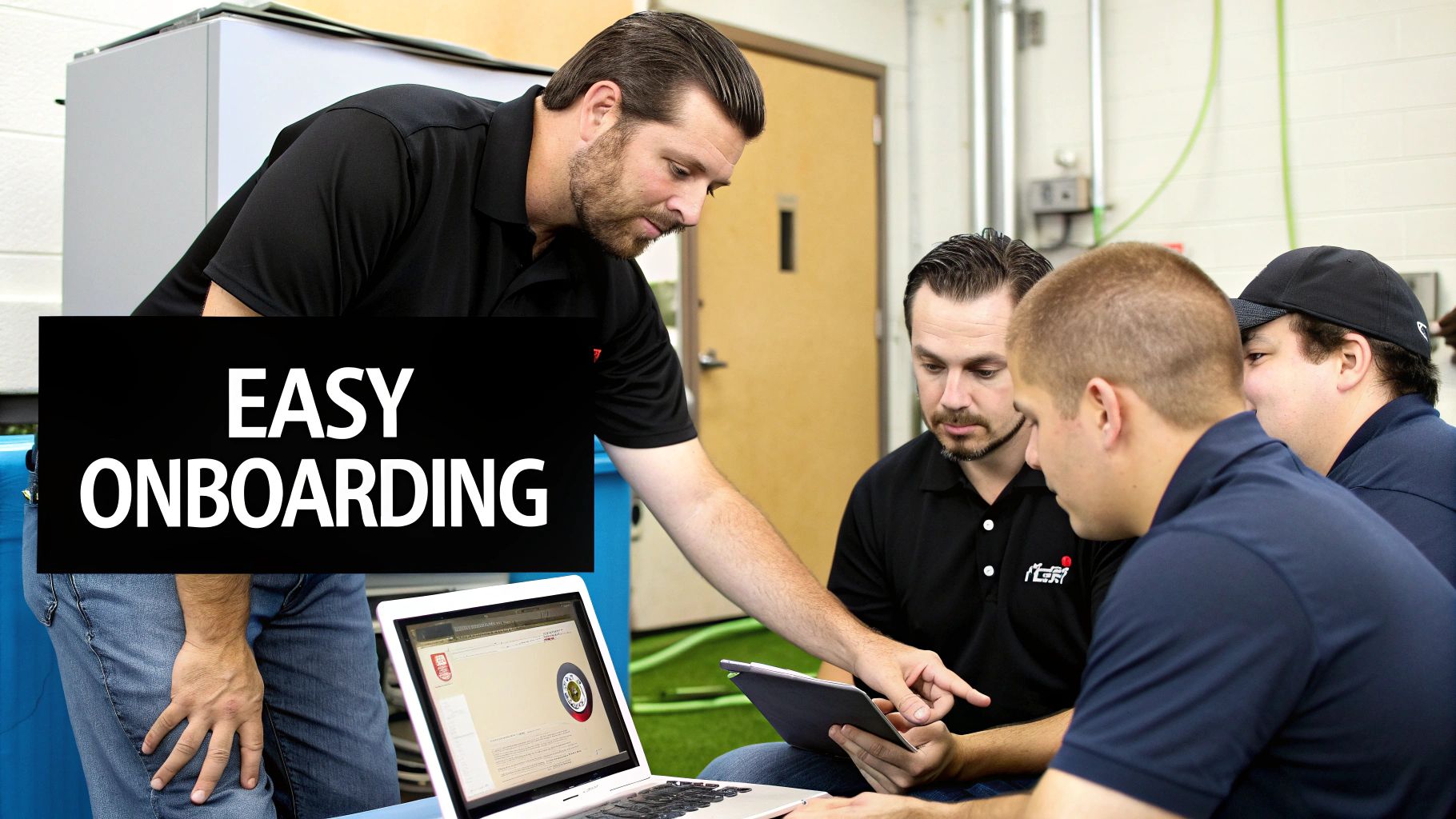
The thought of switching systems can be daunting, but any good software partner will walk you through it. Realistically, you should plan for a focused onboarding period during the first 30 days. This isn't just a "here are your logins, good luck" situation. It usually involves hands-on help migrating your customer data, training sessions for your office staff and techs, and working with an expert to get your workflows set up just right.
The goal isn't just to learn a new tool; it's to make that tool work for your business. A platform that invests in good onboarding ensures your team is comfortable and capable from day one, which is the secret to getting everyone to actually use it.
Does It Integrate with QuickBooks?
Yes, and this is a big one. For any serious HVAC software, a rock-solid integration with accounting tools like QuickBooks is a must-have, not a nice-to-have.
This connection is what stops the madness of double-entry. When an invoice is created or a payment is collected in the field, it automatically syncs to your books. This simple connection saves a staggering amount of admin time and virtually eliminates the kind of typos that can throw your finances off for months. It keeps your operations and your accounting perfectly in sync, giving you a true, up-to-the-minute look at your company's financial health.
Ready to see what an all-in-one platform built specifically for the trades can do for your business? TackonFSM gives you the tools to schedule smarter, get paid faster, and finally get a handle on your inventory. Start your free 14-day trial today.