
HVAC Maintenance Plan: The Blueprint for Recurring Revenue
Think of an HVAC maintenance plan as a subscription for comfort. It’s a formal agreement where a customer pays you a recurring fee, and in return, you provide regular system check-ups, tune-ups, and often, a few extra perks. This simple shift can completely change your business, moving you from the chaos of emergency calls to the stability of predictable, recurring income.
Why an HVAC Maintenance Plan Is Your Key to Predictable Revenue

If you're like most HVAC owners, your year is a financial rollercoaster. The phone rings off the hook during the first heatwave, and you're slammed again during the first deep freeze. But what about those mild spring and fall months? The unpredictable lulls can make cash flow a constant worry and strategic growth feel out of reach.
This is where maintenance plans change the game. Instead of waiting for a frantic call about a broken-down AC unit, you're already on the schedule to keep it running smoothly. You get to flatten those revenue curves and build a reliable financial foundation.
This isn't just a service; it's a fundamental shift in your business model—from a reactive firefighter to a proactive partner for your customers.
The Win-Win Scenario for You and Your Customers
A well-designed maintenance program isn't just a sneaky upsell; it's a genuine win for everyone involved. It builds real, lasting relationships and provides massive value.
For your customers, the benefits are immediate and easy to understand:
- Peace of Mind: They don't have to sweat through a heatwave, wondering if their AC will make it.
- Lower Bills: A finely-tuned system is an efficient one, which means lower energy costs every month.
- Priority Service: When something does go wrong, they get to jump to the front of the line.
- Longer Equipment Life: Just like a car, regular maintenance helps an HVAC system last years longer, pushing off a huge replacement expense.
For your business, the upside is transformative. You get a steady, predictable stream of cash flow you can count on, month in and month out. That stability makes it easier to manage payroll, buy new equipment, and plan for long-term growth.
An HVAC service agreement is the single most effective tool for building customer loyalty. When you see a customer twice a year for maintenance, you become their trusted advisor, not just an anonymous emergency contact.
To really see the difference, let’s compare the two business models side-by-side.
Reactive Repairs vs Proactive Maintenance Plans
| Business Aspect | Reactive Repair Model | Proactive Maintenance Plan Model |
|---|---|---|
| Revenue Stream | Unpredictable, seasonal spikes and lulls | Stable, recurring monthly or annual revenue |
| Cash Flow | Inconsistent and hard to forecast | Predictable and reliable |
| Scheduling | Chaotic, driven by emergencies | Planned in advance, filling seasonal gaps |
| Customer Relationship | Transactional, often a one-time fix | Long-term partnership built on trust |
| Technician Workflow | High-stress, emergency-driven work | Methodical, preventative work with upsell opportunities |
| Business Valuation | Lower, based on inconsistent profits | Higher, due to guaranteed recurring revenue |
The table makes it clear: building a proactive maintenance program isn't just about adding a new service, it's about building a healthier, more valuable company.
Tapping into a Growing Market
This isn’t just a good idea—it’s where the entire industry is heading. The market for HVAC maintenance services is exploding, projected to grow from around $78–$93 billion in 2023–2024 to well over $110–$146 billion in the next decade.
This incredible growth proves that customers are actively seeking out the reliability and cost savings that these plans offer. You can explore more data on this expanding market to see the full scope of the opportunity. By creating a solid maintenance program now, you’re positioning your business to ride this wave and capture a significant piece of a rapidly growing pie.
The Anatomy of an HVAC Maintenance Plan That Practically Sells Itself

If you want to create an hvac maintenance plan that customers actually want to buy, you have to offer more than just a vague promise to "check things out." You need to build a package of real, tangible value that makes signing up feel like an obvious win.
Think of it less as a service and more like a VIP membership for their home's comfort system. The foundation is a crystal-clear scope of work. It’s not just a list; it’s your promise, telling the customer exactly what they’re paying for. This transparency eliminates confusion and builds trust right from the start.
The Heart of the Plan: Your Maintenance Checklist
The maintenance checklist is the core of your entire plan. It's the physical proof of the expert work your technicians are doing during each visit. A detailed, professional checklist shows homeowners you’re not just kicking the tires—you're performing a comprehensive tune-up designed to catch problems early and maximize efficiency.
You’ll want to break your checklist down by season to tackle the specific demands of heating and cooling systems.
Spring/Summer Cooling Checklist:
- Inspect and Clean Condenser Coils: Dirty coils are public enemy number one for AC efficiency and can lead to major breakdowns. This is a non-negotiable step.
- Check Refrigerant Levels: The right charge is crucial for performance. Low levels almost always mean there’s a leak that needs to be found and fixed.
- Flush Condensate Drain Lines: This simple step prevents the nightmare of water backups and property damage during those hot, humid months.
- Test Capacitors and Relays: We’re making sure the electrical components that kick the system into gear are strong and won’t fail on the hottest day of the year.
- Inspect and Calibrate Thermostat: An accurate thermostat means better comfort and lower energy bills. It’s a small detail that makes a big difference.
Fall/Winter Heating Checklist:
- Inspect the Heat Exchanger: This is a critical safety check. We’re looking for any cracks that could lead to dangerous carbon monoxide leaks.
- Clean and Test Burners and Ignition Assembly: This guarantees the furnace ignites safely and efficiently every single time it gets cold.
- Test Safety Controls and Limits: We’re triple-checking that all the built-in safety features are working perfectly to protect the home and family.
- Lubricate All Moving Parts: A little lubrication goes a long way, reducing friction on motors and blowers to extend their life and quiet them down.
- Check Electrical Connections: Tightening up any loose connections prevents serious safety hazards and keeps the system running reliably.
This level of detail turns a generic "tune-up" into a concrete, high-value service. If you're building your plan from scratch, grabbing a definitive HVAC maintenance plan template can give you a fantastic starting point.
Beyond the Checklist: The Value-Added Perks
The checklist covers the technical side, but the real magic that makes a plan irresistible lies in the exclusive perks. These are the benefits that solve a customer’s biggest fears: surprise costs and long waits during an emergency.
Consider structuring your benefits into tiers—like a Bronze, Silver, and Gold package. This approach appeals to different budgets and makes it easy to show customers the value of upgrading.
A great HVAC maintenance plan shifts the customer's mindset from "Do I need this?" to "Which level of protection is right for me?" The decision is no longer if they should sign up, but which plan they should choose.
Here are some of the most powerful value-added benefits you can offer:
- Priority Scheduling: This is your ace in the hole. When a member's AC dies on a 95-degree day, they get to jump to the front of the line. That peace of mind is priceless.
- Discounted or Waived Fees: Offer a 10-20% discount on all repairs (parts and labor) or completely waive diagnostic fees for members. This takes the sting out of unexpected breakdowns.
- Guaranteed Service Windows: Promise a faster response, like service within 24 hours, for all plan members.
- Inflation Protection: Let them lock in their annual plan price for a few years, protecting them from future price hikes.
- Extended Warranties: Offer extended labor warranties on any repairs you perform as long as they remain a member.
When you combine a robust technical checklist with these high-value perks, you create a maintenance plan that doesn't just sell—it builds a loyal customer base and a predictable, recurring revenue stream that will stabilize and grow your business.
Smart Pricing Strategies for Your HVAC Service Agreements
Figuring out what to charge for your HVAC maintenance plan is a delicate dance. If you price it too high, you'll scare people off. Go too low, and you'll have a bunch of happy customers but a program that's bleeding cash. The goal is to find that sweet spot where the customer feels they're getting a great deal and your business locks in a healthy profit.
Don't think of it as just slapping a price tag on a couple of tune-ups. You're selling something much bigger: peace of mind, the promise of reliability, and priority treatment when things go wrong. Your price has to reflect that total value.
Before you even think about a number, you have to get real about your costs. This isn't just about what you pay your tech for two visits a year. You need to factor in fuel, truck maintenance, the admin time it takes to schedule and bill, and the real cost of any discounts you offer on future repairs. Once you know your break-even point, you can start building a profitable model from there.
The Power of Tiered Pricing Models
One of the most effective ways to price your plans is with a tiered model—think Bronze, Silver, and Gold. This strategy is brilliant because it changes the customer's mindset. Instead of asking "should I buy this or not?" they start asking, "which one of these is right for me?" It naturally nudges them toward a purchase.
- Bronze Tier (The Essential): This is your foot in the door. It needs to cover the absolute core of what you're offering: two solid, comprehensive seasonal tune-ups. It’s the perfect, no-frills option for homeowners who are watching their budget.
- Silver Tier (The Smart Choice): This will likely be your bestseller. It has everything from the Bronze plan but adds in some high-value perks that really matter, like a 15% discount on repairs or waived diagnostic fees. For most homeowners, this tier hits the perfect balance of cost and benefit.
- Gold Tier (The Ultimate Peace of Mind): This is your premium, all-inclusive package. Here, you can add exclusive benefits like guaranteed priority service (think a tech at their door within 24 hours), an extended labor warranty on any repairs you do, or even credits they can put toward a new system down the road. This plan is for the customer who wants zero worries and is willing to pay for it.
When you lay it out like this, the Silver plan becomes the "anchor," making the Gold plan feel like a smart upgrade and the Bronze plan seem like a great basic starting point.
Here's a simple way to visualize how you could structure your own tiered plans.
Sample Tiered HVAC Maintenance Plan Structure
| Feature | Basic Plan (Bronze) | Standard Plan (Silver) | Premium Plan (Gold) |
|---|---|---|---|
| Seasonal Tune-Ups | 2 per year (AC & Heat) | 2 per year (AC & Heat) | 2 per year (AC & Heat) |
| Repair Discount | 10% | 15% | 20% |
| Diagnostic Fee | Full Price | Waived with repair | Waived |
| Priority Service | Standard | Priority Scheduling | Guaranteed 24-Hour Service |
| Labor Warranty | Standard | 1-Year on Repairs | 2-Years on Repairs |
| Monthly Price (Example) | $14.99/mo | $21.99/mo | $29.99/mo |
This is just a starting point, of course. You can customize the features and pricing to perfectly match what your customers value and what your business can deliver profitably.
Choosing Your Billing Structure
How you bill for your plans is just as crucial as what you charge. You want to make paying you as easy and painless as possible for the customer, which in turn helps secure your recurring revenue. You really have two main paths to go down.
- Annual Billing: The customer pays one lump sum for the entire year. This is a huge win for your cash flow and cuts down on administrative headaches. A great way to encourage this is by offering a small discount, something like "pay for 11 months and get the 12th free."
- Monthly Billing: This breaks the cost down into a small, recurring monthly payment. It completely lowers the barrier to entry, making the plan feel more like a small subscription—like Netflix—than a big, one-time purchase. It's an much easier "yes" for many customers.
With modern field service software like TackonFSM, setting up automated monthly billing is a breeze, making it just as easy to manage as annual plans. Honestly, offering both is the way to go, as it lets customers choose what works best for their own budget.
A well-priced HVAC maintenance plan isn't just another way to make money; it's a strategic tool. It anchors customers to your business, turning one-time repair clients into long-term, high-value relationships.
Don't underestimate how big this market is. Preventive maintenance makes up about 38% of the entire HVAC service market, making it the single largest category of work. By building and pricing your plans the right way, you're tapping directly into the biggest source of customer demand. This creates predictable, year-round revenue that smooths out the seasonal peaks and valleys that drive every HVAC owner crazy. You can discover more about the growing HVAC service market to get a sense of just how massive this opportunity is. When you nail your pricing, you set your business up to capture that demand and profit from it.
How to Actually Sell and Market Your Maintenance Plan
Look, creating a fantastic HVAC maintenance plan is a huge accomplishment, but it's only half the job. A great plan sitting in a binder on a shelf doesn't make you a dime. The real work—and the real reward—comes from getting customers to actually sign up. This isn’t something that happens by accident; it requires a focused strategy that uses both your technicians' expertise and some smart digital marketing.
Your techs are your secret weapon. Seriously. They’re not just your workforce; they're your most persuasive sales team. They've already earned the customer's trust. They're standing right there in the home, looking at the very piece of equipment that needs care.
The key is to train them to be educators, not pushy salespeople. We want to shift their focus from just fixing today's problem to preventing tomorrow's headache. Every service call is an opportunity. A rattling motor, an aging unit, a casual question about high energy bills—these are all perfect openings to explain how a maintenance plan is the answer.
Turning Technicians into Trusted Advisors
The best sales pitch is the one that doesn't sound like a sales pitch at all. It's just a helpful recommendation from the expert they already trust. The entire conversation needs to be framed around what’s in it for the customer, not what’s in it for your bottom line. Your techs should be explaining how routine tune-ups prevent those dreaded middle-of-the-night breakdowns, lower their monthly energy bills, and squeeze more life out of their expensive system.
Give your team simple, easy-to-remember scripts they can make their own. For instance, while cleaning a filthy coil, a tech could say something like:
"You'd be shocked by how much extra electricity a system burns when the coils get clogged up like this. Our maintenance plan includes a deep cleaning every year, which honestly saves most homeowners more on their utility bills than the plan itself costs."
See what that does? It points out a real problem and positions the plan as the logical, money-saving fix. You can even role-play these kinds of conversations in your team meetings to build confidence. And don't forget to offer a small, clear bonus for every plan sold. It’s a great way to motivate your team and show them you appreciate the effort.
Building Your Digital Sales Funnel
While your techs are your front-line sellers, your digital marketing should be working around the clock to bring in leads. A solid online presence is non-negotiable today. A great place to start is learning about effective website design for home service contractors, since your website is the foundation of everything else you do online.
Your digital strategy should have a few key pieces working together:
- A Dedicated Landing Page: Don’t just bury your plan on your main services page. Give it its own space! Create a landing page that spells out every single benefit, shows off your pricing tiers in an easy-to-read table, and is plastered with glowing testimonials from happy members. Make the call-to-action impossible to miss: "Join Now" or "Get Peace of Mind."
- Smart Email Marketing: Your existing customer list is pure gold. Send a targeted email to anyone who had a major repair last year, gently reminding them how a plan could have prevented that mess. You should also send out seasonal reminders to everyone, stressing the importance of a pre-summer AC check or a pre-winter furnace tune-up.
- Social Media Proof: Use platforms like Facebook and Instagram to show people the value, not just tell them. Post short videos of your techs performing a tune-up. Share screenshots of five-star reviews from plan members. Create simple graphics that compare the cost of maintenance to the gut-punch of an emergency replacement. Visuals make the benefits feel real.
By blending the hands-on expertise of your technicians with a well-oiled digital marketing machine, you create a powerful system that consistently grows your membership base. Each part supports the other, turning unpredictable repair calls into the steady, recurring revenue that can truly stabilize and grow your business.
Streamlining Your Maintenance Program Operations
Getting a customer to sign up for an HVAC maintenance plan is a huge win, but it's only the beginning. The real test—and where your long-term profit comes from—is in how well you deliver on that promise. A clunky, disorganized operation can quickly turn a profitable program into a logistical nightmare that burns out your staff and leaves customers unhappy. The secret is to build a smooth, repeatable workflow that makes executing hundreds of maintenance visits feel like second nature.
Just imagine trying to manually schedule 500 tune-ups twice a year. Your dispatcher would be buried in spreadsheets and drowning in phone calls, just trying to build logical routes while juggling emergency calls. This is where having a modern, tool-driven operation gives you a massive competitive edge. You need a system that handles recurring jobs, automates customer communication, and gives your techs everything they need to do their job right.
Automating the Scheduling and Dispatching Puzzle
Let's be honest: the biggest operational headache is scheduling. Without a system, it's just chaos. This is where modern Field Service Management (FSM) software completely changes the game. Instead of a messy whiteboard, your dispatcher gets a visual, drag-and-drop calendar to see every technician's schedule and location in real time.
This kind of technology lets you:
- Batch Schedule by Location: Group all the tune-ups in a specific neighborhood together. This move alone will drastically slash drive time and fuel costs.
- Automate Reminders: Set up the system to automatically text or email customers a week before their visit, and again on the day of service. You'll see your no-show rate plummet.
- Optimize Routes: Let the software plan the most efficient travel path for each technician, helping them fit more high-value jobs into their day without the stress.
This approach turns a tangled mess into a simple, automated workflow. It frees up your dispatch team to focus on what they do best: handling real emergencies and providing stellar customer service.
Equipping Technicians for Success in the Field
Efficiency doesn't stop at the office door. Your technicians out in the field need the right information, right now. A solid FSM platform gives them a mobile app that basically acts as their command center for the day.
The flowchart below shows the key steps in a successful sales process, which absolutely must be supported by streamlined operations.
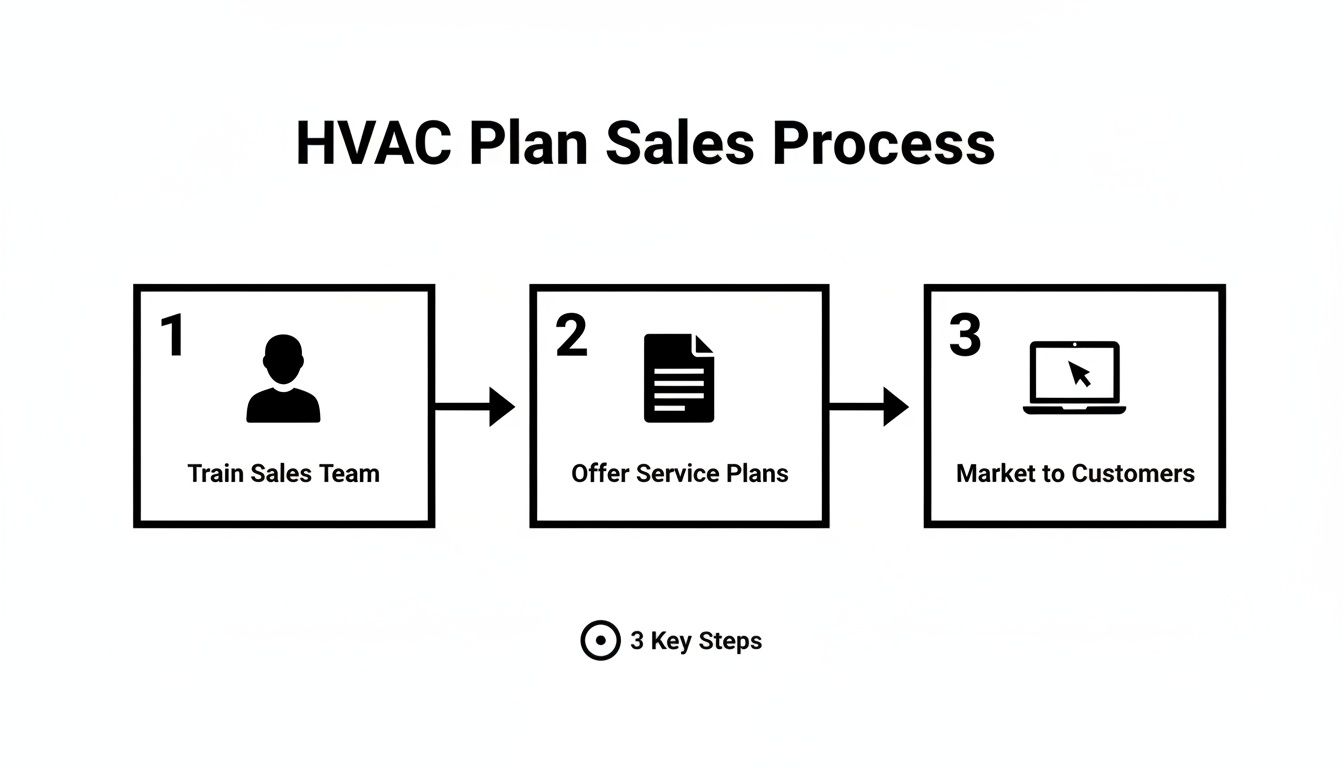
This process makes it clear: effective training, consistent offers, and ongoing marketing are the pillars of growth. But all of them rely on a rock-solid operational backbone to actually work.
The goal of a streamlined operation is to make things so easy for the customer and technician that the maintenance plan feels like a seamless, high-value subscription service, not a series of complicated appointments.
With mobile FSM tools, a tech can pull up a customer's entire service history, follow a digital maintenance checklist, and add notes or photos directly to the job file. Say goodbye to lost paperwork and hello to perfect documentation for every single tune-up.
Simplifying Billing and Renewals
The final piece of the operational puzzle is making sure you get paid on time and that customers stick around. Manually chasing hundreds of monthly payments or annual renewals is a surefire way to lose revenue.
Automation is the only way to go. FSM software like TackonFSM can automatically charge a customer's card on file each month and send out friendly renewal reminders before a plan expires. This locks in your recurring revenue with almost no effort, smooths out your cash flow, and boosts your member retention rate.
By connecting every part of the process—from the sale to scheduling, service, and billing—you turn your HVAC maintenance plan from a good idea into a smoothly running, highly profitable engine for your business.
Tracking the Key Metrics of a Healthy Maintenance Program
You can't improve what you don't measure. An HVAC maintenance plan can be a serious revenue engine, but if you're not tracking its performance, you're just flying blind. To build a program that truly thrives, you have to look past the total number of members and get into the numbers that show you what’s really going on.
These metrics aren't just data points for a spreadsheet; they're the vital signs of your recurring revenue. They tell you what's working, what's not, and where you need to focus your energy to get real, sustainable growth. Think of it like a tech hooking up gauges to check a system’s vitals—these KPIs do the same thing for your business.
By keeping an eye on a few critical numbers, you can stop guessing and start making smart, data-driven decisions that boost profits, create loyal customers, and build long-term value.
Must-Track KPIs for Your Service Program
To get a clear picture of your program's health, you need to zero in on three core areas: how good you are at signing people up, how long you can keep them, and how much they're worth to your business over time. These numbers are all connected and tell a complete story.
Here are the essential KPIs every HVAC owner should have on their dashboard:
- Member Conversion Rate: This shows you how well your team is turning one-off service calls into maintenance plan memberships. It’s the clearest measure of how effective your sales pitch and training are.
- Customer Attrition (Churn) Rate: This is the percentage of members who cancel their plans over a certain period. A high churn rate is a major red flag that could point to problems with your pricing, service quality, or the value you're offering.
- Customer Lifetime Value (CLV): This number predicts the total revenue you can expect to bring in from a single maintenance plan member over the entire time they do business with you. A high CLV is the mark of a truly healthy program.
Let's dig into how to calculate and actually use each of these powerful indicators.
Putting Your Data to Work
Knowing your numbers is the first step, but the real magic happens when you use them to make better decisions. For instance, a low Member Conversion Rate might be a sign that it’s time to work on your techs’ sales scripts or maybe add a small bonus for every sign-up.
Your KPIs are more than just report cards—they are a roadmap. They show you exactly where to invest your time and resources to strengthen your maintenance program and, ultimately, your entire business.
If you see your Attrition Rate creeping up, that’s your cue to find out why. Send out a survey to former members. Maybe a competitor is offering a deal you need to match, or perhaps the perks of your plan just aren't clear enough.
On the flip side, watching your Customer Lifetime Value climb confirms your hard work is paying off. It shows your members are not only sticking around but also trusting you with higher-margin repair and replacement jobs.
By regularly checking in on these metrics, you can fine-tune every part of your HVAC maintenance plan—from pricing and perks to sales training and customer service—to make sure it remains a profitable cornerstone of your business for years to come.
Answering Your Top Questions About HVAC Maintenance Plans
Even with a solid plan, you're bound to have questions as you start or grow your maintenance program. Let's tackle some of the most common hurdles HVAC owners face, moving from ideas on paper to real-world, profitable execution.
These are the questions that pop up time and time again as shops build out their recurring revenue.
How Do I Get Technicians to Sell Plans Without Being Pushy?
The secret is to shift their mindset from "salesperson" to "educator." Your techs are the trusted experts in the home. They shouldn't be pushing a product; they should be offering a genuine solution to real homeowner worries, like a surprise breakdown on the hottest day of the year or sky-high energy bills.
Give them simple, benefit-driven talking points. For instance, when a customer mentions their high utility costs, a tech can naturally explain how a proper tune-up often saves them enough on their monthly bill to cover the cost of the plan itself. A little role-playing in team meetings can also work wonders for building their confidence.
And finally, a small, clear commission for each new member doesn't hurt. When your team truly believes in the value of the maintenance plan and gets a little something for sharing that value, the entire conversation feels more like a helpful recommendation than a hard sell.
The best sales tool your technician has is the trust they've already built. When you teach them to educate customers on the real-world benefits of maintenance, they sell with authenticity and make the customer relationship even stronger.
What Is the Biggest Mistake to Avoid When Launching a Program?
The single biggest mistake is setting your price too low because you haven't accounted for all your costs. So many contractors fall into the trap of just calculating the labor and time for two tune-up visits and calling it a day.
That approach completely ignores a ton of other very real expenses:
- Admin Time: Think about the hours your office staff will spend scheduling, billing, and managing hundreds of these recurring appointments.
- Discount Costs: That 15-20% off future repairs comes directly out of your profit margin on those jobs. It’s a real cost.
- Opportunity Costs: What's the true cost of that "priority service" guarantee? It might mean pulling a tech off a high-profit installation to handle a member's service call during your busiest week.
Before you set a price, do the math and figure out your actual break-even point. It's much smarter to start with a price that reflects the total value you're delivering than to launch too cheap and find out months later that your most popular service is actually a money pit.
Should I Offer Monthly or Annual Payment Options?
You absolutely should offer both. Giving customers a choice caters to different budgets and financial habits, and that flexibility will boost your sign-up rate, period.
An annual, upfront payment is a fantastic shot in the arm for your cash flow. You can easily nudge people toward this option by offering a small discount, like "pay for 11 months, get the 12th free."
But for many homeowners, a small monthly payment is just an easier "yes." It feels less like a big purchase and more like a simple, affordable subscription they can set and forget.
Ready to streamline every part of your maintenance program—from selling and scheduling to billing and renewals? TackonFSM is the all-in-one platform built to make your service agreements profitable and easy to manage. Discover how TackonFSM can transform your operations.