

How to Start a Plumbing Business That Succeeds

So, you're a great plumber, but are you ready to be a great business owner? The two are very different. Before you even think about buying a van or ordering business cards, the real work starts on paper. This is where you build the blueprint for your entire operation.
Building Your Business Blueprint From The Ground Up

Jumping straight into fieldwork without a solid plan is a rookie mistake. It’s like starting a major repipe without mapping the existing lines—it’s going to get messy, and it’s going to be expensive. Your business blueprint is the strategic framework that will guide your decisions, protect you legally, and set you up for long-term success.
The good news? You’re getting into a booming industry. The U.S. plumbing market is massive, with projections expected to hit $169.8 billion in revenue by 2025. Even with around 132,000 plumbing companies out there, the demand for skilled plumbers is off the charts.
Hard data shows that businesses with a formal plan actually grow 30% faster than those flying by the seat of their pants. That plan is your roadmap from day one.
Crafting A Lean Business Plan
Forget those dusty, 100-page binders. A modern business plan is a lean, practical guide for you. Its main job is to force you to get honest about your numbers, your customers, and your competition. Of course, if you're chasing a small business loan, it’s also the document that will sell a lender on your vision.
At a minimum, your plan needs to cover a few key areas:
- Company Description: What’s your mission? Will you specialize in residential service calls, new construction, commercial maintenance, or all of the above? What makes you stand out from the other guys?
- Market Analysis: Who are you serving? Homeowners? Property managers? General contractors? Size up your local competitors—what are they good at, and where are their weak spots? That's your opening.
- Financial Projections: This is where the rubber meets the road. Map out your startup costs, realistically project your revenue for the first three years, and figure out your break-even point.
A well-crafted business plan doesn't just help you get a loan; it forces you to think through every aspect of your business, identifying potential challenges before they cost you real money. It's your first and best risk management tool.
Let’s talk numbers. Understanding what it costs to get started versus what it costs to keep the doors open is crucial for your financial planning.
Startup Costs vs Long-Term Investment
Here's a breakdown of initial startup expenses versus ongoing operational costs to help new owners budget effectively.
| Expense Category | Typical Startup Cost Range (One-Time) | Estimated Monthly Cost (Ongoing) | Notes & Considerations |
|---|---|---|---|
| Business Registration & Licensing | $300 – $1,500 | $50 – $200 | Includes LLC/S-Corp filing fees, state/local licenses, and initial permit bonds. |
| Tools & Equipment | $5,000 – $15,000+ | $100 – $500 | Varies widely based on new vs. used and the scope of services offered. |
| Work Vehicle & Upfitting | $10,000 – $45,000+ | $500 – $1,200 | A used van is a common starting point. Upfitting includes racks, bins, and branding. |
| Insurance (Down Payment) | $500 – $2,000 | $400 – $1,000 | The initial payment for general liability, commercial auto, and workers' comp. |
| Software & Technology | $250 – $1,000 | $100 – $400 | Includes field service management software (like TackonFSM), accounting software, and a website. |
| Initial Marketing | $500 – $2,500 | $300 – $1,500+ | Covers logo design, business cards, door hangers, and initial online ad campaigns. |
This table illustrates that while you have significant one-time costs, the ongoing monthly expenses are what you truly need to manage to protect your profit margins. Budgeting for both is key to staying financially healthy.
Choosing A Legal Structure
This is one of the most important decisions you'll make, and it has a huge impact on your taxes and personal liability. Going the "sole proprietor" route is easy, but it's risky—it means there's no legal separation between you and the business. If someone sues your company, they can come after your house, your truck, and your personal savings.
That’s why most savvy plumbers choose a more formal structure:
- Limited Liability Company (LLC): This is the go-to for a reason. An LLC creates a legal wall between your business and personal assets. If the business gets into trouble, your personal stuff is protected. It's also simple and flexible when it comes to taxes.
- S Corporation (S-Corp): As you grow and become more profitable, an S-Corp can offer some smart tax advantages. It allows you to pay yourself a "reasonable salary" and take the rest of the profits as distributions, which can lower your self-employment tax bill.
No matter which path you take, the first rule of business finance is learning about properly separating business and personal expenses. Open a dedicated business bank account and get a business credit card from day one. Mixing funds is a recipe for a massive headache at tax time and can even put your liability protection at risk.
Spend a few hundred bucks to sit down with a local accountant or lawyer. They'll help you pick the right structure for your specific situation. It’s one of the best investments you can make early on.
Getting Licensed, Insured, And Legally Compliant

Trying to run a plumbing business without the right credentials is like building a house on sand. It's the quickest way to find yourself buried in massive fines, voiding any insurance you might have, and destroying customer trust before you even earn it.
Getting legally compliant isn’t just about ticking boxes. It’s about building a professional operation that protects you, your future team, and your clients from day one. This goes way beyond a standard business license; the plumbing trade is heavily regulated for good reason, and you'll need to navigate specific trade licenses that can change drastically from one state—or even one county—to the next.
Securing The Right Plumbing Licenses
Your first call should be to your state's contractor licensing board. They are the definitive source for what you need to operate legally. Don't guess or go by what a plumber in another state told you.
Most places have a tiered licensing system, and you need to know where you fit in. A journeyman plumber, for instance, is qualified to do the work but often has to operate under a master plumber's supervision. The master plumber has the advanced expertise to pull permits, oversee other plumbers, and legally own the business.
- Apprentice: This is the entry-level, where you're learning the trade under direct supervision.
- Journeyman: A licensed pro who has finished their apprenticeship and passed a state exam.
- Master Plumber: The highest credential, which requires years of journeyman experience and passing another, more comprehensive exam.
In some states, the business owner must hold a master plumber license. If you're a skilled journeyman ready to go out on your own, you might need to hire a licensed master plumber to act as your qualifier until you can sit for the exam yourself.
Understanding Essential Business Insurance
Insurance is your financial firewall. A single uncovered accident—a flooded basement, an injured employee, a fender bender in the company van—can wipe out an unprotected business overnight. Stop thinking of it as an expense; it’s a non-negotiable cost of doing business right.
Think of insurance this way: It's the one bill you pay hoping you'll never have to use it. But if you do need it, it will be the single best investment you ever made in your company's survival.
At a minimum, every plumbing business needs these core policies:
- General Liability Insurance: This is your primary shield, covering property damage and bodily injury to others. When a pipe you installed bursts and ruins a customer's new hardwood floors, this policy pays for it—not your business account.
- Workers' Compensation: If you have even one employee, this is legally required in most states. It covers their medical bills and lost wages if they get hurt on the job, which protects them while shielding you from devastating lawsuits.
- Commercial Auto Insurance: Your personal auto policy will not cover an accident that happens while you're driving for work. You need a dedicated policy for your work van or truck.
To get a clearer picture of what you need, check out this complete guide to plumbing company insurance. It dives much deeper into the specifics of coverage.
Solidifying Your Customer Contracts
Finally, get out of the habit of working on a handshake. A professional service agreement is essential for managing expectations and protecting you from disputes down the road.
Your contract should clearly spell out the scope of work, the total cost, the payment schedule, and how you'll handle any unforeseen issues that crop up. This document is your best defense against misunderstandings and your best tool for making sure you get paid on time for the work you do.
Equipping Your Operation For Day One
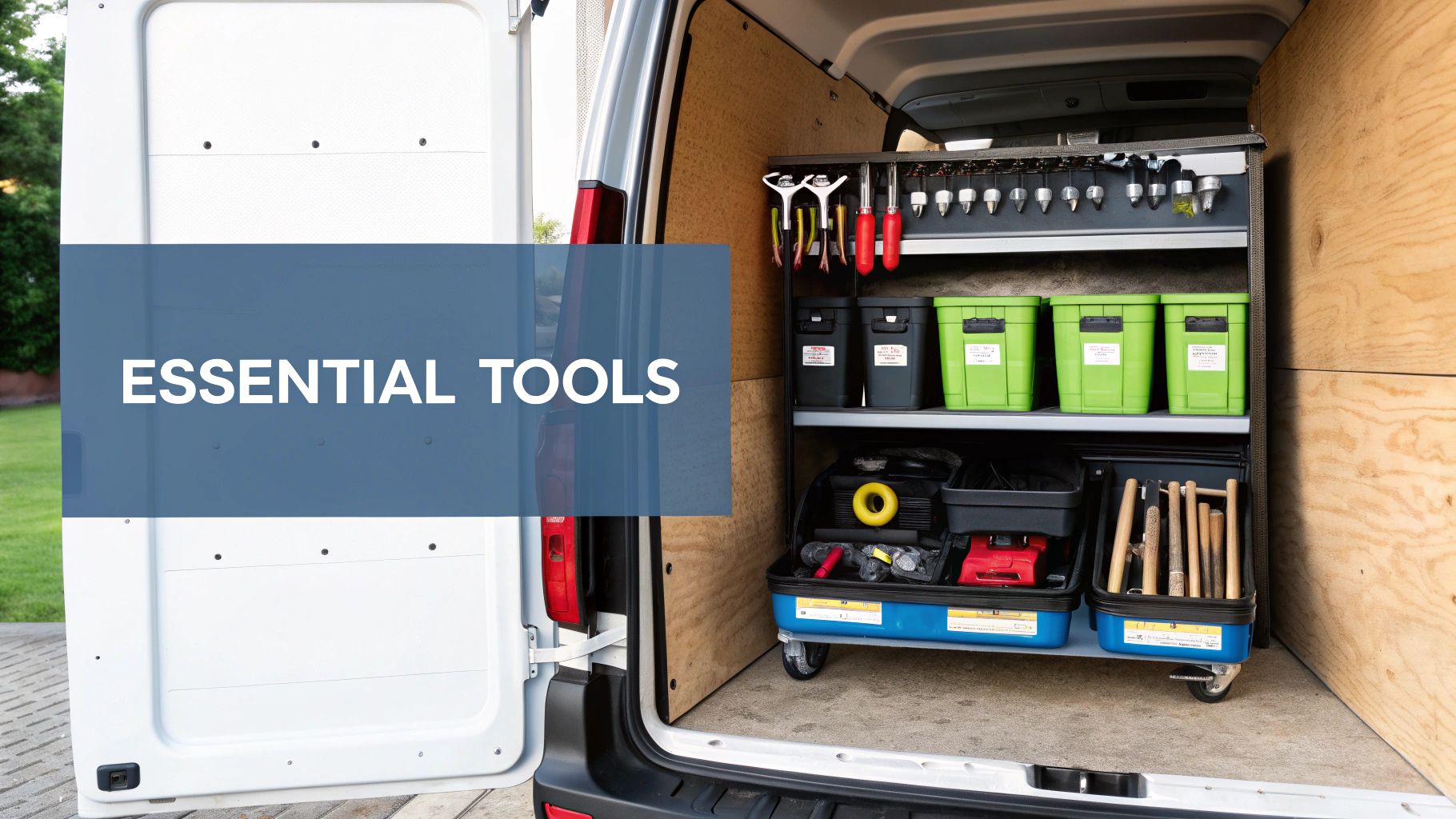
Alright, let's talk about the hardware. Your tools, your van, and your equipment are the absolute backbone of your plumbing business. They aren't just assets on a balance sheet; they are your mobile workshop and, frankly, the first thing a customer sees. Getting this right from the jump is critical for your efficiency, your bottom line, and the professional image you project on every single job.
I've seen it a hundred times. A new owner rolls up in a van that’s under-equipped, forcing multiple trips to the supply house and killing their profit on the job. On the flip side, an overstocked van ties up thousands in precious startup capital on parts that just collect dust. The real art is finding that sweet spot—starting with the absolute essentials and then scaling your inventory as cash flow improves and your service offerings grow.
Assembling Your Essential Tool Arsenal
Staring at a supply house catalog when you're just starting out can be completely overwhelming. The smart way to tackle this is to think in tiers. Nail down the basics first before you even think about dropping big money on specialized equipment you might only use once a year.
Here’s a practical way to break down your initial shopping list:
- Tier 1: Foundational Hand Tools: These are the non-negotiables you'll grab on pretty much every call. We're talking a full set of pipe wrenches, basin wrenches, tube cutters, adjustable wrenches, various pliers (channel-lock, needle-nose), a good level, screwdrivers, and a reliable tape measure.
- Tier 2: Power and Diagnostic Tools: This is where you start to level up your capabilities. You absolutely need a cordless drill/driver set and a reciprocating saw for any demo work. A PEX crimping tool set is another must-have, given how common it is in modern residential jobs.
- Tier 3: Specialized, High-Margin Equipment: These are the tools that unlock the more profitable jobs. Start with a handheld drain auger (a basic snake) for simple clogs. As you grow, you can invest in a sewer inspection camera and a small hydro-jetter. Those two items are genuine game-changers for building a drain cleaning service.
Don't fall into the classic trap of buying every shiny new tool on day one. Your goal should be to handle 80% of common service calls with your initial loadout. For that oddball job, you can always rent specialized equipment until buying it makes clear financial sense.
You'll also face the new vs. used debate. New tools give you peace of mind with warranties, but good used equipment can save you a fortune. My advice? Spend your budget on new power tools and diagnostic gear where reliability is everything. For hand tools, you can often find high-quality used sets that will last a lifetime if you take care of them.
Outfitting Your Mobile Command Center: The Work Van
Your van is so much more than just a way to get from A to B. It’s your rolling warehouse, your mobile office, and a billboard for your brand. A clean, organized van saves you time, cuts down on stress, and stops you from buying parts you already own but just can't find.
When you're setting it up, think accessibility and organization. Invest in a solid shelving system and use labeled bins for all your small fittings. Add ladder racks and make sure you have a secure spot for bigger equipment like your drain snake. A well-organized van tells a customer you’re a pro who cares about the details before you even walk through their door.
Mastering Smart Inventory Management
Every part sitting on your van's shelves is cash. The goal is to stock what you need without tying up a ton of money. This is where the 80/20 rule becomes your best friend: you want to stock the 20% of parts that will solve 80% of the problems you run into.
Instead of just guessing, build your first inventory list around the most common residential calls:
- Toilet Repairs: Flappers, fill valves, wax rings, and bolt kits.
- Faucet & Sink Repairs: Common-sized P-traps, supply lines, and a few basic faucet cartridges.
- Water Heater Components: A handful of universal thermocouples and pressure relief valves.
- Pipe Fittings: A core selection of ½” and ¾” copper and PEX fittings.
Focusing on these high-turnover items means you can complete most jobs in a single visit, which customers absolutely love. It keeps your initial investment lean, freeing up cash for other critical parts of your business. Later on, you can use job data from software like TackonFSM to dial in your van stock with incredible accuracy.
Setting Your Prices For Sustainable Profit
Your skill with a wrench will get you in the door, but how you price your work will determine if you get to stay in business. Seriously, getting your pricing wrong is one of the fastest ways to run a new plumbing company into the ground. You'll be busy, sure, but you'll be busy losing money. This isn't about guessing what your last boss charged; it's about building the financial engine for your own company.
Getting your pricing right means more than just covering your costs. It’s about knowing what your expertise is worth, showing that value to the customer, and making sure every single job pushes your business forward. You have to find that sweet spot where you're competitive but not selling yourself short.
Choosing Your Pricing Model
In the plumbing world, you’ll generally see two ways to bill for a job. The one you pick will really shape how customers see you and how your team operates day-to-day.
To help you decide, let's break down the most common pricing models you'll encounter. This is a foundational decision, so it pays to understand the good, the bad, and the ugly of each.
Pricing Model Comparison
| Pricing Model | How It Works | Pros | Cons |
|---|---|---|---|
| Time & Materials (T&M) | You bill an hourly rate for labor plus the cost of all parts used on the job. | Simple to calculate. Seems "fair" for unpredictable repair jobs. | Customers get anxious watching the clock. Can lead to invoice disputes. Punishes efficient technicians. |
| Flat-Rate Pricing | You charge one upfront, fixed price for a specific task (e.g., "Water Heater Replacement"). | Customers love the transparency and predictability. Builds trust. Encourages efficiency. | Requires a well-built price book. You can lose money if you misjudge the job's complexity. |
While T&M feels safe, it often creates a weird tension with the customer. They're constantly worried you're moving slow just to pad the bill. Flat-rate pricing, on the other hand, gets rid of that anxiety. The customer knows the exact price before you even start, which builds a ton of trust and usually leads to much happier clients (and better online reviews).
For most new owners, I strongly recommend flat-rate pricing. It shifts the entire conversation from "how long will this take?" to "what's the value of getting this fixed?" It also makes your quoting consistent and motivates your team to be efficient, not just slow.
Calculating Your True Costs and Overhead
You can’t set a profitable price if you don't know what it actually costs you to open the doors each morning. This is a classic mistake new owners make—they only think about their own paycheck and the cost of a faucet. To be truly profitable, you have to account for every single hidden expense.
This all comes down to your shop rate, sometimes called a burdened labor rate. It’s the real cost of having a technician on the road for one hour, and it's a lot more than just their wage.
Here's what goes into it:
- Direct Labor Costs: This isn't just the plumber's hourly pay. It’s also payroll taxes, workers' comp, health insurance, and any other benefits you offer.
- Overhead Costs: Think of this as everything you pay for just to be in business. We're talking truck payments, gas, insurance, your scheduling software subscription, marketing costs, phone bills, and maybe even shop rent.
To get a rough number, add up all your monthly overhead expenses. Then, divide that by the total number of hours you realistically expect your team to be billing customers that month. Add that number to your technician's direct hourly labor cost, and that's your true cost of doing business. Any price you quote has to be higher than that to make a dime.
Crafting Estimates That Win Jobs
An estimate isn't just a price tag; it's your first real sales pitch. It needs to look professional, be dead simple to understand, and make the customer feel confident they’re hiring a pro. A sharp, well-organized estimate instantly justifies your price.
As you put your numbers together, remember the bigger picture. The median plumber salary is around $61,550 a year ($29.59 hourly), which shows the solid earning potential right out of the gate. But with over 25% of plumbers now 55+ and a staggering 55% labor shortage that costs our economy $33 billion a year, efficiency is everything. New businesses that can work smart are poised to grab a piece of the 42,600 job openings that pop up annually. You can dig deeper into these plumbing industry statistics to see how they create real opportunities.
Let’s walk through a real-world example: quoting a standard tank water heater replacement.
- Figure Out Material Costs: First, list out everything you'll need: the water heater itself, new supply lines, fittings, a ball valve, and any venting parts. Add your material markup, which is usually somewhere between 25-50%.
- Estimate Your Labor: From experience, you know this is about a three-hour job. You'll multiply those three hours by your target billable rate—the one you already calculated that includes your labor, overhead, and profit margin.
- Add Other Costs: Don't forget to include any permit fees your city charges or the cost to dispose of the old, heavy tank.
- Present it Like a Pro: This is where you separate yourself from the competition. Use a tool like TackonFSM to create a clean, digital estimate. It should clearly spell out the work to be done, show the total flat-rate price, and have your terms and conditions attached. This is how you stop guessing and start building a system that protects your profit on every single job.
Finding Your First Customers and Making a Name for Yourself
Alright, you've got the skills and a van loaded with the right gear. That's a great start, but it doesn't mean much if your phone stays silent. Landing those first few customers is what turns your idea into a real, cash-flowing business. This isn't about dropping a fortune on billboards; it's about smart, targeted marketing that establishes you as a local go-to without draining your startup funds.
The whole point is to be the first name that pops into a homeowner's head when a pipe bursts or a drain backs up. These days, that battle is won online, usually on a smartphone, in the span of a few seconds.
Own Your Local Search with a Google Business Profile
Think about it: when a homeowner has a plumbing emergency, what's the first thing they do? They grab their phone and search "plumber near me." This is exactly why a well-tuned Google Business Profile (GBP) is your single most powerful—and free—marketing weapon. If you're starting a plumbing company today, claiming and optimizing your profile isn't optional. It’s essential.
Your GBP is your digital storefront. It’s what people see in Google Maps and the local search results, showing your company name, service area, hours, and—most critically—your customer reviews.
A sharp Google Business Profile is the new Yellow Pages ad, except it actually works. It puts your business right in front of people who have an urgent problem and are ready to hire someone right now.
To get your profile humming, you need to be thorough:
- Fill out everything: Don't skip a single section. Add your service areas, specific hours, phone number, and a link to your website.
- Show off your work: Upload high-quality photos of your clean, branded van, your team in uniform, and some before-and-after shots of your best work.
- Make reviews a habit: This is huge. Make it a standard part of your process to ask for a review after every single job.
Build Trust with a Simple, Professional Website
While your Google profile gets you discovered, your website is where you seal the deal. It’s where you build credibility and turn a curious searcher into a customer. You don't need a thousand-dollar site to get started. A simple, clean, and professional website acts as your online business card and sales pitch all in one.
At a minimum, it needs to clearly answer four questions:
- Who are you? Your business name, logo, and a quick sentence about your commitment to quality.
- What do you do? A straightforward list of your services, from drain cleaning to water heater installs.
- Where do you work? The specific towns and neighborhoods you cover.
- How do I hire you? A big, easy-to-find phone number and a simple contact form.
A clean website with real photos and obvious calls to action instantly separates you from the "guy in a truck" and shows you're a serious, professional operation.
The Power of Word-of-Mouth, Both Digital and Old-School
Positive online reviews are the modern-day word-of-mouth. Think about it—before people spend their hard-earned money, they want proof that you’re reliable. Getting into the habit of asking every happy customer to leave a review on Google or Yelp will pay dividends forever.
But don't get so focused on digital that you forget the timeless power of shaking hands and building real-world connections. Getting to know other professionals in your community can create a steady pipeline of high-quality referrals.
Make a point to connect with these folks in your service area:
- General Contractors & Remodelers: They're always looking for a reliable plumber for kitchen and bathroom projects.
- Real Estate Agents: They constantly need a go-to plumber for inspection repairs and issues that pop up for new homeowners.
- Property Managers: These people are gold. They manage multiple units and need a dependable plumbing company for routine maintenance and emergencies.
By combining a strong online presence with genuine local networking, you're not just marketing—you're building a lead-generation engine that will help you grow your plumbing business from the ground up.
Streamlining Your Operations to Scale Smoothly
Once the calls start rolling in and your business picks up steam, you’ll hit a brand-new set of challenges. Suddenly, you're not just a plumber anymore; you're managing the controlled chaos of a busy schedule. This is where many great technicians get stuck.
Making the leap from plumber to successful business owner all comes down to building solid systems. Without them, you’re constantly putting out fires—a missed appointment here, a lost invoice there—instead of steering the ship and planning for real growth.
The whiteboard and stack of notebooks that worked for your first few jobs will quickly become your biggest bottleneck. One scheduling mix-up can torpedo a customer relationship. The goal is to create a predictable, professional process for every single job, from the moment the phone rings to the minute you get paid.
From First Call to Final Payment
Think about the entire journey a job takes. It starts when a potential customer calls. That lead needs to be captured and scheduled right away. Then, a tech has to be dispatched with all the right information—customer history, job notes, parts needed. Once the work is done, you need to create an accurate invoice on the spot and collect payment.
Nailing this process is what separates the pros from the amateurs.
Little things make a huge difference. Automated appointment reminders can almost eliminate no-shows, saving you from wasting time and fuel on a trip for nothing. When your techs show up with a tablet that has the entire job history, they look professional and are ready to solve the problem on the first visit.
This is how you build a reputation for being the reliable company people trust. The first part of that journey—getting the customer in the door—is often the hardest.
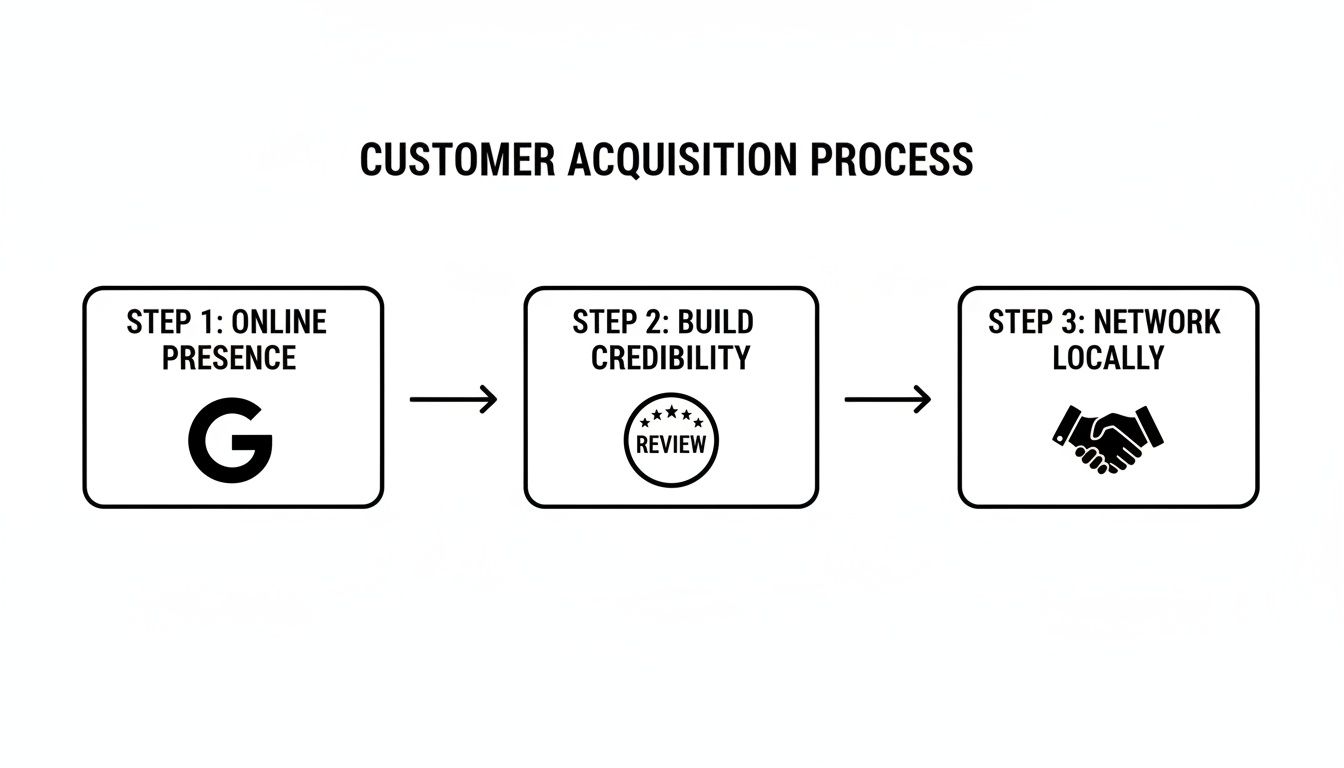
As you can see, a solid online presence is your starting point. It feeds directly into building the credibility you need to earn trust, which you then amplify through your local network.
Your Business Command Center
This is where modern field service management (FSM) software becomes your secret weapon. Think of it as the central nervous system for your entire operation, connecting your office team with your plumbers in the field in real time. It’s way more than just a fancy digital calendar; it's a complete toolkit for running your business.
A visual dispatch board, for instance, lets you see where all your techs are and who's available with a single glance. Those frantic morning dispatch calls turn into a simple drag-and-drop. It’s how you squeeze in a high-profit emergency call without throwing your whole day into disarray.
Platforms like TackonFSM are built for trade businesses figuring out exactly how to start a plumbing business. They pull everything—scheduling, dispatching, invoicing, and payments—into one place.
By putting all the routine administrative tasks on autopilot, these systems give you back your time. You finally get to step back and work on your business instead of just being buried in it. That shift is the key to scaling without losing your mind or your profit margins.
Got Questions About Starting Your Plumbing Business? Let's Talk.
If you're thinking about starting your own plumbing business, you've probably got a million questions swirling around. That's a good thing. Asking the right questions now sets you up for a much smoother ride later on. Let's tackle a few of the most common ones I hear from new owners.
How Much Cash Do I Really Need to Get Started?
This is the big one, right? The honest answer is: it depends. You'll see a wide range, but most new plumbing businesses get off the ground with an initial investment somewhere between $10,000 and $50,000.
Your biggest expenses are going to be a reliable work van, your core set of tools, and your first year's worth of licensing and insurance. A decent used van might run you anywhere from $5,000 to over $25,000, while a solid tool inventory will likely cost between $3,000 and $10,000. Add another $1,000 to $5,000 for your initial insurance premiums and licensing fees.
My advice? Start lean. You don't need the fanciest truck or every specialty tool on day one. Get a dependable vehicle and the essential tools you need for the most common service calls. You can always upgrade and buy that expensive drain camera once you've built up some positive cash flow.
Do I Need a Master Plumber's License to Be the Boss?
This is a critical detail, and the rules change dramatically depending on where you hang your shingle. In some states or counties, the owner of the business must be a Master Plumber to pull permits and legally operate. No exceptions.
In other places, a licensed Journeyman can own and run the show. The only way to know for sure is to get on the phone with your local licensing board. They have the final say.
Don't ever assume the rules are the same as the next town over or take someone else's word for it. This is one of those things you have to verify yourself, directly with the source. Getting this wrong can shut you down before you even get your first call.
What's the Best Software for a New Plumbing Shop?
When you're just starting out, simplicity is your best friend. Forget about juggling five different apps for your calendar, invoices, and customer list. You'll waste time and make mistakes. The smartest move is to invest in an all-in-one field service management (FSM) platform right from the beginning.
Find a single system that handles the essentials:
- Scheduling and dispatching jobs
- Building estimates and sending invoices
- Taking payments right on the job site
- Keeping customers in the loop with texts and emails
One feature that's a huge time-saver is a pre-built parts database. It helps you create accurate estimates in minutes and keeps your inventory in check, protecting your profit on every job.
Ready to run your business the right way from the start? See how TackonFSM puts scheduling, invoicing, and inventory into one easy-to-use platform built for new plumbing businesses. Find out how TackonFSM can help you succeed.