
How to price plumbing jobs: Master Quotes with Confidence

Figuring out how to price a plumbing job feels like a high-stakes balancing act, but it's not a guessing game. It's a system. Profitable pricing comes down to a simple formula: accurately calculating your material costs, figuring out your fully loaded labor rates, covering all your business overhead, and adding a healthy profit margin.
The goal is to package all of that into a simple flat-rate price that makes sense to the customer.
The Blueprint for Profitable Plumbing Prices
Let's be real, pricing is complicated. You have to cover every expense, pay your team what they're worth, and still have enough profit left over to actually grow the business. The first and most important shift is moving away from confusing hourly rates toward transparent, upfront flat-rate pricing. Customers appreciate the clarity, and it protects your bottom line from unexpected job-site delays.
This isn't just a trend; it's the standard. In a U.S. market valued at over $121.5 billion, flat-rate pricing has dominated since the early 2000s. By 2023, more than 70% of plumbing businesses were using this model, often leaning on software to create consistent, profitable estimates.
Your Four Core Pricing Pillars
Every single profitable quote you write will stand on four fundamental pillars. If you get these right, you’ll never leave money on the table or accidentally price yourself out of a job. A big part of this is truly understanding your business's financial DNA, which means identifying your cost centers and profit centers.
This quick visual shows you how the four pieces fit together.
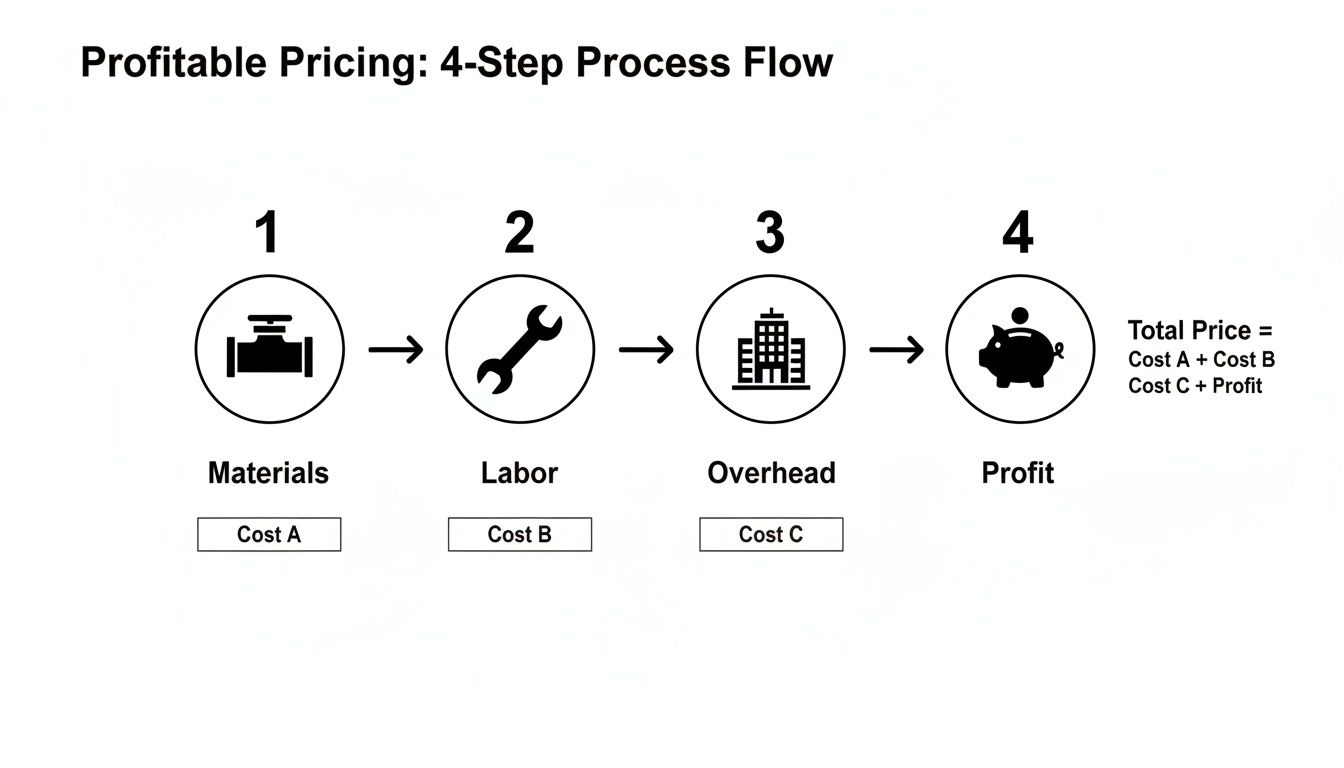
As you can see, it's a sequential process. Each component adds a necessary layer to build the final price you show your customer.
Getting this right isn't just about winning one job; it's about building a repeatable system that ensures your business stays healthy and has the cash flow to scale. It's about turning chaos into consistency.
Key Takeaway: Pricing isn't an art; it's a science. When you have a clear formula that accounts for every cost and your desired profit, you eliminate the guesswork and build a much more resilient company.
The Four Pillars of a Plumbing Job Price
Here's a quick look at the four essential components that make up a profitable and comprehensive plumbing quote. Think of them as the building blocks for every estimate you create.
| Pricing Component | What It Covers | Real-World Example |
|---|---|---|
| Direct Costs | The raw cost of materials (pipes, fittings, fixtures) and the "fully loaded" cost of labor to install them. | The wholesale price of a new water heater plus your plumber's hourly wage and benefits. |
| Overhead | All the indirect costs of running your business—truck payments, insurance, office rent, marketing, software fees. | A percentage of your monthly business expenses allocated to this specific job. |
| Profit Margin | The money left over after all costs are paid. This is what you use to grow the business, invest, and save. | A 15-20% markup added to the total of your direct costs and overhead. |
| Trip Fee | A separate, flat fee to cover the cost of getting a truck and a technician to the customer’s door. | A $79 service call fee that covers fuel, vehicle wear, and initial diagnostic time. |
By breaking your pricing into these four distinct pillars, you gain total clarity and control over your financial outcomes, ensuring every job contributes positively to your bottom line.
This systematic approach is essential for any plumbing contractor, whether you're running a couple of trucks or coordinating a much larger crew. You can learn more about how field service management software makes a difference in streamlining this entire process.
Nailing Down Your True Job Costs

Before you can even dream about profit, you have to get a rock-solid handle on what a job actually costs your business to perform. Guessing is a fast track to going broke. This is the foundation of your entire pricing strategy, and it means digging into every single expense—both the obvious ones and the ones that hide in the background.
To do this right, you need to track your financials like a hawk. Having a good grasp of a double-entry bookkeeping system isn't just for your accountant; it’s fundamental to your survival. Every profitable quote you write starts right here, with an honest look at what it really takes to get the work done.
What are Your Direct Costs?
Direct costs are the easy ones, at least on the surface. They’re the expenses you can point to and say, "This was for the Smith job." It really boils down to two things: the materials you install and the labor it takes to do it. Getting these numbers right isn't just important—it's everything.
Let’s start with materials. We're not just talking about the big-ticket items like a water heater or a faucet. I’m talking about every single fitting, every foot of PEX, every tube of sealant, and every roll of Teflon tape. Forgetting to bill for these "sundries" is like letting profit slowly leak out of every job.
My Two Cents: Don't try to remember prices or use an old list from your supply house. It’s a losing game. A digital price book that’s updated regularly—ideally right inside your field service software—is the only way to make sure your quotes reflect what you're actually paying for parts today.
Figuring Out Your "Fully Loaded" Labor Rate
Your labor cost is so much more than what you pay your tech per hour. This is where so many companies go wrong. The fully loaded labor rate is the true cost to your business for having that plumber on the clock.
To find this crucial number, you have to pile on all the extra expenses that come with having an employee:
- Payroll Taxes: That's your FICA contributions (Social Security and Medicare) plus federal and state unemployment taxes.
- Workers' Comp: This is a big one in our trade, and it varies by state and your safety record.
- Benefits: Add up what you spend on health insurance, retirement plans, paid time off, and any other perks you offer to keep good people.
- Unbillable Time: What about drive time? Weekly meetings? Training sessions? Your techs are on the clock, but you're not billing a customer. You have to account for that.
Add up the total annual cost for one employee, then divide it by the number of hours you can realistically bill for them in a year. This is usually somewhere around 1,500-1,700 hours once you subtract holidays, vacation, and sick days.
The number you get is your fully loaded rate. That is the number you have to use in your calculations, not just their hourly wage.
Uncovering and Spreading Out Your Overhead
Overhead costs are the silent killers of profitability. These are all the things you have to pay for just to keep the lights on and the doors open, whether your team is turning wrenches or not. They often get forgotten in quick, back-of-the-napkin estimates, but they absolutely must be recovered in your pricing.
Just think about all the monthly bills:
- Your Fleet: Truck payments, gas, insurance, tires, and maintenance.
- Your Shop: Rent or mortgage on your office or warehouse.
- Utilities: Power, internet, and phone bills.
- Insurance: General liability and any other business policies.
- Software: Your scheduling software subscription, accounting tools, etc.
- Marketing: Everything you spend to make the phone ring.
- Office Staff: The salaries for dispatchers, bookkeepers, and anyone else not in the field.
The smartest way to handle this is to calculate your overhead recovery rate. Add up your total overhead for the year, then divide it by your total number of billable labor hours. This gives you an hourly overhead cost. You need to add this amount to every single billable hour just to break even before you even think about adding a cent of profit.
With labor often making up 50-60% of total job costs, and the industry facing a massive 55% workforce shortage—projected to leave 550,000 jobs unfilled by 2027—getting every part of this cost calculation right is non-negotiable.
Setting Smart Labor Rates and Material Markups
Once you’ve got a firm grip on your actual costs, it's time to build in your profit. Honestly, this is the part of the process where your business either thrives or just gets by. Setting smart labor rates and material markups isn't a guessing game—it's a deliberate strategy that separates the truly profitable companies from the ones that are just busy.
This is how you ensure every hour a technician works and every part they install is actively contributing to your company's long-term health and growth.

Establishing Your Billable Hourly Rate
Your billable rate shouldn't be a number you pull out of thin air or, worse, just copy from a competitor down the street. It has to be a carefully calculated figure that covers your technician's fully loaded cost, chips in for overhead, and still hits your target profit margin. If your rate misses any one of those three components, you're essentially working for free at some point during the day.
Let's walk through the formula:
- Start with the loaded rate: This is the true hourly cost of having your technician on the clock—wages, taxes, benefits, and even their unbillable time.
- Add the overhead recovery rate: This is the slice needed every hour to cover all your business's operating expenses.
- Apply your profit margin: Finally, this is the percentage you add on top to ensure the business is actually making money.
For example, say your loaded labor rate is $45/hour and your overhead recovery rate is $35/hour. Your breakeven cost is $80/hour. To hit a healthy 20% profit margin on your labor, you’d need to be charging around $100/hour.
Smart Strategies for Marking Up Materials
Material markup is definitely not a one-size-fits-all game. A classic mistake I see all the time is applying a flat percentage to every single part. It’s simple, sure, but this approach leaves a ton of money on the table with small parts and can easily price you out of jobs with big-ticket items.
A much more effective strategy is a sliding scale markup, often called a matrix pricing model. The idea is simple: apply a higher markup to less expensive parts and a lower one to more expensive components.
Real-World Example: You might mark up a $5 PVC fitting by 300% (selling it for $20), but a $1,000 water heater might only get a 30% markup (selling it for $1,300). The big markup on that tiny fitting covers the time and effort to source, stock, and manage it. Meanwhile, the more modest markup on the water heater keeps your total job price competitive.
This approach ensures you're compensated fairly for handling all materials, big or small, without scaring off customers when it's time for a major installation. It's a key part of learning how to price plumbing jobs for maximum profitability.
Enforcing minimum profit margins is crucial, especially in a market where homeowners' average spend is around $90/hour. Statistics show that 44% of plumbers worry about underpricing jobs without software to guide them. By enforcing a minimum 20% margin on line items, you can potentially lift your net profits by 18%—a vital move as the industry faces a significant labor shortage. You can find more plumbing pricing statistics on BuildOps.com.
The Critical Role of the Trip Fee
Finally, let's talk about the trip fee, sometimes called a service or dispatch fee. This isn't just an "extra" charge; it's a foundational piece of a profitable service call. This flat fee covers the very real, tangible costs of rolling a truck and getting a skilled technician to a customer’s door.
Think about what it really covers:
- Fuel and Vehicle Wear: The direct cost of just getting to the location.
- Insurance: The liability and auto insurance required for your entire fleet.
- Non-Billable Drive Time: Paying your tech for their time spent sitting in traffic.
- Initial Diagnostic Time: The first 15-30 minutes of assessing the problem.
Without a trip fee, every small job—like a simple clog or a minor leak—starts out at a loss. By putting a standard fee in place ($59, $79, or more, depending on your market), you guarantee that every single call is profitable from the moment you arrive. It’s an essential tool for protecting your margins and keeping your business financially healthy.
Optimizing your team's routes and schedules is also essential. Check out our guide on how field service scheduling software saves time and money.
Building Your Own Flat Rate Pricebook
All those careful calculations for labor rates, overhead, and profit margins are just numbers on a page until you put them to work. This is where the rubber meets the road—where you turn theory into a practical, money-making system by building a flat-rate pricebook.
If you're still pricing jobs on the fly from the back of your truck, it's time for an upgrade. A well-built pricebook is your company's playbook. It takes the guesswork out of quoting, plugs profit leaks, and guarantees every technician presents the same fair, profitable price, every single time. It's the key to running your business, instead of letting it run you.
Start With Your Most Common Jobs
The thought of building a complete pricebook from scratch can feel like a massive project. So don't try to boil the ocean. Instead, focus on the 80/20 rule: identify the 20% of services that generate 80% of your revenue.
These are your bread-and-butter jobs. Just grab a notepad and list them out. Things like:
- Standard water heater replacement (gas or electric)
- Clearing a mainline drain with a sewer machine
- Replacing a kitchen or bathroom faucet
- Toilet rebuild (flapper, fill valve, etc.)
- Garbage disposal installation
- Sump pump replacement
By tackling these frequent jobs first, you’ll immediately cover most of the quotes your team writes day-to-day. You can always flesh out the pricebook with more complex or niche tasks later. The goal right now is to build momentum and get a system you can actually use.
Deconstruct Each Task Into Its Components
For every job on your high-frequency list, you need to break it down into its basic financial parts. This is where you pull together all the pieces we've discussed—direct costs, labor time, markups, and overhead.
Let’s use a simple faucet replacement as an example.
First, figure out the actual time it takes an experienced tech to do the job right. Be honest. This isn't just wrench time; it includes setup, testing, cleanup, and walking the customer through the finished work. Let's call it 1.5 hours.
Next, list every single material needed, down to the smallest washer.
- The faucet itself
- A new set of supply lines
- Plumber's putty or a tube of silicone
- Teflon tape
Now, apply the labor rates and material markups you've already established. This is the moment your pricing strategy comes to life. You’re no longer just guessing—you're following a repeatable, profitable formula.
Pro Tip: Don't forget to account for your trip fee. You have two options: either bake it into the total cost of the job or list it as a separate charge that gets waived when the customer approves the work. Whichever you choose, just make sure it's in there.
A Sample Flat Rate Calculation
Let's put all the pieces together. The table below shows a simplified breakdown of how to price that faucet replacement for your pricebook. This is how you combine all your individual costs and rates into a single, confident price for the customer.
Example Flat Rate Price Calculation for a Faucet Replacement
See how to combine your calculated costs, labor, overhead, and profit margin into a single flat-rate price for a common task.
| Line Item | Cost or Rate | Quantity | Subtotal |
|---|---|---|---|
| Labor (Includes overhead & profit) | $125/hour | 1.5 hours | $187.50 |
| Trip Fee | $89 | 1 | $89.00 |
| Faucet (Wholesale Cost) | $80 | 1 | $80.00 |
| Faucet Markup (60%) | $48 | 1 | $48.00 |
| Supply Lines (Cost) | $20 | 1 set | $20.00 |
| Supply Lines Markup (100%) | $20 | 1 set | $20.00 |
| Sundries (Putty, tape, etc.) | $5 | 1 | $5.00 |
| Sundries Markup (100%) | $5 | 1 | $5.00 |
| Final Customer Price | $454.50 |
In your pricebook, you’d likely round this up to a clean, easy-to-present number like $459. Now, any tech can quote this job confidently, knowing every cost is covered and the company's profit is protected. Your next step is to simply repeat this process for all your other common jobs.
Why FSM Software Is a Game-Changer for Pricebooks
Sure, you can build a pricebook in a spreadsheet. But anyone who has tried knows it quickly becomes a maintenance nightmare. Material costs from your suppliers are constantly changing, and keeping a static document updated is tedious and a recipe for mistakes.
This is where modern field service management (FSM) software really shines.
Instead of a clunky spreadsheet, you get a living, breathing pricebook integrated directly into your workflow. You can build tasks by pulling from a central database of your parts and services, automatically applying the right markups and labor rates every time.
With a tool like TackonFSM, the system does the math for you, dramatically cutting down on human error and making sure every quote is built to protect your margins.
The best part? Your techs can access the entire pricebook from their tablet or phone in the field. They can pull up the "Standard Faucet Replacement" task, show the customer a professional, pre-built price, and get approval on the spot. This speed and consistency builds incredible trust and helps close more sales, all while ditching that dreaded "uh, let me call the office" delay.
Avoiding Common and Costly Pricing Mistakes
Figuring out how to price a plumbing job is one thing. Actually sticking to your system and not falling into the usual traps? That's a whole different ballgame. The good news is you can learn from the mistakes I and countless other plumbers have made, which is a lot cheaper than making them yourself. In this business, even tiny pricing errors can snowball into huge losses.
I've seen it time and again, especially with guys just starting out. They grasp the big picture but let their profit leak out through a dozen small cracks in their process. Dodging these common pitfalls is really what separates the plumbing businesses that truly thrive from the ones that just scrape by.
Forgetting the Small Stuff on Every Quote
One of the most common ways plumbers lose money is by forgetting to bill for all the little "sundries." I’m talking about the plumber's putty, Teflon tape, primer, glue, and fasteners that go into nearly every single job. Sure, a tube of silicone doesn't seem like much, but when you multiply that across hundreds of jobs a year, you're talking about real money.
If you're not accounting for these items, you're essentially giving away inventory. A well-built pricebook handles this in one of two ways: it either has a standard "sundries" line item you add to every quote, or it builds that cost directly into the markup on the main parts. The bottom line is, these aren't just "the cost of doing business"—they are direct job costs and you have to get paid for them.
Another blind spot is underestimating the curveballs that old houses can throw at you. A simple faucet swap in a new construction home is a predictable, in-and-out job. But that exact same job in a 70-year-old house? You might find yourself wrestling with corroded galvanized pipes and seized shut-off valves, turning a one-hour job into three.
My Advice: Your pricebook absolutely needs modifiers or completely separate tasks for working in older, more complex homes. Quoting a job sight-unseen without asking about the age of the house is a gamble that will eventually burn you.
Letting Your Material Prices Get Stale
In a market where costs are all over the place, setting your material prices once a year is a recipe for disaster. The price of copper, PEX, fixtures, and even basic fittings can swing wildly. If your pricebook doesn't reflect what you're actually paying your supplier today, you could easily end up selling parts for less than they cost you.
You have to be disciplined about this. Create a system and stick to it.
- Quarterly Pricebook Review: At an absolute minimum, go through your entire pricebook every three months.
- Monthly High-Volatility Check: For materials known for price swings, like copper pipe or certain water heater models, you need to check your supplier costs every single month.
- Use FSM Software: Honestly, the best way to handle this is with field service management software. A good platform like Jobber or ServiceTitan lets you import updated price files directly from your suppliers, ensuring your quotes are always based on current numbers.
Failing to keep your material costs current is a silent profit killer. It's a slow bleed you won't even notice until you're staring at your year-end reports, wondering where all the money went.
Offering Discounts That Erase Your Profit
Discounts can feel like a great way to close a deal, but they're incredibly dangerous if you don't know your numbers inside and out. Offering a 10% discount might seem like a small gesture, but depending on your margins, that "small" discount could wipe out 50% or more of your net profit on the job.
Before you even think about offering a discount, you must know your breakeven point for that specific job. Your pricing should be built with a target net profit margin—let's say you aim for 15%. If you knock 10% off the top, you just slashed your profit on that job down to 5%. You did all that work for a fraction of what you should have earned.
A much smarter approach is to offer value in other ways. Instead of cutting the price, offer a discount on a future service or a membership in your service plan. This keeps your profit intact on the current job while building a relationship for future work. Never let a customer pressure you into a discount that makes the job a loser. Knowing when to politely walk away is one of the most important skills you can learn.
Got Questions About Pricing Plumbing Jobs? Let's Talk.
Even with the best system in place, you’ll always run into questions when you're dialing in your plumbing prices. It’s part of the process. Getting straight answers from people who've been there is what helps you make better decisions for your business. Let's tackle some of the most common questions I hear from other plumbers.
Hourly vs. Flat Rate: Which Way Should I Go?
This is a big one. While charging by the hour feels straightforward, it can actually create a lot of tension. Customers get nervous watching the clock, and it puts your fastest, most experienced techs at a disadvantage—they literally get paid less for being better at their job.
That’s why most of the industry has shifted to a flat-rate pricing model. You give the customer one firm price upfront, before you even touch a tool. This builds a ton of trust and makes it way easier to get a "yes" on the spot. From your end, it means you're pricing the value of the solution, not just the minutes it takes to install it.
How Often Do I Need to Update My Material Prices?
With the way supply chains have been, you need to be reviewing your pricebook at least quarterly. Seriously. If you let it slide, you could easily end up selling parts for less than what you just paid for them.
For the really volatile stuff—think copper pipes or certain water heater models—I’d recommend checking your supplier costs monthly. It sounds like a lot, but it’s a crucial step to protect your bottom line.
A Quick Tip: This is where a good field service management (FSM) platform is a game-changer. Many, like TackonFSM, let you upload updated price files straight from your suppliers. It saves hours of manual entry and ensures your quotes are always based on current costs.
What's a Good Profit Margin for a Plumbing Business?
First, we need to be clear on the difference between gross and net profit. For a residential service company, a healthy net profit margin—the money you actually put in your pocket after every single bill is paid—is typically between 10% and 20%.
To get that net profit, your gross profit margin (which only covers direct job costs like labor and parts) has to be much higher. You should be aiming for something in the 30% to 50% range. The whole point of building a solid pricing system is to make sure you consistently hit your target net margin on every job.
How Should I Price Emergency and After-Hours Calls?
An emergency call is a premium service, and you absolutely have to price it that way. Don't just add a few bucks to your regular rates. Your pricebook should have a completely separate, higher tier for nights, weekends, and holidays. This isn't about being greedy; it's about being fairly compensated for the inconvenience and the immediate relief you're providing.
Here are a few ways to structure it:
- A Higher Trip Fee: Your initial trip charge should be 1.5x to 2x your normal rate, right off the bat.
- A Premium Multiplier: Apply a multiplier directly to your standard flat-rate prices. A $300 job during business hours might become $450 after 5 PM.
- A Higher Minimum: Set a minimum charge for any after-hours call, no matter how quick the fix is. This ensures it's always worth your while to roll a truck.
The key is to be upfront about these premium rates. A customer with a burst pipe expects to pay more for immediate help; they just want to know the cost before you start the work.
Ready to stop guessing and start building a profitable, repeatable pricing system? TackonFSM gives you the tools to create a dynamic pricebook, streamline your estimates, and protect your margins on every single job. Learn more at https://www.tackonfsm.com.