
How to Price Electrical Jobs for Maximum Profit in 2026

Figuring out how to price an electrical job isn't magic. It all comes down to a straightforward, reliable formula: Labor + Materials + Overhead + Profit. This simple equation is your key to moving beyond guesswork, making sure every quote you send out covers your actual costs and helps you build a healthy business. Honestly, mastering this is the real difference between just getting by and truly getting ahead.
The Blueprint for Profitable Electrical Bids
Getting your pricing right is the bedrock of a successful electrical business. It’s not about pulling a number out of thin air that feels right; it’s a strategic calculation that directly impacts your cash flow, profitability, and whether you'll even be around in a few years. Without a solid system, it's easy to fall into the trap of underbidding just to win work, a habit that slowly bleeds your business dry.
Think of every estimate as a mini business plan for that specific job. It has to cover every single cost—the obvious ones and the hidden ones—while also building in a profit margin that lets you invest back into your tools, team, and company growth.
At its core, any professional electrical bid is built on four pillars:
- Labor: This is what you pay your electricians, but it also includes their payroll taxes, insurance, and benefits. It's your fully-burdened labor cost.
- Materials: The cost of every part you'll install, from the wire and conduit right down to the last switch and outlet.
- Overhead: All the costs of just keeping the lights on—things like van payments, insurance, software subscriptions, and office rent.
- Profit: This is the money you earn after all the bills are paid. It's what fuels your company's growth and gives you a safety net.
If you ignore any one of these, you’re building on a shaky foundation. It's not a matter of if things will go wrong, but when.
Why Guesswork Is a Failing Strategy
I see it all the time, especially with newer contractors: they get caught in a pricing trap. They look at what a competitor is charging and just try to beat it, thinking that's the way to build up a customer list. But that race to the bottom is a dangerous game.
You might land the job, sure. But if that price doesn't cover your true labor costs, the time spent sourcing materials, and a fair portion of your monthly overhead, you've basically just paid for the privilege of working for that customer.
A price that wins the job but loses money is not a victory. True success lies in creating quotes that are both competitive and profitable, ensuring your business has the financial health to deliver quality work and grow for years to come.
As you start to build out your own pricing system, it's smart to look into different effective service pricing strategies to help you better define your value and protect your margins. This isn't just good advice; it's essential in today's market.
The electrical industry is booming. The global market was valued at $1,290.12 billion in 2024 and is expected to climb to $1,363.22 billion in 2025. This growth is being driven by everything from increased electricity demand to the huge push for renewable energy. While that means more opportunities are out there, it also means more competition and unpredictable material costs, making sharp, accurate pricing more critical than ever.
Calculating Your True Labor Costs and Material Markups
Your team's time is your most valuable asset, but it's also your biggest expense. If you're just charging out your electricians based on their hourly wage, you're almost certainly losing money. To get your pricing right, you have to calculate your fully-burdened labor rate—a number that includes every single hidden cost of keeping that electrician on your payroll.
It goes way beyond what they see on their paycheck. A good rule of thumb is that for every dollar you pay an electrician directly, you're spending another 25-40% in associated costs. These "burden" costs are very real. If you don't build them into your estimate, they come straight out of your pocket.
This pricing flow shows how all the pieces fit together to build a profitable quote.

As you can see, labor and materials are just the starting point. Without layering on your overhead and a clear profit margin, you're essentially just working to break even, not to grow a healthy business.
Uncovering Your True Labor Rate
To figure out your true labor rate, you need to do a little math. It’s worth the effort. You'll add up all the indirect costs for an employee for the year and then divide that by their actual billable hours.
To start, let's tally up the annual costs for a single electrician:
- Wages/Salary: The gross amount you pay them before any deductions.
- Payroll Taxes: This includes FICA, as well as federal and state unemployment taxes (FUTA/SUTA).
- Workers' Compensation: A non-negotiable cost that can vary significantly by state and experience rating.
- Benefits: Health insurance, 401(k) contributions, paid time off (vacation, sick days, holidays).
- Other Costs: Think uniforms, phone allowances, ongoing training, and new tools.
This table gives you a clear picture of how to calculate the fully burdened rate for one of your electricians.
Sample Labor Burden Calculation
| Cost Component | Example Annual Cost | Calculation Notes |
|---|---|---|
| Electrician's Annual Wage | $62,400 | Based on a $30/hour wage for 2,080 hours (40 hours/week) |
| Payroll Taxes (FICA, etc.) | $4,774 | Approximately 7.65% of gross wages. |
| Unemployment Taxes (SUTA/FUTA) | $420 | Varies by state; estimated for this example. |
| Workers' Compensation | $3,120 | Estimated at 5% of payroll, a common rate for the trades. |
| Health Insurance | $7,200 | Based on an employer contribution of $600/month. |
| Retirement Contribution | $1,872 | Based on a 3% company match. |
| Other Costs (Uniforms, Phone) | $1,200 | $100/month for miscellaneous employee expenses. |
| Total Annual Burdened Cost | $80,986 | The true annual cost to employ this one electrician. |
So, the total cost for this one electrician is nearly $81,000. If you assume they work 2,080 hours a year, you might think your cost is about $39/hour. But here's the kicker: non-billable time.
Key Takeaway: Not every hour you pay for is an hour you can bill to a client. Time spent driving between jobs, attending safety meetings, or organizing the van is essential but not directly chargeable. You have to account for it.
Let's say after you subtract vacation, holidays, training, and other non-billable time, your electrician only has 1,600 billable hours a year. Suddenly, your true cost for their time on a job site isn't $39/hour—it's $50.62/hour ($80,986 / 1,600). If you're billing them out at anything less than that, you're paying the customer for the privilege of having your electrician on their property.
Applying Strategic Material Markups
When it comes to materials, just passing on the cost from your supply house is a recipe for failure. Your markup needs to cover more than the part itself. It has to account for the time spent sourcing and ordering it, the gas to go pick it up, and the cost of keeping it in stock.
A smart, simple strategy is to use a tiered markup system. This keeps you from overcharging on big-ticket items while ensuring you're not losing your shirt on the small, everyday parts.
Here’s a structure I've seen work well for many contractors:
- Commodity Parts ($1 – $50): Go with a 2x-3x markup. A $2 wire nut costs more in handling and tracking than the part itself. Billing it at $5 or $6 ensures you're covered. This applies to staples, outlets, and other small consumables.
- Mid-Range Items ($51 – $200): A 1.5x markup is a good target. This works well for things like standard breakers, smoke detectors, or decent light fixtures.
- High-Ticket Items ($200+): Use a lower 1.2x-1.3x markup. For expensive gear like a new electrical panel or a standby generator, this keeps your total quote competitive while still covering your costs and contributing to profit.
This tiered method makes sure every single part that goes into a job is profitable. It also creates a consistent pricing framework, which makes your estimating process way faster and more accurate. Integrating your master parts list into a central system is a huge time-saver here; it's worth seeing how field service management software streamlines this process.
Factoring in Overhead and Setting a Healthy Profit Margin

So you’ve nailed down your direct costs for labor and materials. Great. Now comes the hard part—tackling the silent profit killers: your overhead expenses.
These are all the costs of just being in business, the ones not tied to a specific job. Ignoring them is like trying to fill a bucket with a hole in it. You can work yourself to the bone, but you’ll never get ahead.
Your overhead is everything from truck payments and insurance to software subscriptions and office rent. These costs pile up fast. If you don't account for them in every single quote, you’re basically paying for them directly out of your pocket. The goal here is simple: make sure every billable hour contributes its fair share to keeping the lights on.
Identifying Every Single Overhead Cost
To get a real handle on your overhead, you have to get meticulous. Grab a notepad or fire up a spreadsheet and start listing every single recurring business expense that isn't direct labor or parts for a job. Seriously, don't leave anything out.
Your checklist should look something like this:
- Vehicle Expenses: Truck payments, leases, fuel, insurance, maintenance, and those inevitable repairs.
- Office and Shop Costs: Rent or mortgage for your space, utilities, and property taxes.
- Insurance and Licensing: Your general liability policy, business licenses, and any professional dues.
- Software and Technology: Accounting software, scheduling tools like TackonFSM, and your website hosting.
- Marketing and Advertising: Website costs, online ads, business cards, and truck wraps.
- Office Supplies: Everything from printer ink to paper towels for the shop.
- Salaries: Pay for your non-billable team members, like an office manager or dispatcher.
To make sure your profit margins are truly healthy, you also have to factor in what it costs to land new clients. Using a customer acquisition cost calculator guide is a smart way to measure these expenses accurately.
How to Calculate and Apply Your Overhead
Once you have a complete list, add everything up to get your total monthly or annual overhead. Now, you need a simple, repeatable way to bake this cost into every estimate you send out. We call this your overhead recovery method.
A common and effective way to do this is to calculate an hourly overhead cost. Just divide your total annual overhead by the total annual billable hours your technicians work.
Let’s say your total annual overhead comes out to $100,000, and your team logs 5,000 billable hours a year. Your hourly overhead cost is $20 ($100,000 / 5,000). You'd then add this $20 to your fully-burdened labor rate for every single hour you estimate. This makes sure each job is paying its fair share of the business's running costs. For some extra reading, our guide on how field service scheduling software saves time shows how much easier it is to track these hours with the right tools.
Setting a Profit Margin That Fuels Growth
With labor, materials, and overhead covered, the final piece of the puzzle is your profit. This isn't just whatever’s left over at the end of the day; it needs to be a deliberate part of your pricing formula. Profit is the money you use to invest in new tools, hire more electricians, give deserving raises, and build a financial cushion for those inevitable slow periods.
A huge mistake I see contractors make is confusing markup with profit margin. They aren't the same thing.
- Markup is what you add to your cost to determine the selling price.
- Profit Margin is the percentage of the final price that is actual profit.
For instance, if a job costs you $800 and you sell it for $1,000, your markup is 25% ($200 / $800). But your profit margin is only 20% ($200 / $1,000). Aiming for a healthy net profit margin of 15-20% or more is a solid target for sustainable growth.
The electrical industry's stability makes getting your pricing right that much more important. Despite some bumps, electrical contracting revenue in the US still hit $185.7 billion by 2021. A standard pricing benchmark for commercial work often breaks down to 50% labor, 30% materials, and 20% for overhead and profit, though this can vary by region. You can discover more electrical industry statistics that highlight why these models are so critical. The data is clear: disciplined pricing is the key to thriving, not just surviving.
Choosing Your Pricing Model: Flat Rate vs. Time and Materials
One of the biggest decisions you'll make when pricing an electrical job is choosing how you'll bill for it. Your two main options are flat-rate pricing and time and materials (T&M). There's a right time and place for each, and picking the right one often comes down to the specific job you're looking at.
Get this wrong, and you could either leave money on the table or end up with a frustrated customer. A flat rate gives the customer peace of mind, while T&M gives you a safety net for those unpredictable jobs. The most successful contractors I know don't just stick to one method; they know when to use each to their advantage.
By understanding the pros and cons of both, you can confidently choose the best approach for everything from a simple switch replacement to a full-scale rewire. This kind of flexibility is a true sign of a mature, profitable electrical business.
When to Use Flat-Rate Pricing
Flat-rate pricing is your go-to for all the common, repeatable jobs you've done a hundred times. Think about installing a ceiling fan, swapping out a standard outlet, or replacing a light fixture. For these tasks, you can nail down the time and materials needed with your eyes closed.
The biggest win here is for your customer. They get the total cost right up front, which takes away the anxiety of watching the clock and worrying about a ballooning bill. That kind of transparency builds immediate trust and makes it way easier for them to give you the green light.
For you, the contractor, a solid flat-rate pricebook is a direct line to better profits. When your crew works efficiently, you make the same money, rewarding their speed and skill instead of just billing more hours.
Here are a few classic scenarios where flat-rate pricing just makes sense:
- Standard Installations: Popping in new circuit breakers, installing GFCI outlets, or running a dedicated circuit for a new appliance.
- Simple Repairs: Fixing a busted light switch or swapping out a faulty dimmer.
- Common Upgrades: Adding recessed lighting to a room with a standard ceiling height and easy attic access.
By building out a pricebook for these tasks, you create a system for quoting. It ensures everyone on your team prices jobs the same way, which protects your margins and makes your business look professional and organized.
When Time and Materials Is the Smarter Bet
On the other side of the coin, we have the time and materials (T&M) model. This approach is your best friend when you're walking into a job filled with question marks. It's perfect for complex troubleshooting, emergency service calls, and any work in old buildings where you never know what’s hiding in the walls.
With a T&M agreement, the customer pays for the actual hours your electricians work, plus the cost of all the parts used (including your markup). This protects you from the huge financial risk of underbidding a job that turns out to be ten times more complicated than it looked at first.
Imagine you get a call for flickering lights in a 100-year-old house. Is it a loose wire nut or a crumbling knob-and-tube system on its last legs? Trying to give a flat-rate price would be a total shot in the dark. T&M is the only honest and fair way to handle that for both you and the homeowner.
A side-by-side comparison can really help clarify when to use which model, so you can make the best decision for your business and your customers.
Flat Rate vs Time and Materials Pricing Comparison
This table breaks down the key differences to help you decide which pricing model is the best fit for the job at hand.
| Factor | Flat-Rate Pricing | Time & Materials (T&M) Pricing |
|---|---|---|
| Best For | Repeatable, predictable jobs (e.g., outlet replacement, fan install). | Complex troubleshooting, renovations, emergency calls, and jobs with many unknowns. |
| Customer Benefit | Knows the exact cost upfront, eliminating "sticker shock." | Only pays for the actual time and parts used; transparency in billing. |
| Contractor Benefit | Profit is tied to efficiency, not hours. Rewards expertise. | Protects against financial loss from unforeseen complications and scope creep. |
| Primary Risk | Underbidding if the job becomes unexpectedly complex. | Customer anxiety over an open-ended bill; requires clear communication. |
For a T&M job to succeed, crystal-clear communication is non-negotiable. You have to be upfront with the client about your hourly rate and how you bill for materials. Sometimes, offering a "not-to-exceed" price can give them some comfort while still giving you the flexibility you need to do the job right.
If you're still hammering out quotes for electrical jobs with a spreadsheet and a calculator, you're not just working too hard—you're leaving money on the table. That old-school method is slow and practically a minefield for errors. It's so easy to forget a small part or miscalculate a labor rate, and those little mistakes add up. Worse, inconsistent pricing across your team can confuse customers and quietly eat into your profits.
This is exactly where modern Field Service Management (FSM) software can completely change your business. A dedicated platform like TackonFSM is designed to move you beyond guesswork and manual data entry. It helps you build professional, accurate, and profitable quotes in a fraction of the time, turning your estimating process from a chore into a real competitive advantage.

Centralize Your Parts and Labor in One Place
Imagine having every part you could possibly use—from breakers to wire nuts—along with its current cost and your preferred markup, all in a digital catalog. No more frantic calls to the supply house for every quote or guessing at the price of a specific GFCI outlet.
With good FSM software, this becomes your reality. You can:
- Build a digital parts library: Load your most-used items with up-to-date pricing and tiered markups already baked in.
- Standardize your labor rates: Store your fully-burdened hourly labor rates so every estimate automatically pulls the correct, profitable numbers.
- Create service templates: For common jobs like a panel upgrade or an EV charger installation, you can build a template that includes every single part and the typical labor hours.
When a service call comes in, you just pull up the template, make a few tweaks for that specific job, and your quote is practically done. This systematic approach is the secret to pricing electrical work consistently and profitably every single time.
By systematizing your pricing, you eliminate the single biggest source of profit loss: human error. FSM software acts as a guardrail, ensuring every quote adheres to your established material markups and labor rates, protecting your margins on every single job.
This consistency is more important than ever. The U.S. electrical contracting market hit a staggering $255 billion in 2024, and trends like data centers and mass electrification are demanding more sophisticated pricing. Federal data backs this up; the nonresidential Producer Price Index for electrical contractors jumped nearly 2% in a single recent month. A manual pricing system can easily miss a spike like that, but an FSM keeps you current. You can explore detailed economic indicators for contractors yourself to see how these trends directly impact your bottom line.
Protect Your Margins and Get Paid Faster
A great quote is just the start. The real test is making sure the final invoice actually reflects the profitable estimate you sent. Profits often vanish in the handoff between the office, the field, and the final bill. A part gets used but not billed, or extra labor hours go unrecorded.
FSM software connects this entire workflow, creating a seamless path from the initial quote to the final payment. When a customer approves an estimate with a quick digital signature, the system can instantly convert it into a work order for your techs. All the parts, labor hours, and job details are carried over automatically.
This integration pays off in several huge ways:
- Eliminates Double Entry: No more mind-numbing work re-typing line items from a crumpled estimate into an invoice. This saves your office staff countless hours and prevents costly typos.
- Tracks Everything in Real-Time: As your electricians use parts from their van, the software can automatically deduct them from inventory and add them to the final invoice. Nothing gets missed.
- Speeds Up Invoicing: The second the job is done, an invoice can be generated and sent to the customer with a single click. You can even collect payment right on-site via a mobile device or send a secure payment link by text or email.
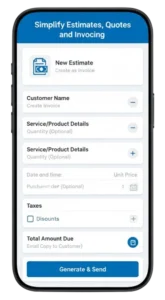
This level of automation means you get paid faster, which is a massive boost to your cash flow. By connecting every step, you ensure the profit you planned for in the estimate is the profit you actually see in your bank account. You can simplify estimates, quotes, and invoicing and see for yourself how a connected system makes a real, tangible difference. Honestly, moving from spreadsheets to a dedicated FSM tool is one of the most impactful steps you can take to grow your electrical business.
Common Electrical Pricing Questions (and How to Handle Them)
Even with the best pricing formula, the real world always throws a few curveballs. Knowing how to handle those tricky situations is what separates the pros from the rookies. It’s about protecting your bottom line without damaging your relationship with the customer.
Let's dig into some of the most common questions and sticky situations we see electricians face every day. These are the moments that can test your communication skills and make or break a job’s profit.
How Do I Adjust Prices When My Suppliers Raise Rates?
This is a big one. It's not a matter of if your suppliers will raise their prices, but when. A sudden jump in the cost of wire or breakers can eat your entire profit if you aren't prepared to act. The worst thing you can possibly do is just eat the cost and hope for the best on the next job.
Communication is your best tool here. Be upfront and honest with your customers, especially those with outstanding estimates.
- For quotes you've sent but haven't been approved: Call them right away. Let them know your supplier's costs have changed and you need to send a revised estimate. Most people are reasonable and will understand, especially when you explain it's a direct pass-through, not you padding the numbers.
- For jobs that are already approved: This is a bit tougher. Go back to your contract. Hopefully, you have a clause that says quotes are only valid for a certain time, like 15 or 30 days, or that material costs are subject to change. If the work hasn't started, you absolutely need to have a conversation.
A simple, direct phone call works best. Try something like this: "Hi [Client Name], I'm calling about the panel upgrade we have scheduled. My supply house just hit me with a 10% increase on the panel itself, which adds [dollar amount] to our cost. I wanted to be upfront and let you know immediately. I'm sending over the updated proposal reflecting that change now."
This approach keeps you in control, shows you're on top of your business, and builds trust. You’re not just a guy pulling numbers out of a hat.
How Do I Present a High-Cost Quote Without Causing Sticker Shock?
Dropping a five-figure quote for a big job like a service upgrade or a whole-home rewire can feel daunting. The secret is to frame the conversation around value, not just cost. Don't just email a PDF with a giant number at the bottom and cross your fingers. You have to walk them through it.
Break your quote down into clear, understandable sections. Instead of one lump sum, itemize the major parts of the job like "New Service Panel & Breakers," "Upgraded Grounding System," and "Labor, Permitting & Inspection." This helps the customer see exactly where their money is going.
Most importantly, you need to connect the dots between the work and the outcome. You aren't just selling breakers and wire. You're selling safety, peace of mind, and protection for their family and their biggest investment.
What Is a Healthy Profit Margin for an Electrical Business?
This can change a bit depending on your location and the type of work you do, but a healthy net profit margin to aim for is generally between 15% and 20%. That’s what’s left in your pocket after you’ve paid for all your labor, materials, and overhead.
- Below 10%: You’re in the danger zone. There’s almost no room for error. One bad job or a callback can wipe out your profit for the whole month.
- 10-15%: You're stable, but you probably don't have much cash left over for growth, buying that new van, or giving your guys a well-deserved bonus.
- 15% or more: Now you're running a healthy, resilient business. You have the financial strength to invest back into the company, hire more help, and handle any slow periods without panicking.
And don't forget the crucial difference between markup and margin. Slapping a 25% markup on your costs doesn't mean you're making a 25% profit. You have to calculate your pricing with your target margin as the end goal.
Estimating, quoting, and invoicing are the financial engine of your electrical business. Field service software like TackonFSM can replace scattered spreadsheets and forgotten invoices with a single, organized system. You can build accurate quotes from a pre-loaded parts list, lock in your target profit margins on every single job, and turn an estimate into an invoice with one click. Stop chasing down paperwork and start getting paid faster.