Field Service Management Software Features: Key Tools for Contractors
Trying to run a modern trade business without the right software is a recipe for disaster. You're constantly walking a tightrope, balancing thin margins, tricky customers, and the endless search for good technicians. The most important field service management software features aren't just bells and whistles; they’re what separate a chaotic, reactive scramble from a well-oiled, proactive operation.
Why FSM Software Is Your Business's Command Center
If your "system" is a mix of paper work orders, sprawling spreadsheets, and a handful of disconnected apps, you're bleeding money in ways you might not even see. A misplaced invoice, a tech sent to the wrong part of town, or a truck that’s missing one critical part—these small fires add up, and they can burn your bottom line to the ground. Field Service Management (FSM) software isn’t just another line item on your budget; it’s the central hub for your entire contracting business.
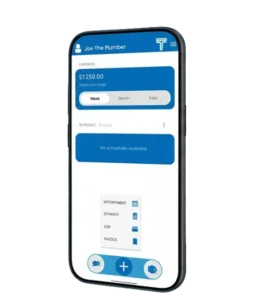
Think of it this way: FSM software acts as the air traffic control for your company. Just like a controller has eyes on every plane, your software gives you complete oversight of every moving part:
- It sends the right technician with the right expertise to the right job.
- It makes sure their van is stocked with the parts they’ll actually need.
- It gives your team instant access to a customer’s full service history and any important notes.
- It helps you get paid on time, every single time.
This level of coordination is no longer a "nice-to-have." It’s essential for staying competitive. The numbers back this up, with the global FSM market expected to jump from $5.12 billion in 2025 to $5.88 billion in 2026—that’s a 15.0% increase in just one year. Cloud-based platforms are leading the charge, making up 64.29% of the market, because they let a business scale from two trucks to twenty without a massive upfront investment. You can find more details on this growth in recent industry reports.
From Putting Out Fires to Steering the Ship
Without a single, unified system, your day is a constant shuffle. A customer calls while you’re trying to create an invoice, which gets interrupted by a scheduling conflict for a priority job. This non-stop context-switching is draining and kills productivity. FSM software brings all those jobs into one place, giving you a single source of truth.
Instead of just reacting to problems as they pop up, a solid FSM platform gives you a clear view of the entire field. You can start anticipating customer needs, optimizing your team's routes, and making smart decisions based on real data, not just a gut feeling.
The Features You Need to Compete
At the end of the day, getting a handle on the core field service management software features is about more than just being efficient. It’s about professionalizing your operation, keeping your customers happy, and building a business that can actually grow. In the next sections, we'll dive into the essential tools that solve these exact problems, helping you move from daily chaos to complete control. You might also want to read up on how FSM software is crucial for your business's growth.
The Four Core Features That Drive Immediate ROI
While a full-blown field service management platform is packed with tools, there are a handful of features that deliver an immediate, tangible impact on your business. These are the workhorses that fix the biggest daily headaches for HVAC, plumbing, and electrical contractors, turning the usual chaos into a smooth, profitable operation. If you want to see a fast return, these four pillars are where you start.
Think of these core field service management software features as the central nervous system for your company. Your FSM software becomes the command center that keeps your dispatchers, your techs in the field, and your customers all on the same page.

As you can see, a modern FSM platform sits right in the middle, making sure critical information flows seamlessly between the office, the field, and your clients.
To show how this works in the real world, let's look at how these core features solve the problems you're likely facing every day.
Solving Daily Headaches with Core FSM Features
| Common Contractor Problem | FSM Feature Solution | Direct Business Benefit |
|---|---|---|
| "My tech drove across town twice for jobs that were a block apart." | Intelligent Scheduling | Optimized routes cut fuel costs and create time for one more job per day. |
| "I have no idea if we have the right filter on Dave's truck." | Real-Time Inventory Management | First-time fix rates go up, and you stop losing money on parts that aren't billed. |
| "Technicians' handwriting is unreadable, and paperwork gets lost." | Technician Mobile App | Eliminates data entry, speeds up billing, and provides a perfect digital record of every job. |
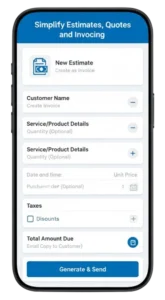
| "Creating quotes takes forever, and I'm not sure if they're profitable." | Integrated Quoting & Invoicing | Standardized, profitable quotes are sent in minutes, and you get paid faster with online payments. |
These examples show a direct line from a common frustration to a software-driven solution that puts more money in your pocket. Let's dig into each of these four features.
Intelligent Scheduling and Dispatching
Your schedule board is the heart of your operation. If you're still using a whiteboard or a clunky spreadsheet, you know how rigid and frustrating it can be—not to mention how easy it is to make a costly mistake. An intelligent scheduling and dispatching tool changes the game completely.
Instead of a static grid, you get a dynamic, living calendar. Need to squeeze in a high-priority emergency call? Just drag and drop the job to an open slot or assign it to a different tech. The system instantly updates everyone, so there's no confusion. That kind of agility is how you maximize billable hours and grab profitable emergency work before your competitors do.
This isn’t just about moving blocks around on a screen. Smart scheduling is about making your entire day more efficient by automatically factoring in tech skills, job locations, and even live traffic to build the smartest routes. This is where you see a huge reduction in wasted drive time and fuel costs.
The software acts as a gatekeeper, preventing you from accidentally sending a new apprentice to a complex commercial job they aren't certified for. It will also automatically group appointments in the same neighborhood, so a technician isn’t zigzagging across your entire service area. These automated tweaks alone can add up to thousands in savings and open up enough time for more jobs each week. For a closer look, check out our guide on field service scheduling software that saves time.
The All-in-One Technician Mobile App
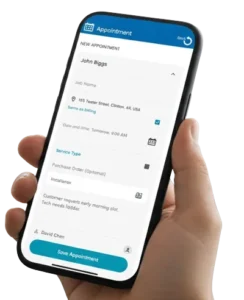
Paperwork is the enemy of profit. It gets lost, it's covered in coffee stains, and it creates a mountain of tedious admin work for you or your office manager. The technician mobile app is the single best weapon against this wasted effort; it literally puts the entire office in your tech's pocket.
From their phone, a tech can view their schedule, get turn-by-turn directions, and pull up the customer's complete service history. They arrive on-site already knowing what work was done last time, which parts were used, and any important notes—like a gate code or a heads-up about a nervous dog.
This instant access to information empowers them to work smarter, not harder. Here’s how it plays out on a typical call:
- Arrival: The tech opens the work order, which has the customer's complaint and the equipment's full history.
- Diagnosis: After finding the problem, they snap a photo of the faulty component and attach it to the job, creating a perfect visual record.
- Repair: They complete the work, logging their time and the parts used right in the app.
- Completion: Before they even back out of the driveway, they generate an invoice, capture the customer's signature on the screen, and take a credit card payment.
The entire job is documented, invoiced, and paid for on the spot. This crushes the end-of-day data entry pile-up, slashes billing errors, and gets cash into your bank account days or even weeks faster.
Integrated Quoting and Invoicing
Building quotes and invoices by hand is slow, and it's a process riddled with opportunities to lose money. Forgetting to bill for a small part, underestimating labor, or using last year's pricing are all common mistakes that quietly drain your profit margins. FSM software with integrated quoting and invoicing solves this by tying your pricebook directly into your financial workflow.
When you build a quote, you're pulling from your digital catalog of services and parts, complete with your most current pricing. This ensures every estimate you send out is both accurate and profitable. You can text or email the quote directly to the customer, where they can approve it with a simple click.
Once it's approved, that quote becomes a work order with a single tap—no retyping anything. And when the job is finished, the work order flips into an invoice just as easily.
- No More Double Entry: Information flows automatically from the quote to the job and finally to the invoice.
- Enforce Profitability: You can set target margins and get alerts if a quote is accidentally priced too low.
- Get Paid Faster: Invoices are sent out with secure payment links, making it incredibly simple for customers to pay you online right away.
This seamless flow takes the guesswork and administrative drag out of your billing cycle, making sure you collect every single dollar you earn.
Real-Time Inventory Management
"Is that part on the truck?" It's a simple question that costs service businesses a fortune in go-backs, wasted fuel, and frustrated customers. Real-time inventory management is one of the most powerful field service management software features because it gives you a bird's-eye view of every part you own and exactly where it is.
The system tracks all your stock, whether it's in the shop, a warehouse, or scattered across your fleet of technician vans. When a tech uses a part, they log it in their mobile app, and the system automatically deducts it from their van's inventory.
This instantly solves some of the most expensive problems in the trades:
- Unnecessary Trips: Techs know for sure if they have the part they need before they drive to the job site.
- Lost Billing: Parts used on a job are automatically added to the invoice, so they never get given away for free.
- Stock Shortages: You can set up automatic low-stock alerts that tell you when it's time to reorder before you run out of something critical.
By getting a firm handle on your inventory, you can dramatically increase your first-time fix rate, which keeps customers happy and protects your bottom line by making sure every part is accounted for and billed properly.
Advanced Features That Professionalize Your Operation
Once you have the basics like scheduling, invoicing, and parts management nailed down, it’s time to look at the field service management software features that truly separate the pros from the amateurs. These advanced tools are what shift your business from just another local shop to a polished, professional operation.
This is where you stop just running the business and start growing it, focusing on delivering a killer customer experience and using real data to make smarter decisions.

Think of it this way: the basic features are your standard toolbox. They get the job done. But these advanced features are like adding a full diagnostic rig and specialized equipment to your garage. You can suddenly work faster, more precisely, and tackle issues your competition can't even diagnose.
Automated Customer Communications
How much of your dispatcher's day is spent answering the same question over and over? "When is my technician going to get here?" Automated customer communications all but eliminate that constant interruption. It's the kind of modern, transparent service that customers don't just appreciate anymore—they expect it.
Instead of your team making manual calls, the software sends out perfectly timed updates automatically. It’s a simple but powerful workflow:
- Appointment Confirmations: A text or email a day ahead of the job to make sure everyone is on the same page.
- Technician En Route Alerts: The moment a tech marks themselves as on their way, the customer gets a text, often with a live map to track their progress. No more guessing games.
- Job Done Notifications: A quick message confirming the work is complete.
- Review Requests: A follow-up text or email that automatically asks satisfied customers to leave a review on Google, helping you build your online reputation.
This simple system keeps customers happy and in the loop. More importantly, it frees up your office staff from being a call center, letting them focus on tasks that actually grow the business. You'll also see a huge drop in no-shows, which is money straight back into your pocket.
In-Depth Reporting and Analytics
For years, many of us ran our businesses on gut instinct and experience. While that's valuable, it can only get you so far. The best field service management software features give you powerful reporting dashboards that turn your daily chaos into clear, simple insights. You finally get real answers to the questions that dictate your bottom line.
These reports aren’t just spreadsheets full of numbers. They're the scoreboard for your business. They tell you exactly where you’re winning, where you’re bleeding money, and what plays to call next to boost your margins.
You can stop guessing and start knowing. In seconds, a good FSM dashboard can show you:
- Job Profitability: Are you actually making money on those small repair jobs, or are they costing you? Which job types are your cash cows?
- Technician Performance: Who’s your MVP for first-time fixes? Who consistently upsells service agreements?
- Marketing ROI: Is that new ad on Facebook actually bringing in profitable work, or just tire-kickers?
- Parts Usage: What are your most-used parts? Are you remembering to bill for every single one of them?
With this kind of data, you can make game-changing decisions. Maybe you'll see that one tech is a rockstar with commercial HVAC but struggles with residential plumbing—now you can assign jobs based on their proven strengths. This is how you build a scalable, profitable company.
Seamless Accounting Integrations
Manually copying invoices, payments, and customer details from your field service software into QuickBooks is not only a soul-crushing task, it's a recipe for disaster. One typo or a missed invoice can create accounting headaches that take weeks to unravel.
A seamless accounting integration gets rid of that double-entry nightmare. The software creates a bridge between your operations and your finances, ensuring everything syncs automatically and accurately. When your tech takes a payment on their tablet in the field, that payment instantly appears in QuickBooks, gets applied to the right invoice, and is marked as paid. Done.
This automation is essential for keeping your financial records clean without all the administrative overhead. Your books stay current, tax time becomes infinitely less stressful, and you get a real-time view of your company's cash flow. For any company with techs in the field, a practical guide to lone worker safety is also a key part of professionalizing your operation and protecting your team. You can also review our other resources to simplify estimates and invoicing. By combining these advanced features, you create a powerful, self-improving system that drives your business forward.
How to Choose the Right FSM Software
Picking the right field service management platform is a huge deal. It’s less like buying a new tool and more like hiring a new operations manager—a decision that will define how your company runs for years to come. The trick isn't finding the software with the longest feature list, but finding a real partner that fits how you work today and can keep up as you grow.
It's easy to get overwhelmed by flashy demos and sales pitches. To cut through the noise, you need to ask the right questions. This checklist will help you see past the marketing and figure out how a platform will actually perform for your team in the real world.
Can It Grow with You?
The software that works for a two-truck operation needs to be a whole lot different than one for a twenty-truck fleet. You need a platform that’s flexible enough to scale with your business without locking you into a pricing plan that eats up all your profit from day one.
This is where you have to get serious about the pricing tiers. Are they straightforward, or are they hiding extra fees for things like setup and training?
During your evaluation, don't be afraid to ask the tough questions:
- What’s the real total cost? Look beyond the monthly subscription. Are there hidden fees for data migration, training, or adding new users down the line?
- How does the pricing actually scale? Is it per tech, per job, or a flat fee? You need to make sure the model makes sense for your growth plans.
- Are there long-term contracts? A company that's confident in its product, like TackonFSM, often provides month-to-month flexibility. This lets you adapt as your business changes without being stuck in a year-long commitment.
A great partner will offer predictable pricing that fits your current size while giving you a clear, affordable path to add more firepower as your business expands.
Is It Built for Your Team?
The most powerful software on the planet is worthless if your techs and dispatchers can't stand using it. Simplicity isn't a bonus feature; it's essential. If the app is clunky or confusing, your team will eventually go back to their old ways, and you’ll be right back in the chaos of paper work orders and messy spreadsheets.
Think of it like this: you wouldn't buy a complicated new power tool for your techs without making sure it felt right in their hands. Software is no different. It has to feel natural to the people using it every single day.
When you're looking at a platform, always insist on a free trial and get your whole team involved. Let your lead tech run a few pretend jobs on the mobile app. Have your dispatcher try scheduling and then immediately rescheduling a few appointments. Their honest feedback is the most important information you can get.
Is It Built for the Modern World?
Let's be blunt: on-premise, server-based software is a thing of the past. For any modern trade business, cloud-based software isn't just a nice-to-have, it's a necessity. It gives you the freedom to run your business from anywhere—the office, the truck, even the beach—without being chained to a specific computer. It also means you don't have the headache and upfront cost of buying and maintaining your own server.
The industry has already made its choice. Cloud solutions grabbed 64.29% of the FSM market revenue in 2023 and are projected to grow at a blistering 10.58% CAGR. For U.S. contractors in an industry set to hit $3.1 billion by 2026, a cloud-native platform like TackonFSM is a strategic move, especially with zero setup fees and free onboarding. You can discover more insights about this trend and its impact on the industry.
Is It Built for Your Trade?
Finally, does the software actually get your business? A generic FSM platform built for "all mobile workers" often completely misses the mark on the specific workflows that HVAC, plumbing, and electrical contractors rely on. You want software that was clearly designed with your trade in mind.
That means things like pre-loaded parts catalogs for your industry, customizable safety checklists for specific job types, and intuitive workflows for managing service agreements and multi-day projects. When a platform understands your world, it stops feeling like software you have to battle and starts feeling like a natural part of your business.
Making a Smooth Transition to Your New FSM

Let's be honest: the idea of moving your entire business to a new software system can be intimidating. I’ve seen plenty of contractors stick with clunky, outdated methods simply because they're afraid of the disruption. But making the move to a modern FSM isn’t like performing open-heart surgery on your business; it’s more like swapping out an old engine for a brand-new, high-performance one.
The whole process feels much less daunting when you break it down into a few manageable steps. Any good software provider will be right there with you, helping you tackle each part. This isn't about blowing up what works—it's about building on a stronger foundation so you can grow.
A Clear Path to Getting Started
When you boil it down, a successful switch comes down to three things: moving your data, training your people, and setting smart, realistic goals from day one. The best platforms are built to make this as smooth as possible, and most offer dedicated support so you’re never left figuring things out on your own.
Here’s a practical look at how to handle each stage.
Moving Your Business Data
Your customer lists, job histories, and pricebook are the DNA of your company. The fear of losing that data—or worse, facing weeks of manual data entry—is a major reason why owners hesitate. Thankfully, with a quality FSM, this is practically a non-issue. Look for a partner that offers assisted data migration.
Think of your data like your toolbox. You wouldn't leave it behind when moving to a new shop. A good FSM provider acts as your moving crew, carefully packing up your essential tools (data) and setting them up in your new workshop (the software) so they're ready to use from day one.
They’ll work with you to export everything from your old systems—whether it’s QuickBooks, a mess of spreadsheets, or another FSM—and get it mapped correctly into the new platform. This means your team has full access to customer history and your standardized pricebook from the moment you go live, so business carries on without skipping a beat.
Training and Empowering Your Team
Getting your crew on board and comfortable is absolutely critical. The best field service management software features are designed to be user-friendly, but a little bit of targeted training goes a long way in building confidence and getting everyone up to speed quickly. The key is to focus on role-specific training so nobody gets overwhelmed.
- For Dispatchers: Your office manager or dispatcher can usually get the hang of a drag-and-drop schedule in a single training session. The goal is to get them comfortable assigning jobs and making changes on the fly.
- For Technicians: The mobile app should be simple enough that a tech can master it after running through a couple of practice jobs. Show them exactly how to see their schedule, fill out a work order, and take a payment right on their phone or tablet.
Make it clear that you want their questions and feedback. A platform like TackonFSM usually includes free onboarding where their experts will actually walk your team through the software. This small investment in training pays for itself almost instantly through fewer errors and a much smoother rollout.
Ultimately, it’s not just about learning a new tool. It’s about helping your team see how this software makes their day-to-day jobs easier.
Frequently Asked Questions About FSM Software
Switching to new software always brings up a handful of make-or-break questions. As you look at different field service management software features, you deserve clear, honest answers. We've been there with hundreds of contractors, and these are the concerns that come up time and time again.
How Long Does It Take to Get My Team Using New FSM Software?
Honestly, it’s much faster than most owners expect, especially if the software is built for real-world use. We often see dispatchers get the hang of a drag-and-drop schedule in just one afternoon. For your techs in the field, it usually only takes a few live jobs for the mobile app to feel like second nature.
A good software partner will do most of the heavy lifting for you. They should offer free, hands-on onboarding and data migration to pull in all your existing information, including:
- Customer lists and site details
- Complete service and job histories
- Your parts inventory and price book
For most shops with 1-10 technicians, being up and running in a single week isn't just possible—it's the standard.
Will an FSM Mobile App Work in Areas with Poor Cell Service?
Yes, it absolutely has to. Any FSM software worth its salt is designed with spotty service in mind, because we all know cell signal is never guaranteed on a job site.
Think of the mobile app as a pre-loaded digital toolbox. It shouldn't stop working just because the internet does. All the crucial job info is downloaded directly to the device, so your team can keep working from anywhere.
Before a technician even leaves the shop, their jobs for the day—including customer details and work orders—are synced to their phone or tablet. If they're in a basement or a rural area with no signal, they can still pull up all the information, fill out checklists, add notes, and take photos. The moment their device gets back online, the app automatically syncs everything back to the office. No lost data, no delays.
Is FSM Software Affordable for a Small Business?
It is now. The idea that this kind of powerful software is only for massive, enterprise-level companies is a thing of the past. Modern, cloud-based systems are built and priced specifically for small and growing contractors.
You should be looking for a straightforward monthly plan based on how many technicians you have. This approach gets rid of the huge upfront costs and confusing multi-year contracts that came with old-school, server-based software.
When you do the math, the ROI becomes obvious almost immediately. The monthly subscription often costs less than the revenue you'd lose from just one mismanaged appointment or a handful of unbilled parts. The right software doesn't just cost money; it makes money by plugging the leaks in your operations.
Ready to see how the right field service management software features can transform your operations? TackonFSM provides the tools you need to schedule smarter, get paid faster, and gain control over your business. Start your free 14-day trial today!