Electrical Bidding Software: Boost Precision and Profits
Bidding on an electrical job with spreadsheets is like trying to build a modern house with just a hammer and saw. Sure, you can get it done, but it’s slow, exhausting work where one tiny miscalculation can threaten the whole project. A single bad formula or an old price in a cell can quietly vaporize your profit margin before you even win the job.
Why Manual Bidding Is Holding You Back
Sticking with spreadsheets isn't just a matter of preference; it's a real handicap in a competitive market. In an industry where speed and accuracy decide who wins, relying on manual methods is a gamble you can't afford to take. The whole process is filled with hidden risks that hit your bottom line and stop your business from growing.
This old-school approach creates constant friction. Every new bid is a copy-paste job from a fragile template, just waiting for a data entry mistake to happen. A simple typo in a material cost or a miscalculation in labor hours can easily slip through the cracks, only to be discovered when it's far too late. That’s the exact moment a supposedly profitable job turns into a money pit.
The Real Cost of Inefficiency
The most obvious cost is time. Your most experienced people spend hours, even days, doing manual takeoffs, flipping through outdated price books, and triple-checking formulas. This isn't just inefficient—it’s a bottleneck that physically limits the number of jobs you can even bid on. While you’re stuck building one complicated estimate, your competition is firing off three professional, accurate proposals using electrical bidding software.
But it’s more than just a time sink. Think about these all-too-common headaches:
- Version Control Chaos: Having multiple spreadsheet versions—like
Final_Bid_v3.xlsxandFinal_Bid_v3_revised.xlsx—floating around is a recipe for disaster. This confusion is a leading cause of submitting bids with the wrong numbers. - Inconsistent Proposals: Without a set system, every proposal you send out looks a little different. This inconsistency can damage a client's trust and make your company look less polished than it really is.
- Forgotten Overheads and Profit: When you're rushing to get a bid out the door, it's dangerously easy to forget to add your markup for overhead and profit. That’s a surefire way to lose money on a job you "won."
The fundamental issue is that spreadsheets were never built for the detailed work of electrical estimating. They don't have the built-in parts databases, automated calculations, or organized workflows needed to keep up.
To get a clearer picture of the risks, let's compare the two approaches side-by-side.
Spreadsheet Bidding vs Software Bidding
The table below breaks down the risks of sticking with manual methods versus the advantages of dedicated software.
| Aspect | Manual Bidding (Spreadsheets) | Electrical Bidding Software |
|---|---|---|
| Accuracy | High risk of human error from typos, broken formulas, and missed items. | Automated calculations and integrated databases drastically reduce errors. |
| Speed | Slow and labor-intensive. Limits the number of bids you can submit. | Dramatically faster. Enables you to bid on more jobs in less time. |
| Consistency | Proposals vary in format and quality, appearing unprofessional. | Standardized templates ensure every proposal is professional and consistent. |
| Profitability | Easy to forget crucial markups for overhead and profit, leading to losses. | Built-in controls ensure all costs, overhead, and profit are included. |
| Data Management | Relies on outdated, manually updated price lists. | Access to real-time, cloud-based material pricing from suppliers. |
Ultimately, dedicated software provides a safety net that spreadsheets simply can't offer, protecting your time, reputation, and most importantly, your profit margins.
A Market That Demands Modern Tools
The stakes have never been higher. The U.S. electrical services market is projected to hit an incredible USD 294.6 billion by 2034, which points to a decade of major growth and opportunity. If you want a piece of that pie, you need tools that deliver precision and protect your profits. You can discover more insights about the U.S. electrical services market and see where the industry is headed.
This expanding market will be won by contractors who can bid faster and smarter. In the end, manual bidding doesn't just cost you time; it costs you opportunities, profits, and your peace of mind.
How Electrical Bidding Software Actually Works
Let's pull back the curtain and look at what this software really does, day-to-day, without all the tech-speak. Forget thinking of it as just another program on your computer. It’s more like a dedicated command center for your entire bidding process. All the spreadsheets, bulky price books, and calculators you're currently juggling? They all get consolidated into one organized, digital workspace.
At its heart, electrical bidding software is a system built to inject speed, accuracy, and consistency into every single estimate you build. It’s designed to replace the hazardous guesswork and tedious manual data entry with a repeatable, automated workflow that defends your profit margins and gives you back your time.
The Bidding Workflow, Reimagined
The process generally follows a logical path, from the initial plans to a polished, professional proposal. It kicks off when you upload a digital blueprint or set of construction plans right into the system. And this is where the first bit of "magic" happens.
Instead of rolling out massive blueprints and breaking out the highlighters and scale rulers, the software performs a digital takeoff. With a few clicks, you can measure every conduit run, count every outlet and light fixture, and identify all the components the job requires. This can shrink a task that once ate up hours—or even a full day—down to a matter of minutes. And it does it more accurately, too.
Once the takeoff is done, the software does more than just spit out a parts list. It connects that list directly to a built-in parts and pricing database.
This isn't some static catalog. It's a live database that's constantly updated with the latest material pricing from your suppliers. This ensures your bids are based on today's real-world costs, not on a price book that’s six months out of date. You just pull the materials you need into the estimate, and the software plugs in the correct, current costs. No more phone calls to the supply house for every little thing. The global market for this kind of software is expected to hit USD 3.9 billion by 2032, which tells you just how many contractors are tired of leaving money on the table. You can dig into the numbers yourself in the full market report from DataIntelo.
One tiny manual error can start a painful domino effect, leading to project delays and serious financial hits.
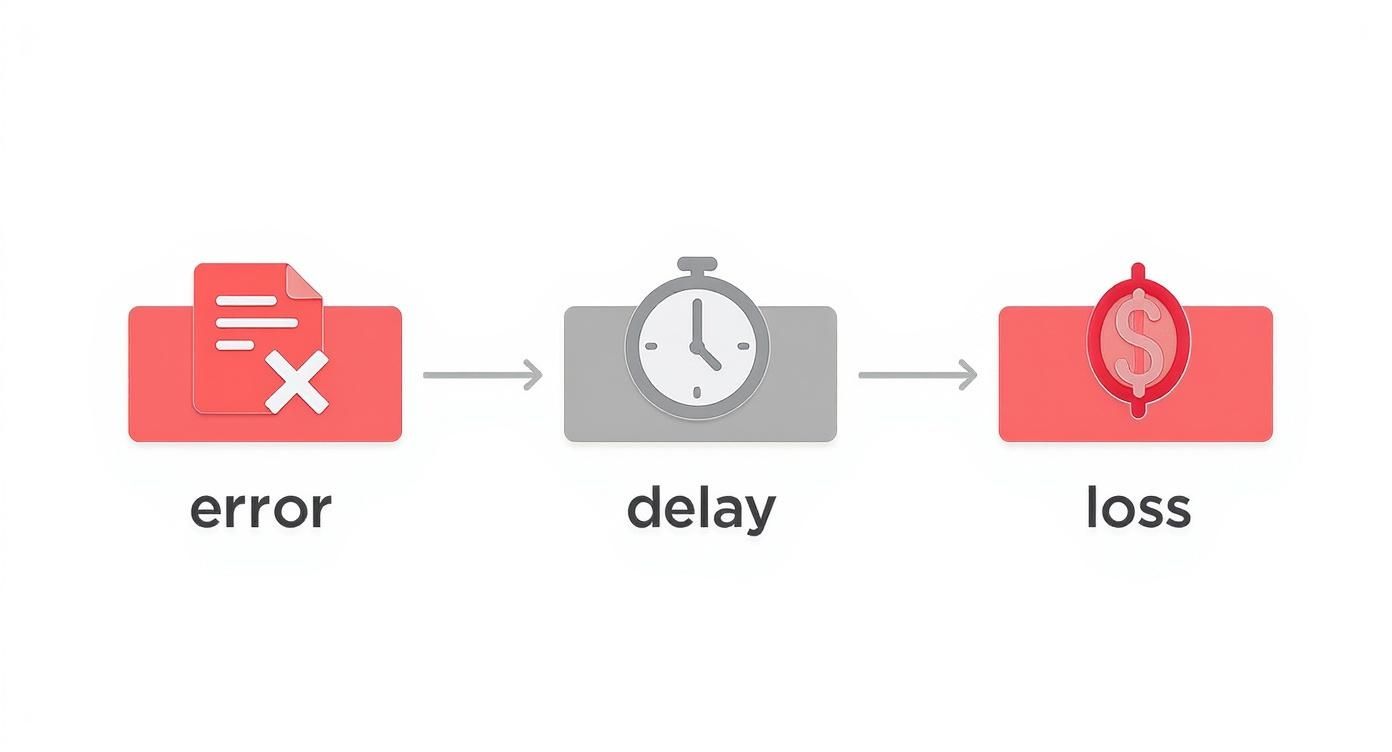
This is the exact chain reaction that good software is built to prevent. By automating the process, you remove that initial point of failure—the manual typo or miscalculation—and protect the entire bid.
From Raw Costs to a Winning Proposal
With your material costs locked in, the system then layers on your company's specific financial logic. This is where you really start to protect your bottom line. The software automatically adds:
- Labor Rates: It accurately calculates labor hours based on the specific tasks and materials involved, letting you apply different rates for an apprentice versus a journeyman or master electrician.
- Overhead Costs: The system tacks on your pre-set percentage for business overhead. You set it once, and those crucial, often-forgotten costs are never missed again.
- Profit Margin: You decide on your target profit margin, and the software applies it consistently to every bid, every time.
The software's real strength is its ability to be your financial gatekeeper. It enforces your business rules on every single estimate, acting as a guardrail to ensure every bid isn't just fast, but is built to be profitable from the ground up.
Once all the numbers are crunched, the software generates a clean, professional-looking proposal. You can use templates that already have your company logo, a clear scope of work, and your terms and conditions baked right in. In just a few moments, you have a polished document ready to send to the client—one that immediately builds trust and helps you win the job.
What Really Makes Electrical Bidding Software Tick? The Core Features
Modern electrical bidding software isn't just a fancy calculator. Think of it as a complete toolkit, where every feature is built to solve a specific, expensive problem you deal with every day. These tools work together, turning a slow, clunky process into a workflow that’s fast, accurate, and profitable. It’s like swapping out hand tools for power tools—the competitive edge is immediate.
Let's break down the game-changing features that leave spreadsheets in the dust.
Digital On-Screen Takeoffs
The first big headache in manual bidding is the takeoff. Rolling out giant blueprints, fumbling with scale rulers, and manually clicking off every single fixture is slow. Worse, it's a breeding ground for errors. One missed circuit or a miscounted string of outlets can sink your profit on a job before you even start.
Digital on-screen takeoffs make that whole process obsolete. You just upload a digital blueprint (like a PDF) directly into the software. Then, you use your mouse to trace conduit runs and click to count fixtures, panels, and receptacles. The software handles all the measuring and counting, spitting out a perfectly accurate, itemized list in minutes.
- Before: Hours squinting at blueprints with highlighters and rulers, hoping you didn't miss anything.
- After: A complete, accurate takeoff done in a fraction of the time, with a clear visual record of exactly what was counted.
Integrated Parts and Material Databases
Once you have a parts list, the next grind begins: pricing. Digging through outdated supplier catalogs or making a dozen phone calls for current costs burns through your day. Even worse, quoting a job with last month's pricing is a surefire way to underbid and lose money.
Good bidding software solves this with a built-in, cloud-based parts database. This gives you instant access to thousands of electrical components, all with up-to-date pricing.
Think of it as a live, digital catalog plugged directly into your estimate. It ensures every bid reflects today's actual material costs, not last quarter's, protecting your margins from market swings.
Many platforms, like TackonFSM, also let you import custom price sheets from your preferred suppliers, guaranteeing you have the most precise numbers possible.
Pre-Built and Custom Assemblies
Estimating common jobs piece by piece is just plain tedious. When you bid a standard office lighting setup, for instance, you're repeatedly adding the fixture, whip, box, and brackets for every single light. It's a massive time-waster.
This is where assemblies become a powerful shortcut. They are essentially pre-packaged kits of materials and labor for common tasks. Instead of adding four separate items, you just add one "office lighting assembly" to your bid.
- Boosts Speed: Drastically reduces the time it takes to bid complex systems.
- Improves Consistency: Makes sure no one ever forgets a crucial part of a standard installation.
- Increases Accuracy: Labor is pre-calculated for the whole assembly, making your estimates much more reliable.
You can use the software's built-in assemblies or create your own for the specific work your company does most. This feature alone can easily cut your estimating time in half.
Smart Labor and Cost Calculators
Let's be honest, calculating labor is often more of an art than a science in manual bidding, and that involves a lot of risky guesswork. Electrical bidding software brings precision to the process. You can set different labor rates for apprentices, journeymen, and master electricians and have the system apply them automatically.
The software calculates labor units based on industry standards tied to the specific materials in your takeoff, ensuring your labor costs are both realistic and profitable. It also acts as your financial safety net by automatically applying your preset percentages for overhead and profit to every single bid. You never have to worry about accidentally giving your profit away.
As projects get more complex, the market is quickly moving toward tools that include features like Building Information Modeling (BIM) integration and multi-user collaboration. You can learn more about these critical feature trends from market research to see where the industry is heading.
Unlock Tangible Business Growth and ROI
https://www.youtube.com/embed/TvBVTdb5kYU
The real power of electrical bidding software isn't just about cranking out estimates faster. It’s about what that newfound speed and accuracy does for your entire business. Think of it less as an operational expense and more as a direct investment in your company's growth, profitability, and future stability. The return on investment (ROI) isn't just a buzzword; it shows up in real, measurable ways that hit your bottom line.
When you finally move past manual methods, you’re building a more resilient and competitive operation. The software fuels growth in four key areas: it lets you bid on more jobs, protects your profits, helps you win more often, and gives you the data you need to make smarter decisions. Let's break down how these benefits translate into the kind of financial results every contractor is looking for.
Increase Your Bid Capacity and Market Share
As a contractor, time is the one thing you can never get back. When your most experienced estimator is tied up for days on a single complex bid, that’s a huge bottleneck. This old-school, manual process puts a hard cap on the number of projects you can even chase, forcing you to walk away from good opportunities simply because you don’t have the bandwidth.
This is the first wall that electrical bidding software knocks down. By automating the most tedious parts of the job—like takeoffs, looking up material prices, and calculating labor—you can slash your estimating time by up to 80%.
A bid that once took a full week to grind out can now be accurately put together in a single day. Suddenly, you can pursue three, four, or even five times as many projects without hiring another person.
This isn't just about being busy; it’s about strategically grabbing more market share. You get the flexibility to bid on a wider range of jobs, from small service calls to large commercial projects, and really expand your company's footprint.
Protect Your Profit Margins on Every Job
When you’re bidding by hand, profit is incredibly fragile. One simple typo, an old material price, or forgetting to add your overhead percentage can quietly wipe out your entire margin. These are the small, preventable mistakes that kill profitability in our trade.
Good software acts as your financial gatekeeper. It enforces your business rules on every single estimate, making sure every cost is covered and every bid is built for profit from the get-go.
- Automated Markups: You set your required overhead and profit margins one time, and the software applies them consistently to every bid. No more accidentally doing jobs for free.
- Real-Time Pricing: Tying into material databases protects you from price hikes. You’re bidding with today’s costs, not last month's, which shields your margins from surprise increases from your suppliers.
- Accurate Labor Costs: Using standardized labor units and applying the right pay scales for different electricians takes the expensive guesswork out of your biggest cost.
This systematic approach turns bidding from a gamble into a predictable, profitable process.
Improve Your Win Rate with Professionalism
Let’s be honest: how your bid looks and how fast you get it to the client matters. A proposal that’s sloppy, inconsistent, or late plants a seed of doubt. On the other hand, a professional, detailed, and prompt bid builds immediate trust and makes you stand out from the competition still fumbling with spreadsheets.
Professionalism breeds confidence. When a client gets a clear, well-organized proposal that breaks down the scope and costs accurately, it signals that you run a tight ship.
Modern electrical bidding software generates polished, branded proposals in minutes. That consistency and speed don't just boost your reputation; they measurably increase your win rate. And winning more of the jobs you bid on is one of the fastest ways to grow your revenue.
Gain Business Intelligence to Guide Decisions
Finally, all your bidding data is a goldmine of business insights just waiting to be tapped. With spreadsheets, trying to analyze that data is a nightmare. Good software, however, tracks every bid you create, giving you a crystal-clear dashboard of your business performance.
You can instantly see which types of jobs are your most profitable, which estimators have the best win rates, and where your margins are strongest. This is the kind of intelligence that lets you stop guessing and start making data-driven decisions, focusing your time and energy on the work that will actually grow your business.
To put these benefits into perspective, let's look at a hypothetical example for a small electrical contractor. The table below outlines the potential financial gains from adopting dedicated bidding software.
Projected ROI From Adopting Bidding Software
| Benefit Area | Metric | Annual Estimated Impact |
|---|---|---|
| Time Savings | 15 hours/week saved for an estimator earning $35/hour | $27,300 |
| Increased Bid Capacity | Ability to bid on 3 additional jobs per week at a 15% win rate | $39,000 (Based on $5k average job profit) |
| Improved Accuracy | Preventing one major underbid per quarter that costs $2,500 | $10,000 |
| Higher Win Rate | 5% increase in win rate on $1M in total bids (at 20% margin) | $10,000 |
| Total Estimated ROI | Annual financial benefit from using the software | $86,300 |
As you can see, the numbers add up quickly. The investment in software pays for itself many times over, not just in efficiency but in real, tangible profit that fuels your company's future.
How to Choose the Right Bidding Software
Picking the right electrical bidding software isn't just about buying a tool; it’s like hiring a new estimator for your team. You need a perfect fit—one that gets your workflow, understands your team, and is ready to help you grow. It's easy to get distracted by flashy features, but that's a classic mistake. The smart move is to focus on what your business actually needs to win more work and protect your margins.
Making a good call here starts by asking the right questions. It's less about a software’s spec sheet and more about how it will slot into your day-to-day reality. A simple checklist can help you cut through the marketing fluff and get straight to what matters.
Does It Grow With You?
The software you pick today has to work for the business you want to be tomorrow. Growth is the goal, right? Your main operational tool shouldn't be the thing that holds you back. Think about where you see your company in one, three, or even five years.
- Team Size: Will the price skyrocket every time you hire a new estimator or project manager? Look for pricing that makes sense as you add people.
- Locked Features: Are the tools you’ll need down the road—like multi-trade support or advanced inventory—stuck behind a massive enterprise paywall? You want a platform that lets you grow into new features without forcing a huge, unexpected price jump.
- Job Complexity: Can it handle bigger, more complicated jobs? If you’re planning to move from small residential fixes to large-scale commercial projects, your software needs to keep up with detailed takeoffs and more complex assemblies.
Here’s a look at the clean, no-nonsense interface inside TackonFSM.
A clear, straightforward layout like this is huge. It means your team can get up and running fast, without a steep learning curve.
Will Your Team Actually Use It?
The most powerful software on the planet is worthless if your team hates it. A clunky, confusing system just creates frustration and drags down productivity. The whole point of moving off spreadsheets is to make life easier, not to trade one headache for another.
Here's the real test: Can a new user jump in, figure out the basics, and build their first accurate bid with just a little guidance? If not, you're looking at a tool that will cause more problems than it solves.
This is why a free trial is non-negotiable. Look for something like the 14-day trial from TackonFSM, and get your estimators—the people who will live in this software every day—to take it for a spin. If they can see the value right away, you've found a winner. There’s no better way to know if it’s the right fit.
Does It Play Well With Your Other Tools?
Your bidding software can't be an island. It’s the starting line for a process that runs all the way through project management, scheduling, and getting paid. If it can’t talk to your other systems, you're just creating more work for yourself with manual data entry.
Before you sign anything, make sure it connects with the tools you already use. Here are the must-haves:
- Accounting: A direct link to software like QuickBooks or Xero is essential. When you win a bid, you want all that financial data to flow straight from the estimate to the invoice without anyone having to type it in again.
- Field Service Management (FSM): The dream for most contractors is having everything in one place. An all-in-one platform like TackonFSM does just that, connecting your bidding with dispatch, scheduling, and inventory. It creates one smooth workflow from the first quote to the final payment.
- Supplier Catalogs: Your bids are only as good as your pricing. The software must let you import custom price lists directly from your suppliers to keep your numbers accurate and protect your profit.
One last thing—don't forget about support. When you’re up against a bid deadline and something goes wrong, you need a real person who can help you, fast. You're not just buying software; you're choosing a partner who should be just as invested in your success as you are.
A Simple Plan for a Smooth Software Transition
Buying powerful electrical bidding software is the easy part. The real win comes when your team actually uses it—when it becomes a core part of their daily workflow. A rushed rollout almost always leads to frustration and a quick retreat back to those old, comfortable spreadsheets. But a smooth transition isn't about luck; it's about having a deliberate, simple plan.

Think of it like commissioning a new piece of essential equipment for the shop. You wouldn't just plug it in and hope for the best. You'd prep the space, show your team how to operate it safely, and run a few tests to make sure it's calibrated just right. The same logic applies here.
This roadmap will walk you through the essential steps to get your team onboard and productive from day one, so you start seeing a return on your investment almost immediately.
Four Steps to a Seamless Implementation
Getting started on the right foot just takes a little prep work and a focused effort to build your team's confidence. By breaking the process into four manageable stages, you can swap that implementation anxiety for genuine excitement about the new tools at their fingertips.
-
Prepare Your Data for Migration: Before you move in, you’ve got to clean house. Gather your most current material price lists from suppliers, your standard labor rates, and any custom assemblies you’ve built out in your spreadsheets. Having this info organized and ready to import will make the setup process incredibly fast and ensures your very first bids are built on solid, accurate data.
-
Dedicate Time for Focused Training: Please, don't just hand over a login and expect your team to figure it out on their own. Block out a specific time—even just a few hours—for uninterrupted training. Most software providers, including TackonFSM, offer guided onboarding to walk your team through the core functions, from building the first estimate to generating a sharp-looking proposal.
-
Customize Your Templates and Branding: Make the software feel like it’s yours right away. Upload your company logo and tweak the proposal and estimate templates to match your branding. A professional bid builds client trust, and this simple step makes sure every document that leaves your office is consistent and polished.
A smooth rollout is a planned process, not an accident. The goal is to build momentum and prove the software’s value quickly, turning potential skeptics into your biggest advocates.
- Run Bids in Parallel to Build Confidence: This is the most important step. For the first week or two, have your team create a few bids using both the new software and your old spreadsheet method. This side-by-side comparison is the ultimate confidence builder. It lets them personally verify the new system's accuracy while seeing just how much faster and more reliable it is. When the numbers match up, but one method took a fraction of the time, the benefits become impossible to ignore.
This proactive approach makes sure your new electrical bidding software becomes the first, crucial link in a fully connected workflow. From the moment a bid is won, that data can flow seamlessly into project management, scheduling, and invoicing, truly changing how your entire operation runs.
Frequently Asked Questions
Jumping into electrical bidding software can feel like a big leap, especially if you've spent years wrestling with spreadsheets. Let's tackle some of the most common questions contractors have, so you can feel confident about making the right move for your business.
Is This Software Hard To Learn If I Only Know Spreadsheets?
Honestly, it's easier than you think. While any new tool takes a minute to get used to, modern bidding software is built for electricians, not tech wizards. The best platforms are designed to feel intuitive, walking you through the process from takeoff to final proposal.
Most providers offer fantastic setup help and support. What we hear from contractors is that after just a few hours of training, the software feels way simpler than their old, clunky spreadsheets. It automates all the tedious, error-prone calculations that used to take up all their time.
Can This Software Integrate With My Other Business Tools?
Yes, and that’s where the real magic happens. The top electrical bidding software options are designed to be team players, connecting seamlessly with the other tools you use every day. This creates a smooth flow of information from the bid you just won all the way to the final payment, killing off double data entry for good.
Common and crucial integrations usually include:
- Accounting Programs: Syncing with tools like QuickBooks or Xero is pretty standard. This means job costs and invoice details flow over automatically, keeping your books accurate without the extra work.
- Field Service Management (FSM): All-in-one systems like TackonFSM bundle bidding with scheduling and dispatch. This creates one unified command center for your entire operation.
This kind of connection ensures everyone—from the office to the field—is on the same page, which is a massive upgrade from having data stuck in isolated spreadsheets.
Is It Worth The Cost For A Smaller Electrical Business?
Without a doubt. In fact, for a smaller shop, the return on your investment can be even faster and more dramatic. Don't look at the software cost as just another bill; think of it as an investment in efficiency and a safety net against costly mistakes.
Here's a practical way to think about it: if the software helps you dodge just one major underbid or win one extra profitable job this year, it has likely already paid for itself.
It really does level the playing field. This kind of tool gives smaller companies the power to pump out bids with the same speed, precision, and polish as the big guys. That means you can compete for better projects and grow your business the right way.
Ready to see how an all-in-one platform can protect your margins and help you win more bids? TackonFSM combines powerful estimating tools with scheduling, dispatch, and inventory management. Start your 14-day free trial and build a better bid today!