Best Electrical Estimating Software: Top Tools & Tips
Let's be honest, trying to find the right software can feel like a chore. But here’s the thing: the best electrical estimating software is simply the one that fits how you actually work.
Your needs will dictate the right tool. Maybe you need pinpoint-accurate digital takeoffs for complex blueprints. Or perhaps a deep, constantly updated material database is non-negotiable. For others, it's all about giving the field team mobile access. Whatever it is, the goal is to match the software's strengths to your project types and company size.
To get started, let’s frame this decision by breaking down the core functions you should be comparing.
Choosing Your Ideal Electrical Estimating Software
Making a software switch is more than just about bidding faster. It's a strategic decision to protect your profit margins and get your operations running smoothly. When you move on from clunky spreadsheets or outdated programs, you'll see a real impact on your bottom line. Better accuracy and less time spent building proposals just makes business sense.
Ultimately, you're looking for a platform that can grow with you. It needs to work just as well for a small crew on residential jobs as it does for a larger firm bidding on major commercial contracts.

This guide isn't about giving you a generic top-ten list. Instead, we're going to dig into how specific features solve the real-world problems electrical contractors face every day. You'll get the practical insights you need to pick a system that truly improves your entire workflow, from the first takeoff to the final invoice.
Key Functional Areas to Compare
Before you start looking at specific software brands, it helps to get clear on the core functionalities and how each one helps your business. Every platform has its strengths, and knowing what you value most will make your evaluation much simpler.
- Takeoff & Estimating Engine: This is the absolute heart of any estimating software. It's what determines how quickly and accurately you can measure plans and calculate all your material and labor costs.
- Database & Pricing Integration: In a market with constantly changing material costs, having an up-to-date and customizable database for parts and labor isn't a "nice-to-have"—it's essential for creating profitable bids.
- Workflow & Project Management: This is what connects your estimate to everything else. It bridges the gap between the bid and the actual job, covering things like scheduling, dispatching, and invoicing.
Let's break these down a bit further. The table below gives a quick overview of these essential functions, what they mean for your business, and the specific features you should be looking for.
Quick Comparison of Core Software Functions
| Core Function | Impact on Business | Key Feature to Look For |
|---|---|---|
| Digital Takeoff | Slashes manual calculation errors and can speed up the bidding process by up to 75%. | Support for multiple file types (PDF, CAD) and one-click count tools for fixtures and outlets. |
| Material & Labor Database | Protects your profits by ensuring bids use current, accurate pricing for parts and labor units. | Pre-loaded, customizable databases with options for real-time supplier price updates. |
| Proposal Generation | Helps you create professional, branded proposals in minutes, improving how clients see you and boosting win rates. | Customizable templates that let you easily include scope, terms, and capture digital signatures. |
| Mobile Accessibility | Gives you the flexibility to make on-the-go estimate adjustments and get approvals, which is critical for teams in the field. | A dedicated mobile app with offline functionality, so you can create and view estimates anywhere. |
Think of these four areas as your foundational checklist. As you start evaluating different options, you can measure them against these core needs to see how they stack up for your business.
The New Reality of Electrical Estimating
The electrical contracting game is changing fast. Forget the days of winning bids with spreadsheets and a calculator—those methods just can't keep up anymore. Projects are getting more complicated, margins are razor-thin, and clients want accurate quotes, like, yesterday.
This pressure has sparked a real need for better tools. Modern electrical estimating software is more than just a digital upgrade from pen and paper; it’s a core business tool that directly protects your bottom line. It handles the grunt work, nails the details down to the last screw, and gives you the hard data you need to make profitable decisions.
Why Everyone Is Making the Switch
The industry is jumping on board with this technology, and the numbers prove it. The global market for electrical estimating software hit about USD 1.5 billion in 2023 and is expected to blow past USD 3.9 billion by 2032. That’s a compound annual growth rate of 11.2%, which tells you these tools are becoming essential for managing complex jobs and avoiding budget-killing mistakes. You can dig deeper into these market expansion insights on dataintelo.com.
This trend is more than just a statistic; it signals a major shift in how successful contractors run their businesses. The shops that adopt modern software are bidding more jobs with more confidence and winning them.
The Bottom Line: For any contractor looking to grow, specialized software isn't a "nice-to-have" anymore. It's a must-have for staying accurate, protecting your profit, and keeping up with the demands of modern electrical projects.
Moving Beyond Standalone Estimating Tools
We're also seeing a big move away from single-purpose estimating programs and toward all-in-one platforms. A dedicated takeoff tool is great, but its usefulness usually ends the moment you win the job. The real power comes from a system that connects your estimate to everything else.
This is where integrated Field Service Management (FSM) software, like TackonFSM, really changes the game. Your estimate doesn't just sit in a folder; it becomes the foundation for the entire project.
Look at the dashboard above. Estimating is just one piece of a puzzle that includes scheduling, dispatching, and billing.
With this kind of connected system, a customer-approved quote turns into a work order with a click. It automatically pulls materials from your inventory and gets a tech on the schedule.
This smooth handoff gets rid of double data entry, cuts down on human error, and gives you a complete picture of a job's profitability from bid to final invoice. Your estimate transforms from a static document into the launchpad for your entire operation. It's a critical difference to consider when you're trying to find the best electrical estimating software for your business's future.
Comparing the Top Electrical Estimating Solutions
When you're shopping for the best electrical estimating software, you're not just picking a product. You're really deciding on a business model. The market has two main camps: specialized, standalone tools built purely for bidding, and integrated Field Service Management (FSM) platforms that weave estimating into a much bigger operational picture.
Standalone tools are sharpshooters. They do one thing exceptionally well: create precise, detailed, and competitive bids. On the other hand, an integrated FSM platform sees the estimate as just the first domino to fall in a job's lifecycle. Grasping this core difference is the key to choosing a system that solves your real-world problems.
This decision tree can help you figure out which path makes the most sense for where your company is now and where you want it to go.
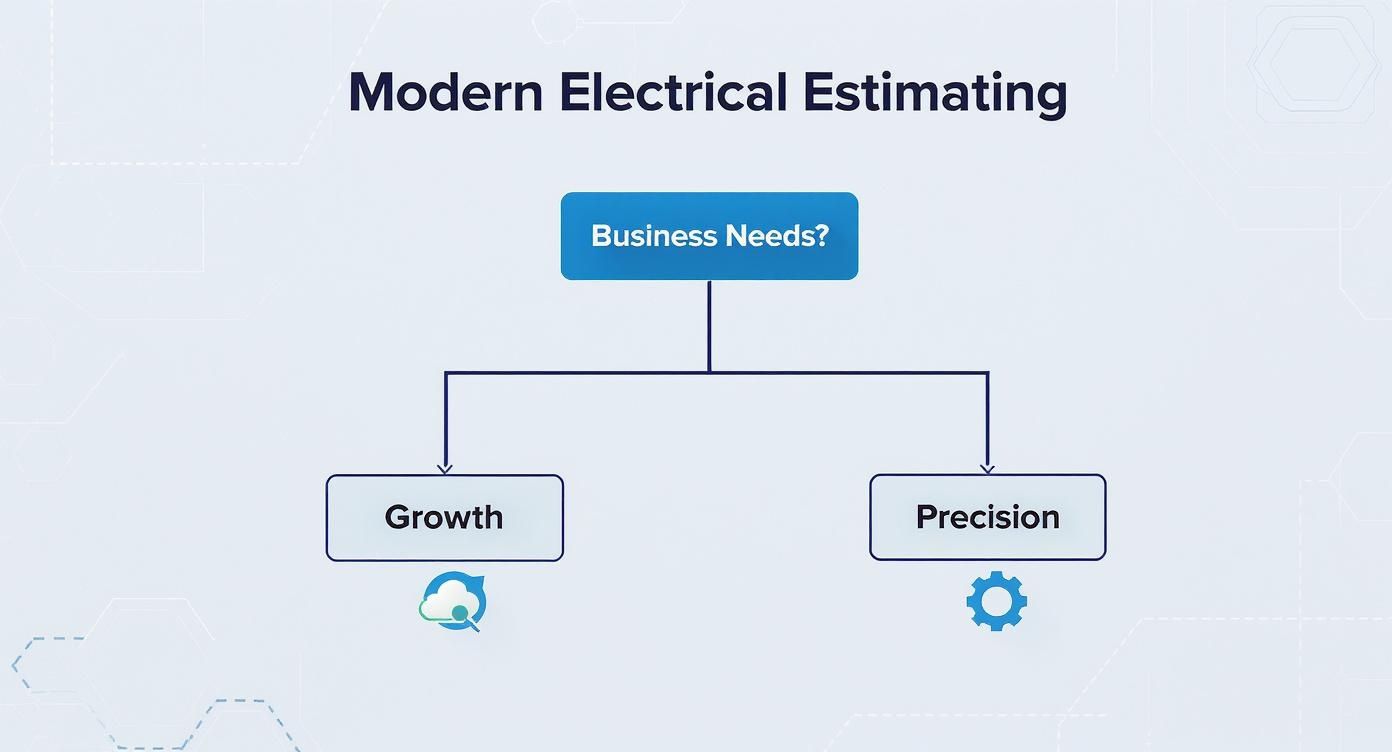
As you can see, there’s a clear fork in the road. Businesses that live and die by bid accuracy and takeoff speed often gravitate toward specialized tools. But for those looking to scale their entire operation and smooth out the wrinkles from start to finish, an integrated FSM is usually the smarter play.
The Power of Specialized Estimating Software
Standalone estimating software is engineered for one job: helping you win more bids with absolute precision. Think of industry mainstays like McCormick Systems and ConEst IntelliBid. These platforms have been around for a long time, and it shows in their incredibly detailed electrical databases and powerful digital takeoff features.
These tools are the perfect fit for contractors tackling large, complex commercial projects. When a single mistake on a bid can wipe out your entire profit margin, you need this level of detail. They’re the digital equivalent of a high-powered microscope, designed to analyze blueprints, count every last fixture, and apply exact labor units with surgical accuracy.
Real-World Scenario: A Large Commercial Bid
Let's say you're bidding on a new multi-story office building. It’s a beast of a project with thousands of fixtures, intricate conduit runs, and specialized wiring. A standalone tool lets your estimator:
- Perform rapid digital takeoffs straight from PDF or CAD files, automatically tallying every outlet and switch.
- Use pre-built assemblies for common installations, making sure no small part is forgotten.
- Apply hyper-specific labor units based on NEC standards and your own historical job data.
Here, the software’s sole purpose is to produce the most profitable and competitive bid possible. After you win, that project data usually gets exported and manually entered into a different system for project management or accounting.
Key Differentiator: The strength of standalone tools is their unmatched depth during the bidding phase. They are masters of granular detail, complex calculations, and deep, trade-specific databases that are non-negotiable for high-stakes commercial work.
While powerful, this laser focus also creates a pretty big gap in your workflow. The bid data doesn't just magically appear in your scheduling, dispatching, or inventory systems. This creates data silos and forces your team to do a lot of manual re-entry.
The Advantage of Integrated FSM Platforms
Integrated FSM platforms, like our own TackonFSM, look at estimating from a totally different angle. For them, the estimate isn't the finish line—it's the starting pistol for a seamless workflow. While they have solid estimating and takeoff tools, their real magic is in what happens after the client gives you the green light.
These systems are built for service-heavy businesses and contractors juggling a high volume of jobs. When operational efficiency matters just as much as bid accuracy, this is where they shine. They connect everyone—from sales and estimating to dispatch and accounting—on a single, unified platform.
Real-World Scenario: A Residential Service Company
Picture an electrical contractor managing dozens of service calls and small-to-medium installs every week. With an integrated FSM like TackonFSM, their day-to-day looks like this:
- Create the Estimate: An estimator in the office or a tech in the field quickly builds a professional quote using a mobile-friendly price book.
- Customer Approval: The customer gives their approval with an e-signature right on a tablet or through a link in their email.
- Instant Conversion: With a single click, that approved estimate becomes a live work order.
- Automated Next Steps: The system automatically checks if the needed parts are in stock, reserves them, and puts the job on the dispatch board for scheduling.
- Seamless Invoicing: Once the job's done, the original estimate data flows directly into an invoice, which is ready for payment in the field.
This connected process gets rid of the administrative headaches that slow down so many contracting businesses. No more manually creating work orders, calling the shop to check on parts, or retyping line items into QuickBooks.
Feature Deep Dive Standalone vs Integrated FSM Solutions
The right tool really comes down to your business priorities. This table breaks down how each type of software tackles key functions and what that means for your actual workflow.
This table compares the capabilities of specialized estimating software against an all-in-one FSM platform like TackonFSM, focusing on workflow efficiency and business impact.
| Feature Area | Standalone Estimating Software | Integrated FSM Software (e.g., TackonFSM) | Workflow Advantage |
|---|---|---|---|
| Data Flow | Data is siloed in the estimating department. Requires manual export to other systems. | Estimate data flows automatically into work orders, scheduling, inventory, and invoicing. | Integrated FSM: Eliminates double entry and ensures data consistency from bid to final payment. |
| Mobile Access | Often limited or non-existent; designed for desktop use by dedicated estimators. | Robust mobile apps let techs create, adjust, and get approvals for estimates on-site. | Integrated FSM: Empowers field teams to close sales faster and adapt to change orders in real time. |
| Inventory Link | No direct link to real-time inventory. Material lists are generated but not synced. | Estimates can pull parts directly from a live inventory database, showing real-time stock levels. | Integrated FSM: Prevents selling out-of-stock parts and reserves materials the moment a job is approved. |
| Business Scope | Optimized exclusively for the pre-construction or bidding phase of a project. | Manages the entire project lifecycle, from initial customer contact to final payment and reporting. | Integrated FSM: Provides a complete 360-degree view of job profitability and operational efficiency. |
In the end, the choice boils down to your biggest bottleneck. If your main challenge is cranking out incredibly detailed bids for massive projects, a specialized tool is probably your best bet. But if your growth is being choked by administrative drag, communication gaps, and clunky workflows, an integrated FSM offers a far more complete solution.
For most growing electrical contractors, the best electrical estimating software is one that does much more than just estimate. It's a system that unites your entire operation, turning a winning bid into a profitable, smoothly-run project without all the manual busywork.
Integrating Estimating Software Into Your Workflow
Bringing new software into your business is a lot more than just a purchase—it's a fundamental change to how you operate. Even the best electrical estimating software is useless if it doesn't fit naturally into your daily operations. A successful rollout needs a clear plan that connects the new tool with the systems and processes your team already uses.

Think of the software as the central hub for all your project data. The goal is to get away from estimates living in isolated spreadsheets and create a single, unbroken stream of information from the initial bid all the way to the final invoice. This is what separates efficient, scalable businesses from those bogged down in administrative chaos.
Connecting Estimating to Core Business Systems
Modern electrical contracting isn't just about winning bids; it’s about making sure everyone is on the same page and working with consistent data through every phase of a project. For that to happen, integrating your estimating tool with other critical systems isn't just a "nice-to-have"—it's a necessity.
A huge trend we're seeing is the link between estimating tools and Building Information Modeling (BIM). This connection lets estimators pull incredibly accurate material counts and measurements directly from a project's digital blueprint. It dramatically cuts down on manual takeoff errors and makes collaborating with architects and engineers much smoother. This is all part of a larger move toward cloud-based tools that give you mobile access and real-time updates, which you can read more about in these electrical software market trends on verifiedmarketresearch.com.
When your systems talk to each other, your estimate goes from being a static document to a living project blueprint. This connection breaks down the data silos that lead to costly mistakes and frustrating delays.
Here are the key integration points to focus on:
- Accounting Software: When you link your estimating platform to something like QuickBooks or Xero, you automate your invoicing. An approved estimate can instantly become a professional invoice without anyone having to re-type a thing. This means fewer errors and faster payments.
- Project Management Tools: Syncing with your project management software automatically pushes the materials and labor hours from your bid into the project plan. Your team gets a clear roadmap from day one, without any confusion.
- Inventory Management: This is where the real magic happens. When an estimate gets the green light, the system can automatically reserve the needed parts from your warehouse or van stock. It will even flag any shortages before they become a problem on the job site.
A Sample Workflow in an Integrated Platform
To see how this works in the real world, let's walk through how an estimate flows inside a modern platform like TackonFSM.
- Estimate Creation & Approval: An estimator in the office or a tech in the field builds a quote using a pre-loaded, mobile-friendly price book. The customer signs off on it right there on a tablet.
- Automatic Work Order Conversion: With a single click, that approved estimate becomes a live work order. All the job details, parts, and customer info are automatically carried over. No double entry.
- Material & Crew Assignment: The work order instantly triggers an inventory check, reserving the parts needed for the job. It then pops up on the dispatch board, ready to be assigned to the right crew based on their location and schedule.
- Invoicing & Payment: Once the job is done, the data from the original estimate flows straight into a final invoice. The tech can take payment on-site, or the system can automatically send the customer a secure payment link.
This kind of automated workflow cuts out countless hours of administrative busywork and closes the communication gaps that so often open up between the office and the field.
Migrating From Spreadsheets or Legacy Systems
Leaving an old system behind can feel like a massive undertaking, but a methodical approach makes all the difference. The trick is to break the process into smaller, more manageable steps and be realistic with your team.
Here are three practical tips to make the transition a success:
- Start with Your Data: Before you do anything else, clean up your existing data. Get rid of old customer info you don't need and standardize your parts list. Most providers, including TackonFSM, offer data migration support to help you import your cleaned-up lists of customers, parts, and prices.
- Train Your Team in Phases: Don't throw everyone into the deep end at once. Start with a small group of "power users" and let them master the new system first. They can then become champions for the software and help train the rest of the team.
- Set a Realistic Go-Live Date: Plan for at least 30-60 days for your team to get comfortable, transfer all the data, and run a few test projects. A gradual rollout is far less disruptive than flipping a switch overnight and allows you to iron out any kinks before you fully commit.
Getting the Most Bang for Your Buck with Smart Automation
Investing in top-tier electrical estimating software isn't just an expense—it's a strategic move to boost your profitability. The right platform delivers a real, measurable return by turning slow, manual tasks into fast, automated workflows. This shift hits your bottom line directly by cutting down on mistakes, shortening your bidding cycle, and freeing up your team for more important work.
Think about all the hours your team sinks into counting fixtures on a PDF or double-checking prices against an old spreadsheet. Every single minute spent on that is a direct cost. Smart automation plugs that leak, transforming what was once a time-suck into a an engine for growth.
From Manual Takeoffs to Automated Accuracy
One of the quickest ways you'll see a return is by automating takeoffs from digital plans. Manually measuring and counting every single component on a blueprint is painstakingly slow and, frankly, an invitation for human error. A single slip-up—forgetting a run of conduit or undercounting light fixtures—can wipe out your entire profit margin on a job before it even starts.
Automation takes that risk off the table. Modern software can pull takeoff data directly from digital plans and drawings, which speeds up bid prep and makes sure every component, from conduits to wiring, is counted correctly. This automation not only slashes manual errors but also significantly accelerates your project timelines. For instance, a platform like Method:Field Services is built to integrate directly with popular accounting tools like QuickBooks and Xero. This lets you flip an estimate into an invoice seamlessly and even includes features like e-signatures to get customer approvals locked in faster. You can find more details on these integrations over at method.me.
This kind of precision means you can submit bids with total confidence, knowing your numbers are based on solid data, not a best guess.
Creating a Smooth Financial Cycle
The financial upside doesn't stop once the estimate is approved. Platforms that sync with your accounting software connect your entire financial process, from the initial quote all the way to the final payment. This integration closes the dangerous gaps where data often gets lost or keyed in wrong.
Think about this all-too-common workflow without connected software:
- The estimate gets built in a spreadsheet.
- Once the client says yes, someone has to manually re-enter every line item into the accounting system to generate an invoice.
- Any change order mid-job means updating both systems by hand, doubling the work and inviting errors.
The Takeaway: A fragmented financial workflow is a hidden profit killer. Every minute your team spends on manual data entry is a minute they aren't spending on billable work, and every mistake risks under-billing a client or sparking a frustrating payment dispute.
An integrated system seals those cracks. When your estimate, change orders, and invoices all draw from the same well of data, you ensure everything is accurate and consistent. This translates to getting paid faster, cutting down on administrative headaches, and keeping a crystal-clear, real-time picture of each job's financial health.
The Power of a 360-Degree Project View
At the end of the day, the biggest ROI comes from gaining a complete, 360-degree view of your projects. The best electrical estimating software provides this by linking your initial bid to every action that follows—from tracking change orders and monitoring crew performance to managing material costs as they happen.
When your estimate is tied to your inventory, you sidestep expensive delays because a crucial part is out of stock. When it's connected to scheduling and dispatch, you can be sure the right tech with the right materials is heading to the job site. This kind of operational clarity turns your software from a simple bidding tool into the central nervous system for your entire business, driving efficiency and protecting your profits at every turn.
How to Choose the Right Software for Your Business
Picking the right electrical estimating software isn't just about features—it's about finding a tool that fits how your company actually works. The decision you make today will ripple through your operations for years, impacting everything from bid speed to job profitability. It needs to match your team's size, your project types, and where you plan to be in the future.
To help you cut through the noise, I’ve put together a practical evaluation checklist. Think of it as a framework for looking past the flashy sales demos to see if a platform is a genuine asset or just another monthly bill.
Your Evaluation Checklist
Work through these four key areas. A solid choice isn't just about what the software can do, but how it will actually feel to use it day in and day out.
1. Technical and Deployment Requirements
First things first, let's figure out the technical foundation. Getting this right will immediately narrow your search and save you a ton of time.
-
Cloud vs. On-Premise: Does your team need to pull up plans and numbers from a job site, or is everyone working from a central office? Cloud-based software gives you that "work from anywhere" flexibility, which is a game-changer for collaboration.
-
Mobile Accessibility: Are your techs making on-site adjustments or getting client sign-offs? If so, a solid mobile app with offline capabilities isn't a luxury—it's a must-have, especially for service-focused contractors.
2. Core Functional Capabilities
Now, let’s get under the hood. How well does the software handle the bread-and-butter tasks of an electrical contractor?
-
Takeoff Methods: Can you perform digital takeoffs directly from PDF and CAD files? Look for practical time-savers like one-click counts for fixtures and pre-built assemblies that reflect the kind of work you do most.
-
Database Customization: How easy is it to import your existing parts lists and tweak your labor rates? A rigid database is a dealbreaker. You need the freedom to adjust pricing to keep your bids accurate and profitable.
A critical mistake is choosing a platform with a rigid, unchangeable database. Your pricing is unique to your business, and your software must reflect that to protect your margins on every job.
3. Integration and Scalability
A great tool doesn't live on an island. You need to see how it plays with your other systems and whether it can keep up as you grow.
-
Accounting & BIM Sync: Does it connect seamlessly with your accounting software, like QuickBooks, or support BIM for more complex commercial projects? Manual data entry between systems is a recipe for errors.
-
Vendor Support & Onboarding: What kind of help will you get when it's time to go live? Look into their training process and how they handle data migration. A smooth rollout is key to getting your team on board and seeing a return on your investment quickly. Partnering with a supportive vendor, like TackonFSM, can make all the difference.
Common Questions from Electrical Contractors
When you're shopping for new electrical estimating software, you're bound to have some questions. After years of talking with contractors, we've noticed the same ones pop up time and again. Here are straight answers to the most common queries we get.
How Long Does It Take to Get Up and Running?
This really depends on the software you choose and how big your team is. A simple, cloud-based tool can have you set up in a couple of days for basic tasks.
But a full-scale implementation is a bigger project. You've got to move your customer lists, import your parts database, and get everyone on the team comfortable with the new system. That process can take a few weeks. The key is to find a partner who offers solid onboarding support—it makes all the difference in getting your team to actually use the new tool quickly.
Will This Connect with My Accounting Software?
Absolutely. Most modern platforms are built to talk to each other. The best electrical estimating software will have ready-made integrations with the accounting tools you already use, like QuickBooks, Xero, or Sage.
This is a must-have feature, not a nice-to-have. It gets rid of the soul-crushing task of entering the same data twice and connects your estimate directly to your final invoice. When your systems are integrated, your financial data stays accurate, giving you a real-time pulse on how profitable each job truly is.
A seamless link between your estimating and accounting software is non-negotiable for an efficient business. It saves countless administrative hours and prevents the costly mistakes that arise from manual data re-entry.
What's the Real Difference Between a Standalone Tool and an FSM Platform?
This is probably the most important decision you'll make, as it defines how you'll run your business.
-
Standalone Estimating Tools: Think of these as specialists. They are laser-focused on one thing: creating incredibly detailed bids and doing digital takeoffs. They're built for precision, especially on large, complex bids.
-
FSM (Field Service Management) Platforms: An FSM platform like TackonFSM is the whole package. Estimating is just one piece of the puzzle. It also handles your dispatch, scheduling, inventory, invoicing, and even how you talk to customers.
A standalone tool will definitely make your bids sharper. But an FSM platform redesigns your entire operation from the first call to the final payment, giving you total control and visibility over every single job.
Ready to see how an all-in-one FSM platform can change your workflow for the better? See how TackonFSM connects your estimates to every part of your business. Explore TackonFSM today!