The Top Benefits Of Inventory Management Software For Profitability
We’ve all been there. A technician is halfway through a critical HVAC repair, stuck in a sweltering attic, only to discover the one capacitor they need is missing from the van. This isn't just a minor hiccup. It's a direct hit to your bottom line—it means a second truck roll, a delayed job, and an unhappy customer.
The real benefit of inventory management software is simple: it stops these costly scenarios in their tracks. It gives you real-time visibility and control over every single part, making sure the right item is always in the right place, exactly when you need it.
Stop Losing Money And Start Gaining Control
For any trade business—whether you're in HVAC, plumbing, or electrical—daily operations can feel like organized chaos. You're already juggling service calls, dispatching techs, and managing customer expectations. Throw disorganized inventory into the mix, with parts scattered between the warehouse, a fleet of service vans, and various job sites, and that chaos starts to eat away at your profits.
Trying to track inventory with spreadsheets or paper logs is like trying to navigate a city rush hour with a folded paper map. It’s slow, outdated, and a recipe for expensive mistakes. A part gets used on a job but never makes it to the invoice. A technician wastes an hour driving to a supply house for a component that was sitting in another tech’s van the whole time. These aren't just small leaks; they're a constant drain on your resources.
Think of inventory management software as the GPS for your parts. It’s not just another piece of complicated tech; it's a practical tool built to bring order to the daily scramble. The idea is straightforward: a single, central digital system that gives you a live, accurate picture of every item your business owns.
From Manual Chaos to Automated Control
This kind of system completely changes how you handle your most valuable physical assets. Instead of guessing what’s on a truck, your team knows for sure. Instead of spending hours on manual stock counts at the end of the month, the system updates inventory levels automatically as parts are used on jobs.
This shift from tangled, reactive processes to smooth, proactive control is one of the biggest steps you can take toward running a better operation.
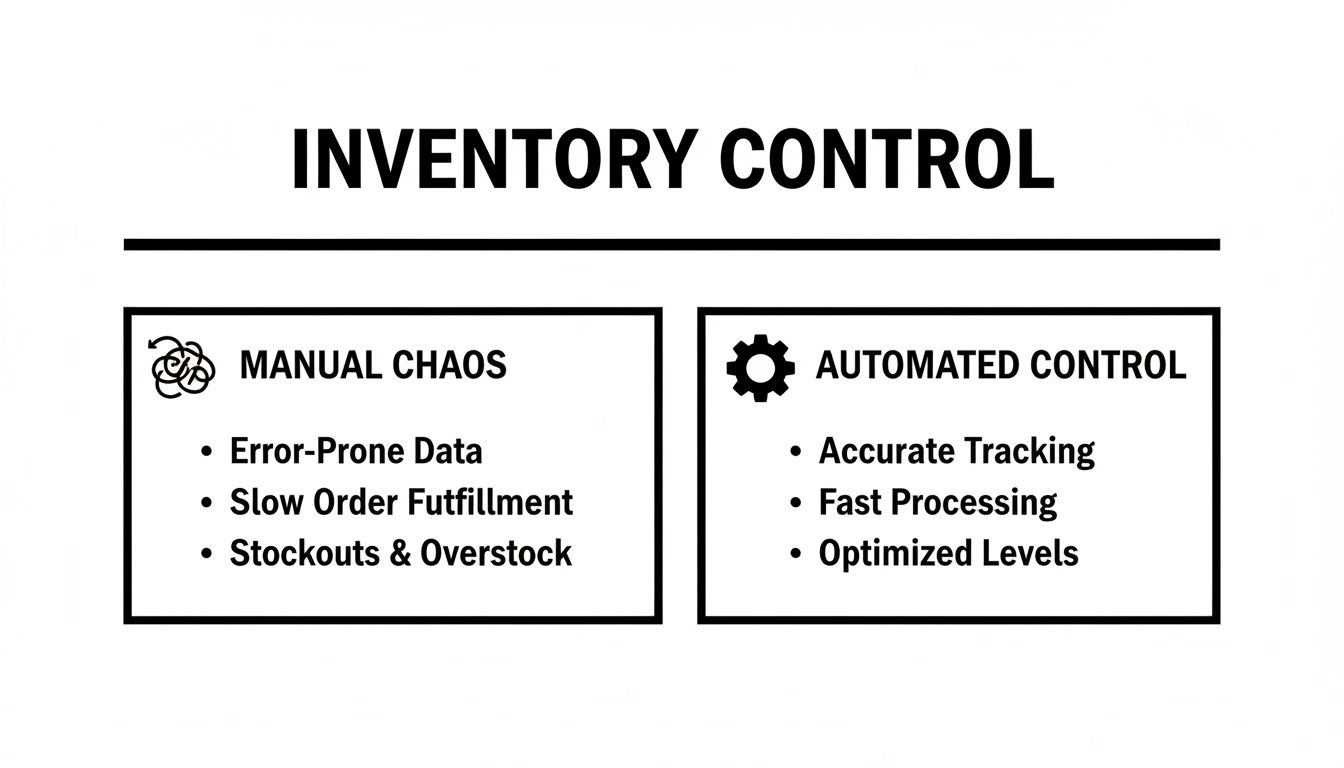
The difference is night and day. Let's break down exactly what that looks like.
Manual Tracking Vs Automated Inventory Management
For a lot of shops, "inventory management" means a cluttered spreadsheet or a clipboard hanging on the warehouse wall. The move to an automated system tackles the biggest headaches head-on.
| Challenge | The Manual Way | The Automated Way |
|---|---|---|
| Real-Time Visibility | Guesswork. You only know what's in stock after a physical count. | Instant updates. You know what's on every truck and shelf, 24/7. |
| Accuracy | Prone to human error, typos, and forgotten entries. | High accuracy. Barcode scanning and automatic updates minimize mistakes. |
| Efficiency | Time-consuming. Hours are wasted on manual counts and tracking down parts. | Fast and simple. Techs can find and log parts in seconds from their phones. |
| Job Costing | Inconsistent. It's easy to forget to bill for small parts, hurting profitability. | Precise. Every part used on a job is automatically tracked and can be added to the invoice. |
| Reordering | Reactive. You order new parts only after you've run out, causing delays. | Proactive. The system sets low-stock alerts, so you reorder before you're empty. |
Switching to an automated system isn't just about getting organized; it's about plugging financial leaks and making your entire team more effective.
Gaining this control means fewer emergency supply runs, more accurate job costing, and a huge reduction in parts that are lost, forgotten, or never billed to a customer. You're turning your inventory from a liability into a well-managed, profit-driving asset.
The impact here is real and measurable. Industry data shows that businesses adopting modern inventory tools often see their order accuracy and fill rates jump by 8–20 percentage points within the first year. That improvement translates directly to more on-time job completions and fewer stockouts, which boosts both your revenue and your reputation. You can find more insights about these market trends online.
Ultimately, the goal is to stop bleeding money on preventable mistakes and start taking the control you need to grow your business profitably. This guide will walk you through the specific benefits that make this shift possible.
Unlock The Financial Benefits Of Smart Inventory Control
Beyond making daily operations smoother, the biggest win with inventory management software is its direct impact on your bank account. It’s not just about tidying up the warehouse; it’s about plugging the financial leaks that quietly drain your profits every single month. Smart inventory control is really just smart cash flow management, turning a chaotic and expensive part of your business into a real asset.

This shift helps solve some of the most nagging money problems in the trades. By giving you a clear, live look at every part you own, the software helps you slash unnecessary spending, capture revenue you were losing, and make smarter, more profitable decisions.
Stop Wasting Money On Carrying Costs
Every single part sitting on a shelf or rattling around in a service van has a hidden cost attached to it. It’s called carrying cost, and it’s like a slow, constant drip draining your company’s finances. This isn't just what you paid for the part; it's also the cost of the space it takes up, the insurance you pay on it, and the risk that it will get damaged or become obsolete before you can ever use it.
Think of it this way: that box of expensive compressors you bought "just in case" isn't an asset—it's tied-up cash. That’s money you could be using for a new marketing campaign, hiring another tech, or upgrading your team's tools. Overstocking handcuffs your working capital, stopping you from using that money to actually grow.
This is exactly the problem inventory management software is built to solve. It gives you the data to stock smarter, not just bigger.
- Optimized Stock Levels: You can finally see which parts are your fast-movers and which ones just sit there, letting you stock only what you really need.
- Reduced Overstocking: The system analyzes your actual usage history, so you can stop buying excess parts based on a gut feeling.
- Lower Storage Needs: A leaner, more efficient inventory often means you don't need as much warehouse space, cutting down your overhead.
The core idea is simple: holding less unnecessary stuff frees up cash. Instead of having thousands of dollars gathering dust on a shelf, that money is in your bank account, ready to be put to work.
And this isn't just a minor tweak. Industry analyses show that businesses who get a handle on their inventory see major results. A recent survey found that companies using these tools cut their excess inventory by 15% to 35%, a massive reduction in the capital they had tied up in parts. You can dig deeper into these inventory management market trends to see the numbers for yourself.
Eliminate Emergency Buys And Minimize Shrinkage
We've all been there. The last-minute, panicked trip to the supply house is a huge money pit. When a tech realizes they're missing a critical part halfway through a job, everything stops. They have to drive to a supplier and often pay a premium just to get the customer's heat back on. These emergency runs absolutely destroy job profitability by adding unbilled labor hours and inflated material costs.
An inventory management system with automated reorder points acts as your early warning system.
- Automated Low-Stock Alerts: The software will ping you the moment a specific part—like a common furnace ignitor—hits its minimum level, whether on a van or in the warehouse.
- Proactive Reordering: This heads-up lets you restock during your regular, planned supplier runs, where you can get your normal, better pricing and avoid those emergency markups.
On top of that, precise tracking helps you fight back against inventory shrinkage—the polite term for parts lost to theft, damage, or just sloppy record-keeping. When every part is scanned out and assigned to a specific job number, you create a clear paper trail. This accountability alone drastically cuts down on the mystery of "where did it all go?" and protects your bottom line from those invisible but costly losses. By getting a grip on your assets, you make sure your profits stay in your business where they belong.
Boost Technician Productivity And Field Efficiency
While smart inventory control has a huge impact on your bottom line, its benefits go way beyond the balance sheet. The real magic happens out in the field. For your technicians, good inventory management is the difference between a frustrating day full of delays and a smooth, professional service call.
When you empower your techs, it’s not just a morale booster. It’s a direct path to getting more done and making more money.
The single biggest time-waster in any trade business is the unnecessary trip. We’ve all been there—a drive back to the shop for a forgotten part or an emergency run to the local supply house. These detours absolutely kill productivity. Each trip adds unbilled hours to a job, burns fuel, and throws your whole daily schedule off track.
This is where having a real-time view of your inventory becomes an absolute game-changer for your team on the ground.
Eliminate Wasted Trips And Unnecessary Delays
Think about this all-too-common scenario. An HVAC tech gets to a customer’s house for an AC repair and diagnoses a bad capacitor. The question is, do they have the right one on the van? The old way meant digging through messy bins for ten minutes or calling the office and hoping someone could check.
With modern inventory software, that whole process takes seconds. The tech just pulls out their phone, opens the app, and sees a complete, accurate list of every part on their specific truck. They know instantly if they have what they need. No guesswork, no crossed fingers.
This one simple check prevents the dreaded second trip. The benefits start adding up immediately:
- Fewer Supply House Runs: Techs can confirm they have the parts before they even leave for a job, which drastically cuts down on those mid-day emergency stops.
- More Billable Hours: All that time your team saves by not driving around is time they can now spend on the next job, bringing in more revenue.
- Better On-Time Arrivals: When the last job doesn't run long because of a parts issue, your techs are far more likely to get to their next appointment on time. Happy customers, happy office staff.
Multi-Location Tracking From The Warehouse To The Van
One of the most powerful things a good inventory system does is track parts across multiple locations. It gets that your inventory isn’t just sitting in one warehouse; it’s a living, breathing ecosystem spread across your entire fleet of mobile stockrooms—your service vans.
This multi-location tracking is what ensures the right parts are in the right place at the right time. For a growing business, this isn't a nice-to-have; it's essential. The software treats each van like its own mini-warehouse with a dedicated stock list, giving you and your team total clarity.
When a technician can instantly see not only what's on their own van but also what’s on a nearby colleague’s truck, they can make smarter decisions in the field. This capability turns your entire fleet into a shared, mobile parts network.
Let's walk through a real-world "before and after" to see the difference.
The Old Way a Service Call Breaks Down
- Arrival: A plumber shows up to a leaking water heater and finds it needs a specific pressure relief valve.
- The Search: They waste 10 minutes digging through their van. No luck. They call the office.
- The Delay: The office staff then spends 15 minutes calling other techs, trying to track down the part.
- The Trip: The plumber has to drive 30 minutes to a supply house, pay a premium for the part, and drive back.
- The Result: The job takes an extra hour of unbilled time, the customer is left waiting, and the job’s profitability tanks.
The New Way With Inventory Software
- Arrival: The plumber diagnoses the same issue.
- The Check: They pull out their phone, see the part isn't on their van, and tap a button.
- The Solution: The app shows another tech is finishing a job just two miles away and has the exact valve needed.
- The Fix: A quick call coordinates a hand-off. The part is in hand in 15 minutes.
- The Result: The job gets done efficiently, the customer is impressed with the quick fix, and the company's first-time fix rate goes up.
This ability to improve your first-time fix rates is one of the most important metrics for any service business. When you solve the problem on the first visit, you create a happy, loyal customer and maximize your profit on every single job. The right inventory software, like the tools built into TackonFSM, is what makes that happen consistently.
Deliver Superior Service and Build Customer Trust
Let's be honest, beyond the spreadsheets and balance sheets, what really grows a trade business is trust. In this industry, your reputation is everything. And a huge part of earning that trust comes down to one simple thing: having the right part, on the right van, at the right time.

This is where a solid inventory management system stops being just an internal tool and becomes a cornerstone of your customer service. It shapes every single interaction, from that first desperate phone call from a homeowner to the final, successful job completion. It’s what makes your business look prepared, professional, and reliable.
Set Positive Expectations from the First Call
A great customer experience doesn't start when your tech arrives. It starts the moment a customer picks up the phone. Picture this: it’s the dead of winter, and a homeowner calls you with a broken furnace. They’re stressed. They're cold. A confident, clear answer at that moment is priceless.
With real-time inventory data at your dispatcher's fingertips, the conversation changes completely. Instead of a vague, "We'll send someone to take a look," they can pull up stock levels on the spot. They can say, "It sounds like a faulty ignitor. We have that part in stock right now, and I can get a technician over to you this afternoon."
That one sentence does so much work for you:
- It builds immediate confidence. The customer instantly feels like they've called a company that knows what it's doing.
- It provides real reassurance. Knowing you have the part eases their anxiety about a long, drawn-out repair.
- It sets accurate expectations. You can give a more reliable service window because you've already eliminated the biggest variable—the hunt for a missing part.
This first impression is what separates the true pros from the rest and starts the customer relationship on solid ground.
When a customer hangs up the phone feeling heard and confident, you have already won half the battle. This initial interaction is your first and best chance to demonstrate that your company is reliable and prepared to solve their problem efficiently.
Avoid Return Visits That Destroy Trust
Nothing kills a customer's confidence faster than the dreaded phrase, "I have to go back to the shop to get a part." From their point of view, it just looks like you're disorganized. They've already taken time off work and cleared their schedule for you, and now you’re asking them to do it all over again.
This isn't just an inconvenience; it sends a clear message that you don't value their time. It makes your company look unprepared, no matter how skilled your technician is. Every one of those unnecessary return trips chips away at the trust you're trying to build.
By making sure your vans are stocked correctly before they leave the shop, inventory management software turns these frustrating return trips into a thing of the past. This has a direct impact on your first-time fix rate, a critical metric for customer satisfaction. In fact, a 73% majority of consumers say that valuing their time is the most important thing a company can do. Solving their problem in a single visit is the ultimate sign of respect.
When customers feel respected, they don't just pay the bill—they leave glowing online reviews and recommend you to their neighbors. That word-of-mouth marketing is the lifeblood of any local trade business. It just goes to show that the real impact of smart inventory management reaches far beyond your warehouse shelves; it builds the trust that grows your business.
Make Smarter Decisions with Real Inventory Data
Trying to manage your inventory with a spreadsheet or, worse, a clipboard and pen is like flying a plane with the windows blacked out. You have a vague idea of where you're going, but you’re relying on gut feelings and old information to make critical business decisions. This is where modern inventory software truly shines—it takes all that scattered parts data and turns it into your business's control tower.
It stops being a simple list of what's on the shelf and becomes the command center for your entire operation. This changes the game from just "tracking parts" to making strategic, data-driven moves that fatten your bottom line. You can finally see the whole story of your inventory's performance, turning raw numbers into real-world intelligence.
This clarity lets you navigate the day-to-day chaos with confidence, knowing every decision is backed by solid proof.
From Guesswork to Growth
Good inventory software gives you reports and analytics that finally answer the tough questions. Instead of wondering which parts are your real moneymakers, the system shows you, plain and simple. It moves you past basic counting and into the world of business strategy, where every piece of data tells you something important.
This is how you start fine-tuning every aspect of your inventory, from what you buy to how you price your jobs.
- Spot Your Winners and Losers: Instantly see which parts—like specific HVAC capacitors or PEX fittings—are flying off the truck and which ones are just collecting dust. This tells you exactly where to invest your cash for the fastest return.
- See Seasonal Trends Coming: Do you always burn through AC contactors starting in May? The software’s history will show you that pattern, so you can stock up before the heatwave hits and never get caught empty-handed.
- Know Your True Job Profitability: When every single part is automatically tied to a work order, you can finally see the exact material cost for every job. This is absolutely critical for setting prices that protect your margins.
It’s the difference between using an old paper map and a live GPS. The map is static and quickly becomes outdated. The GPS, on the other hand, gives you real-time data, alerts you to traffic jams, and finds the most efficient route to your destination. In this business, that destination is profitability.
Negotiate Better Deals and Price with Confidence
When you're armed with this kind of data, you hold all the cards. Imagine walking into a meeting with your supplier and showing them exactly how many units of a specific part you bought last year. That gives you some serious leverage to negotiate better volume discounts. Your purchasing decisions are no longer based on a hunch; they're based on historical fact.
That same confidence carries right over to how you price your services. When you know the precise cost of every screw, fitting, and component on a job, you can build estimates that guarantee you hit your target profit margin. No more accidentally underbidding a big install because you forgot to account for all the small, miscellaneous materials.
Getting access to this level of insight is easier than ever. Cloud-based software has made these powerful tools affordable for small and medium-sized businesses. Instead of a massive upfront investment, it’s a predictable monthly operating expense. This is a big reason why you can find more detailed info on the market trends in inventory software showing such rapid adoption.
At the end of the day, it's about turning information into action. With a system like TackonFSM, the benefits of inventory management software are about much more than just knowing what you have. It’s about knowing what to do next.
Frequently Asked Questions

Thinking about inventory software is a great start, but I get it—you’ve got questions about how it all works in the real world. Taking on a new tool is a big decision, and you need straight answers before you jump in. This section tackles the most common questions we hear from trade business owners like you.
We'll cut right to the chase on things like cost, complexity, and how these systems actually hold up out in the field. Let's dig in.
Is Inventory Software Too Complex For My Small Business?
That’s probably the number one concern I hear, and the answer is a hard no. Modern systems are built for the daily grind of a trade business, not for some massive Amazon warehouse. The whole point is to give you a simple, user-friendly tool that actually solves problems instead of creating new ones.
Think of it this way: the goal is to make your life easier. For your dispatcher, that means a clear dashboard showing what's in stock. For your techs, it’s a mobile app that’s as easy to use as anything else on their phone.
Your daily tasks get a lot simpler and way more accurate. A tech scanning a part’s barcode to log it as "used" takes two seconds and kills the chance of human error. It’s a huge step up from scribbling on a notepad or trying to remember to update a clunky spreadsheet back at the shop. The initial setup takes a little effort, but the time you save later is more than worth it.
How Does The Software Actually Work On A Service Van?
This is where you really see the magic happen. A good inventory system treats every one of your vans like its own mini-warehouse on wheels. This is a huge deal because it gives you a crystal-clear view of the parts closest to your jobs.
When a tech needs to use a part, the process couldn't be simpler:
- They open the mobile app.
- They scan the part's barcode or just pick it from their van’s inventory list.
- The system instantly updates your master stock count in real-time.
That one simple action sets off a domino effect. The part is automatically logged against that specific job, which means it gets added to the customer’s invoice. You’ll never lose money again on parts that were used but forgotten.
The best systems also act as a lookout for you. You can set minimum stock levels for critical parts on each truck. When a tech uses the last furnace ignitor, the software can automatically send an alert to restock, preventing a parts run on the very next call.
This turns your fleet from a bunch of disorganized trucks into a smart, connected network of mobile stockrooms.
What Is The Real Cost And Is It A Good Investment?
Most modern inventory software runs on a subscription—what the tech world calls Software as a Service (SaaS). This is a massive win for small businesses because you don't have to drop a ton of cash on software licenses and servers upfront. Instead, you pay a predictable monthly or annual fee that just becomes a regular operating expense.
The return on that investment (ROI) is huge, and it comes from a few different places. You start seeing the payback almost immediately because the software stops the bleeding:
- Lower Carrying Costs: You’re not tying up cash in parts that just collect dust on a shelf.
- No More Lost Revenue: Every single part gets billed because it’s tracked from the van to the invoice.
- More Efficient Techs: Fewer emergency trips to the supply house mean more time on billable jobs.
- Higher First-Time Fix Rates: Getting the job done on the first visit makes you more profitable and keeps customers happy.
Most business owners find the software pays for itself surprisingly fast. It works by plugging all those small, steady financial leaks that really add up over a year.
Can Inventory Software Integrate With My Accounting Tools?
Absolutely, and you shouldn't even consider a system that doesn't. A seamless connection to accounting software like QuickBooks is non-negotiable for any good field service management platform. This is what connects what’s happening in the field to what’s happening in your bank account.
Here’s a practical example. When you buy new parts, the data syncs from your inventory system to your accounting software, keeping your books accurate. Then, when a tech uses one of those parts, it’s added to the invoice in your field service app.
That final invoice data is then pushed directly into QuickBooks. For your office team, this is a lifesaver. It completely gets rid of the mind-numbing task of entering the same information twice. Not only does it save a ton of admin time, but it also gives you a perfectly accurate, real-time picture of your job costs, profitability, and overall financial health.
Ready to see how this all comes together in the real world? TackonFSM builds powerful, easy-to-use inventory control right into its all-in-one platform for scheduling, dispatching, and invoicing. Stop losing money on parts and start gaining control. Explore TackonFSM and start your free trial today.