
Electrician Website Design That Wins Jobs in 2026

A great electrician website does more than just exist online—it becomes your hardest-working, most reliable 24/7 salesperson. It's not a digital business card. It's a machine built to attract new customers, earn their trust instantly, and turn their interest into booked jobs, all while you're out on a call or home with your family.
Your Website Is Your Best 24/7 Salesperson
Think of your website as your most dependable employee. This team member works around the clock, never calls in sick, and perfectly pitches your business to every single person who stops by. It’s your first handshake and your initial consultation, qualifying leads before they ever pick up the phone.
Picture this: a homeowner has a flickering light fixture and needs help, fast. They search online and find two local electricians. The first has a clunky, outdated site that’s nearly impossible to use on a phone. The second has a clean, professional website that clearly shows their services, highlights dozens of five-star reviews, and has a big "Book Now" button right at the top.
Who do you think gets the job? Your website makes the same powerful first impression that a clean, branded van does on the street. It tells people you’re a pro.
Building Trust Before the First Call
Let's be honest—the stakes are high in your trade. You're not just fixing a leaky faucet; you're working with electricity. Homeowners are inviting a stranger into their home to handle a system that, if messed up, could be incredibly dangerous. That’s why they do their homework.
A professional website isn't just about looking good—it's about building immediate credibility. When a potential customer lands on your page, they're subconsciously scanning for signs that you're a legitimate, trustworthy expert. Simple things like displaying your license number, showcasing real customer photos, and having clear service descriptions go a long way.
Today’s customers are researchers. In fact, studies show that 90% of consumers use the internet to find local businesses, and they rarely just pick the first name they see. They’ll check your Google reviews, look at your Facebook page, and absolutely visit your website. If you don't have a strong online hub, you're practically invisible to a huge chunk of potential customers.
To get ahead, it's crucial to learn about strategic website design for electricians that wins more jobs.
To truly understand what makes an electrician's website work, it helps to break it down into its core components. These are the non-negotiable pillars that support a site built for growth.
Core Pillars of a High-Converting Electrician Website
| Pillar | Why It Matters | Key Elements |
|---|---|---|
| Clear Messaging & Trust | Homeowners need to know you're a credible, safe choice. Trust is the foundation of every service call. | License numbers, "About Us" story, team photos, customer testimonials, and clear service descriptions. |
| Local SEO Focus | Your customers are searching for "electrician near me." You need to show up when and where they're looking. | Location-specific keywords, service area pages, Google Business Profile integration, and local citations. |
| Easy Conversion Paths | Don't make people hunt for your contact info. Guide them directly toward booking a job. | Prominent "Click-to-Call" buttons, simple contact forms, and online booking options. |
| Mobile-First Design | Over half of all web traffic is mobile. If your site is broken on a phone, you're losing business. | Responsive layout, fast load times, and thumb-friendly navigation. |
Each of these pillars works together to turn a passive visitor into a paying customer. A great design isn't just about looks; it's about function.
Connecting Design to Business Growth
A thoughtfully designed website has a direct and measurable impact on your bottom line. Every single piece of it, from the navigation bar to the contact form, should be engineered to guide visitors toward one single goal: scheduling a job.
When you get this right, you see real business results:
- More Qualified Leads: Your site starts attracting customers who are actively looking for the exact services you provide.
- Greater Customer Confidence: A professional look and clear trust signals convince homeowners you’re the right expert for the job.
- Predictable, Sustainable Growth: A consistent flow of online leads gives you a reliable foundation to hire more techs and scale your business.
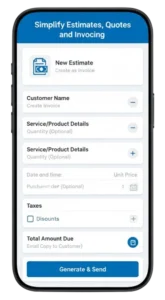
This guide will walk you through the practical steps to build a website that doesn't just look good, but works tirelessly to grow your company. And if you're also looking to improve your quoting process, you might find it helpful to use tools that can simplify estimates and invoicing.
Structuring Your Site to Guide Customers to 'Call Now'
A great electrician website does more than just look professional—it’s a finely-tuned machine designed to guide visitors from a casual search to a booked appointment. Think of your site's layout like a well-organized hardware store. Everything is in its right place, making it easy for customers to find what they need and head straight to the checkout.
On the flip side, a confusing site is like a messy, disorganized garage. When someone has an urgent electrical issue, they don't have time to dig around. If they can't find your phone number or service list in a few seconds, they'll just leave and call the next electrician on Google. A smart, logical structure is your first, best chance to turn a visitor into a paying customer.
Getting someone from a "what's wrong with my outlet?" search to a scheduled job isn't magic. It's a simple, three-step journey that your website needs to support: they research, they build trust, and then they decide to hire.

This shows us that a customer’s decision is a process. Your website has to nail every single step, from the moment they find you to the moment they pick up the phone.
The Blueprint for an Electrician Website
Your site's navigation menu and page layout are the blueprint. Every page needs a clear job to do, working together to answer questions and build a customer’s confidence before they even think to ask.
Here are the absolute must-have pages for any serious electrician's website:
- A High-Impact Homepage: This is your digital storefront. It needs to instantly tell people who you are, what you do, the areas you serve, and why you're the right person for the job. Your phone number should be front and center, along with your best reviews and clear links to your main services.
- Dedicated Service Pages: Don't just throw all your services on one generic page. You need separate, detailed pages for your most important jobs, like "EV Charger Installation," "Electrical Panel Upgrades," and "Emergency Repairs." This is a huge win for SEO and lets you talk directly to customers who know exactly what they need.
- Hyper-Local Service Area Pages: If you work in several towns or even specific neighborhoods, give them their own pages. A page titled "Electrician in Springfield" will rank way better for local searches than just listing "Springfield" in your website's footer. It proves to both customers and Google that you're truly a local expert.
Pages That Build Connection and Drive Action
Beyond just listing services, your site has to feel human. It needs to build a personal connection and make it incredibly simple for someone to get in touch. Two pages are absolutely crucial for this.
First up is your "About Us" page. This is where you tell your story. Are you a family business? A veteran-owned operation? Have you been serving the community for 20+ years? People hire people they trust. Sharing a bit about yourself and your team puts a face to the name and builds a layer of trust that a simple list of services never could.
Your 'About Us' page isn't just a biography; it's a sales tool. It answers the subconscious question, "Do I trust these people in my home?" A compelling story, paired with photos of your actual team, can be the deciding factor for a hesitant homeowner.
Second, you need a "Contact Us" page built for pure speed and simplicity. It should have a dead-simple contact form, your phone number (that’s clickable on a phone!), your email, business hours, and an embedded Google Map. The goal here is to remove every single obstacle standing between a customer and their decision to contact you. Every saved click is another potential lead in your pocket.
Building a Website That Screams 'Trustworthy'
Let's be honest. When a homeowner needs electrical work, they’re nervous. They're not just looking for a service; they're looking for someone they can trust to come into their home and work on a system that, if handled incorrectly, can be incredibly dangerous. In this business, trust isn't a nice-to-have. It’s everything.
Your website is your first handshake, and it sets the tone immediately. A flimsy, outdated site makes a potential customer wonder if your work is just as sloppy. A sharp, professional website, on the other hand, provides instant reassurance that they’ve found a real pro.

Display Your Credentials Loud and Clear
The quickest way to earn a visitor’s confidence is to show them you’re qualified and accountable. These are what we call trust signals, and they need to be front and center—not buried on some forgotten "About Us" page.
Make these credentials impossible to miss:
- License Number: Put your state license number right in your website's header or footer. This is the ultimate proof of legitimacy.
- "Licensed & Insured" Badge: A simple, bold badge in the header instantly answers a customer’s biggest unasked question.
- Certifications: If you hold special qualifications, like being a Master Electrician or a certified installer for brands like Generac or Tesla, show them off. Create a dedicated spot for these logos.
Together, these elements immediately lower a visitor's guard. They show you run a serious business that plays by the rules, which is a massive advantage over the competition.
Putting Social Proof to Work
Your credentials prove you’re qualified, but social proof shows you deliver. It's one thing for you to say you do great work; it’s a whole different ballgame when your past customers are saying it for you. People depend on the experiences of others—in fact, 50% read at least seven reviews before they feel comfortable hiring a business.
Your website is the perfect showroom for your reputation. By strategically placing testimonials and project photos, you transform your site from a static brochure into a dynamic portfolio of success stories that build confidence with every scroll.
So, how do you weave this into your site?
First off, customer testimonials are your best friend. Sprinkle short, powerful quotes from happy clients across your homepage and service pages. A dedicated reviews page is great, but putting a testimonial about a panel upgrade directly on your "Panel Upgrades" page is even better.
Second, show, don't just tell. A project gallery with high-quality "before-and-after" photos is incredibly convincing. It provides concrete proof of your skills, whether you're showing off a neatly wired new panel or a beautifully finished kitchen lighting project.
Finally, for bigger, more complex jobs, consider simple case studies. A quick one-page summary that outlines a customer's problem, your solution, and the great result is a powerful sales tool for landing large-scale projects like commercial wiring or whole-home rewires.
Why Professional Design Matters More Than Ever
The game has changed. The days of relying solely on word-of-mouth are over. With the web design services market expected to reach $61.23 billion in 2025, it's clear that a professional online presence is no longer negotiable for service businesses.
This is especially true for electricians. An astonishing 91% of homeowners now do their research online before hiring a contractor. Your website isn’t just an option; it's your primary battleground for winning new business. To learn more about this trend, you can explore some of the great research available from sources like Figma's research library.
Dominating Local Search and Getting Found on Google
Let's be honest. You can have the most beautiful, trustworthy electrician website on the planet, but it's completely useless if local customers can't find it when they need you most. A slick website that’s buried on page five of Google is like having a brand-new, fully-stocked van with no engine—it looks impressive, but it isn’t going to get you to the next job.
The engine for your website is local Search Engine Optimization (SEO).
Think of local SEO as the digital version of old-fashioned word-of-mouth. It’s how you signal to Google that you're the best, most relevant expert for a homeowner desperately searching for an "emergency electrician in [Your Town]" or "outlet repair near me." Get this right, and you put your business directly in front of people who are ready to hire you, right now.
Finding the Keywords Your Customers Actually Use
The entire foundation of good SEO starts with one simple thing: understanding the exact words your customers use when they search for help. You might call it a "service panel upgrade," but your customer is far more likely to be typing "fuse box replacement" or "new circuit breaker panel cost" into their phone.
The first step is to simply brainstorm all the services you offer. Then, think like a customer and add common locations or problems to those services.
- Service + City: "EV charger installation Springfield"
- Problem + "Near Me": "flickering lights repair near me"
- Urgency + Service + City: "emergency electrician Oakhaven"
These phrases are the raw materials for your website's content. By weaving them naturally into your pages, you’re giving Google a crystal-clear map of what you do and where you do it. If you want to dig deeper, advanced tools from providers like RankMath can give you a serious edge in finding high-value keywords.
On-Page SEO for Your Service Pages
Once you’ve got your list of keywords, it's time to put them to work. This is where your service and location pages transform from simple online brochures into powerful magnets for new business. Each page should be laser-focused on ranking for a specific service you offer.
For instance, your "Electrical Panel Upgrades" page should aim to be the single best resource for anyone in your service area looking for that exact job.
On-page SEO isn't about cramming keywords where they don't belong. It's about building a page that genuinely and thoroughly answers a potential customer's questions. When you provide real value, you naturally signal your expertise to Google and earn a higher ranking as a result.
Your mission is to make every service page a mini-authority on that topic. Talk about your process, explain the benefits, and answer common questions customers have. This strategy doesn't just appease the search engines; it builds trust and shows potential customers you know your stuff.
Your Google Business Profile Is Your Local Billboard
While your website is your digital headquarters, your Google Business Profile (GBP) is your most crucial local billboard. It's that info box that pops up in Google Maps and the local search results, and for many customers, it's the very first impression they'll have of your company. A fully optimized GBP is non-negotiable for any local electrician.
You need to make sure your profile is 100% complete and accurate. Pay close attention to these details:
- Consistent NAP: Your Name, Address, and Phone number must be identical everywhere online, especially on your website and GBP.
- Service Areas: Don't just list your city. Define the specific towns, neighborhoods, and zip codes you serve.
- Services: List out every single service you offer, complete with clear descriptions.
- Photos: Don't be shy! Regularly upload high-quality pictures of your team in action, your clean vans, and finished projects.
- Reviews: Actively ask happy customers for reviews and make a point to respond to them—both the good and the bad. Positive reviews are one of the most powerful signals for local ranking.
Your website and your Google Business Profile are a team. A strong website gives your GBP more authority, and a well-managed GBP sends a steady stream of high-quality local leads straight to your site. For a masterclass on putting all these pieces together, this guide to dominating local search is packed with actionable advice.
7. Turning Clicks Into Scheduled Jobs
Let's be honest. A website that gets tons of visitors but doesn't make your phone ring is just an expensive digital billboard. It might look impressive, but it’s not doing its job. The whole point of your site is to turn a person with a problem into your next scheduled appointment. This is where the magic of "conversion" comes in, and it's what makes a website a true asset instead of just an online brochure.
Your website can't just sit there and look pretty; it needs to actively point visitors in the right direction—booking your services. This is done with smart calls-to-action (CTAs), super-easy contact options, and modern booking tools that make hiring you a no-brainer.
Crafting Calls-to-Action That Actually Work
A Call-to-Action (CTA) is just a fancy term for a button or link that tells a visitor what to do next. Weak, wishy-washy phrases like "Learn More" or "Contact Us" just don't create any urgency. You need strong, clear commands that speak directly to what the customer needs right now.
Think about what your potential customer is feeling. Are they panicked? Are they just planning? Tailor your CTAs to match:
- "Get Your Free Estimate Now": Perfect for the planner who's gathering quotes for a project.
- "Schedule Service Today": Catches the customer who knows they have an issue and just wants it fixed.
- "Call Now for 24/7 Emergency Service": This is your money-maker for high-value, urgent jobs that can't wait.
These aren't just buttons; they're signposts. You need to place them everywhere a customer might make a decision: in your header, after you describe a service, and all over your homepage. Constantly remind them how simple it is to get your help.
Make Getting in Touch Instant and Painless
Imagine a homeowner's lights just went out. The last thing they want to do is go on a scavenger hunt for your phone number. With over 50% of web traffic now coming from phones, making it dead simple for mobile users to call you is essential.
On a mobile site, nothing is more important than a clickable phone number. A customer should be able to tap it and have their phone dial immediately. You want to remove every possible bit of friction between their problem and your solution.
Beyond just a clickable number, take a hard look at your contact forms. Nobody is going to fill out a 15-field questionnaire just to ask about a flickering light. Strip your form down to the bare essentials:
- Name
- Phone Number
- A simple box to describe their issue
It's a simple rule: the easier you make it to contact you, the more people will actually do it. Every extra field is just another excuse for them to leave and call the next electrician on the Google results page.
The Ultimate Conversion Tool: Online Booking
Want to really stand out from the competition? Let customers book a job directly on your website. People are used to scheduling everything online these days, from haircuts to dinner reservations. Offering that same convenience shows you're a modern, customer-first business.
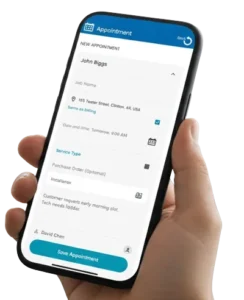
This is where integrating your site with a field service management (FSM) platform like TackonFSM completely changes the game. By embedding a booking portal right on your site, you create a direct pipeline from a visitor's interest straight to your work calendar.

The image above gives you a great visual. That "SCHEDULE NOW" button on the customer's end connects directly to the software your team uses every day. This creates a beautifully smooth experience for the customer and an incredibly efficient, automated system for you.
When a customer books a panel upgrade, for example, the job can instantly pop up on the schedule, complete with all their details. No more manual data entry, no more double-bookings, and no more wasted time for your office staff.
To give you a clearer picture, here’s a quick comparison of the different ways you can turn visitors into jobs on your site.
Website Conversion Element Comparison
| Conversion Element | Customer Benefit | Business Benefit | Best for |
|---|---|---|---|
| Click-to-Call Number | Instant contact, especially in an emergency. Very easy on mobile. | Captures urgent, high-intent leads immediately. | All electricians, but especially those offering 24/7 emergency services. |
| Simple Contact Form | Can reach out after hours or for non-urgent questions without making a call. | Gathers leads 24/7. Allows office staff to respond during business hours. | Businesses that want to capture leads for estimates and non-urgent inquiries. |
| Online Booking Portal | Books a confirmed appointment time instantly, no back-and-forth. Total convenience. | Automates scheduling, reduces admin work, and fills the calendar with zero effort. | Growth-focused electricians who want to maximize efficiency and offer a modern customer experience. |
As you can see, each element has its place, but integrating an online booking system is what truly elevates your website.
It's a powerful combination: clear CTAs get their attention, easy contact options remove any hurdles, and an integrated booking system turns your website into an employee that works 24/7 to fill your schedule. And if you're serious about getting your operations in order, it's worth seeing how a field service scheduling software that saves time can be the final piece of the puzzle.
Frequently Asked Questions About Electrician Website Design
Building a website for your electrical business brings up a ton of questions. I get it. You're wondering about the cost, what it really needs to do, and whether the investment will actually pay off with more calls and better jobs.
It's a lot to think about. So, let's cut through the noise and get you some straight answers based on what works in the real world for contractors just like you.
How Much Should an Electrician Website Cost?
The honest answer is: it depends. The price tag for a new website can swing wildly, but you can generally think about it in three different lanes. What you spend is a direct trade-off between your own time, the site's lead-generating power, and the level of professional polish.
- DIY Builders ($300 – $600/year): Going with a platform like Squarespace or Wix is the cheapest way in. But be warned: what you save in cash, you'll spend in time. These template sites often end up looking generic and rarely have the built-in SEO horsepower to actually rank in local searches and bring in jobs.
- Freelancer or Small Agency ($3,000 – $8,000): This is the sweet spot for most growing electrical businesses. In this range, you're paying for a professional team to build a site that not only looks great on a phone but is also structured to get found on Google. This price should cover a custom design, foundational SEO, and content that speaks directly to your customers.
- Advanced Custom Site ($10,000+): If you're a larger company with multiple crews, you might need more firepower. This budget covers things like a deep integration with your scheduling software, dozens of specific service area pages, or a huge library of project photos and articles.
Remember, a good website isn't an expense—it's a machine for generating work. A professionally built site that brings in just two or three high-value jobs, like a panel upgrade or a generator install, can easily pay for itself in the first few months.
The right budget is one that balances the upfront cost with the very real return you'll get from a steady flow of quality leads.
What Are the Must-Have Features for My Website?
A website that just looks nice is a missed opportunity. To actually turn visitors into paying customers, your site needs a few non-negotiable features working together.
- Mobile-First Responsive Design: Most of your customers will find you on their phone, probably standing in front of the problem. Your site has to be dead simple to use on a small screen, with text that’s easy to read and buttons you can tap without zooming.
- Prominent Trust Signals: Don't make people hunt for your credentials. Your license number, "Licensed & Insured" status, and any key certifications need to be front and center. This is the fastest way to build credibility.
- Click-to-Call and Simple Forms: Your phone number should be everywhere and clickable on mobile devices. When you do ask for information via a form, keep it short. Name, phone, and a quick description of the problem is all you need to start the conversation.
- Specific Service and Location Pages: This is a big one. You need dedicated pages for each service (like "EV Charger Installation") and for each city you work in. This is absolutely critical for showing up in local Google searches.
- High-Quality Photos and Reviews: Show, don't just tell. A gallery of your best work and a steady stream of real customer reviews sprinkled throughout the site are your most powerful sales tools.
A fantastic bonus feature is tying your site directly to your scheduling. Integrating an online booking tool from a system like TackonFSM is a true game-changer for both you and your customers.
How Can I Get My Website to Show Up on Google?
Getting your website on the first page of Google isn't about some secret trick. It's a process called Local SEO, and it boils down to proving to Google that you are a legitimate, trusted, and active electrician in your service area.
First things first: you have to claim and completely fill out your Google Business Profile. This is the info box that shows up in Google Maps and local search results. Treat it as your single most important piece of online real estate.
Next, your website itself has to be built for SEO from day one. This means your pages, titles, and text should include the exact phrases your customers are searching for, like "emergency electrician in [Your City]" or "outlet repair near me."
A huge part of Local SEO is creating individual, detailed pages for every service and every town you cover. A page dedicated specifically to "Lighting Repair in Springfield" has a much, much better chance of ranking for that search than a single, generic "Services" page ever will.
Finally, nothing tells Google you're a trustworthy business more than a consistent flow of positive customer reviews on your Google profile. Make a habit of responding to every review—good or bad—to show you're engaged and you care.
Can I Integrate My Website with Field Service Software?
Yes, and you absolutely should. This is where your website goes from being a simple online brochure to a core part of your business operations. When you connect your site to a field service management (FSM) platform, you build a seamless bridge between your marketing and your day-to-day work.
For example, you can embed an online booking calendar from your FSM software right on your website. When a customer picks a time slot, the job is instantly created on your dispatch board, ready to be assigned to a technician.
Think about that—no more phone tag, no more manually typing customer info from a web form into another system, and no more double-booking. It gives customers the modern, convenient experience they expect and saves your office staff countless hours.
Ready to connect your website to a powerful operational backend? TackonFSM integrates seamlessly to turn online leads into scheduled jobs, automatically. See how you can streamline your business and provide a superior customer experience by learning more at https://www.tackonfsm.com.