
Calculating billable hours: Boost profits for HVAC, plumbing & electrical.

For any service business, accurately calculating billable hours is the bedrock of profitability. It’s the simple act of tracking the time your team spends on a job and turning those minutes and hours into revenue. Get it right, and you thrive. Get it wrong, and you’re leaving money on the table.
Why Mastering Billable Hours Is Critical for Profit
If you run an HVAC, plumbing, or electrical business, you know that managing time is about more than just sending a final bill. It’s the absolute foundation of your company's financial health. Without a rock-solid system, you fall victim to "billable hour leakage"—a silent profit killer where all those little untracked moments add up to thousands of dollars in lost income each year.
Think about a single technician's day. Maybe they spend an extra 10 minutes on-site talking the client through the repair, another 15 minutes driving to the supply house for a specific part, and 5 more minutes typing up notes in the truck. That’s 30 minutes of work that often goes unbilled. Now, multiply that across a team of five technicians every single day. You’re suddenly looking at over 50 hours of lost revenue every month.
The Real Cost of Guesswork
Relying on your team's memory or scribbled notes at the end of the day is a recipe for disaster. We've all been there, trying to piece together a timeline from memory. The numbers don't lie: research shows that waiting just until the end of the day to log time can cause you to lose 10% of your billable hours.
Wait until Friday to fill out the week's timesheets? That number balloons to a shocking 50% loss. This isn't just lost time; it’s a direct hit to your job profitability and makes it nearly impossible to quote future work with any confidence.
The difference between a thriving trade business and one that’s always struggling often comes down to one thing: how effectively you capture and calculate every single billable hour. Every minute truly counts.
From Billable Time to Business Intelligence
Getting your billable hours right does more than just plug revenue leaks. It gives you powerful data on your team’s efficiency, which we call the billable utilization rate. This simple metric shows you what percentage of a technician’s paid time is actually generating income for the business.
A healthy utilization rate has a direct impact on your entire operation:
- Accurate Job Costing: You finally see the true labor cost for every single job, no more guessing.
- Smarter Quoting: You can build estimates that actually protect your profit margins because they’re based on real data.
- Clearer Team Performance: It becomes easy to spot your most efficient techs and identify where a little extra training might be needed.
Making the switch from guesswork to a data-first approach is the first step toward building a more resilient and profitable business. As we’ll explore, the right field service management software is what makes this transition possible, giving you the tools to grow with confidence.
What Counts as Billable Time (and What Doesn't)?
One of the fastest ways to leak profit in a trade business is through inconsistent billing. If one tech bills for a supply run and another doesn’t, you’re not just confusing customers—you're making your job profitability completely unpredictable. The very first thing you need to do is get everyone on the same page with a clear, company-wide policy.
Think of it this way: billable time is any activity spent working directly for a customer that gets their job done. It’s not just "wrench time." It's any task essential to solving that specific customer's problem.
Everything else is non-billable time. This covers all the internal stuff that keeps your business running but isn't tied to a specific invoice. This is your cost of doing business, and it should be baked into your overhead calculations and your hourly rate, not billed ad-hoc.
Billable vs Non-Billable Activities for Trade Contractors
To eliminate the guesswork for your technicians, you need to get specific about the common tasks they perform every day. Here’s a breakdown of typical activities for HVAC, plumbing, or electrical contractors, categorizing them to help you build a standard policy.
| Activity | Category (Billable/Non-Billable/Conditional) | Justification and Real-World Example |
|---|---|---|
| On-site troubleshooting & diagnostics | Billable | This is the expert work the customer is paying for. Example: An electrician spending 30 minutes tracing wires to find the source of an intermittent outage is performing a core, billable service. |
| Direct repair or installation work | Billable | This is the classic "tools on" time. Example: A plumber spends 2 hours cutting pipe and soldering fittings for a new water heater installation. |
| On-site customer communication | Billable | Explaining the diagnosis, walking through repair options, or demonstrating the finished work is part of the job. Example: An HVAC tech spends 15 minutes showing a homeowner how to use their new smart thermostat. |
| Travel to the customer's site | Conditional | This is a major gray area. Many contractors bill for travel from the shop or from the previous job. Example: Your policy might state that travel is billed as a flat-rate "trip charge" or that the clock starts when the tech leaves the previous job. |
| Parts or materials run | Conditional | If a part is needed specifically for the current job and isn't standard truck stock, the time to get it is often billable. Example: A tech has to drive to a supply house for a specific furnace control board. That 45-minute round trip is a direct result of that customer's repair needs. |
| Daily van restocking | Non-Billable | This is an internal operational task. Example: The tech spends 20 minutes at the shop each morning loading a new water heater and common fittings. |
| Team meetings & formal training | Non-Billable | This is an overhead expense that develops your team but isn't for a specific customer. Example: All technicians attend a mandatory 1-hour weekly safety meeting. |
| Quoting or estimating a new job | Non-Billable | Typically, time spent preparing a quote is a cost of sales, not billable to the potential customer. Example: A lead tech spends 90 minutes doing a walkthrough and preparing a detailed estimate for a full-house rewiring project. |
Categorizing these activities removes ambiguity and ensures every hour is accounted for correctly—either on an invoice or in your overhead calculations.
This decision-making process is constant. For every minute of a tech's day, you have to decide: does this become a line item for the customer, or is it a cost your business absorbs?

What About the Gray Areas?
The "conditional" items are where most businesses get tripped up. A trip to the supply house is a perfect example. Since that trip is only happening because of that customer's specific issue, it’s fair to bill for it. The real question is how. Do you bill it at your full hourly rate? A reduced rate? Or a flat fee?
The key isn't finding one "right" answer that fits every single scenario. The goal is to create a consistent, transparent policy that you can stand behind. Your team needs to know the rules, and your customers deserve to understand what they’re paying for.
When you define these rules up front, you build a reliable system for calculating billable hours. This standardization means every tech tracks their time the same way, which directly leads to more accurate job costing, fairer invoicing, and a much healthier bottom line.
Proven Methods for Tracking Every Billable Minute

If your technicians are still jotting down times on a notepad or trying to piece together their week on a Friday afternoon, you are absolutely leaving money on the table. Relying on memory or paper-based timesheets is a guaranteed path to lost revenue. The goal isn't just to track time; it's to build a rock-solid system that captures every single billable moment without fail.
The financial stakes here are higher than most people think. We've seen industry data showing that businesses can lose up to 15 percent of their billable hours just from sloppy tracking and poor documentation. This "time leakage" happens when a tech does a quick, undocumented fix or when communication between the field and the office simply breaks down.
Moving Past Manual Spreadsheets and Basic Clocks
The first step for many shops is graduating from paper to a shared digital spreadsheet or a standalone time clock app. It feels like progress, but honestly, these methods are still full of holes. They depend entirely on manual entry, which means they are just as prone to human error and still require a technician to remember to start and stop a timer.
More importantly, these basic tools lack critical context. A simple timestamp doesn't tell you which job the tech was on or what they were doing. This makes accurate job costing a nightmare and piles on administrative work as your office staff tries to match random hours to the right customer invoices.
The Real Advantage: Integrated FSM Software
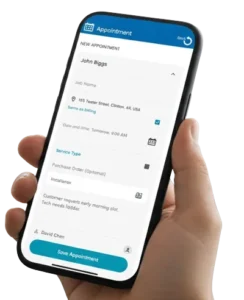
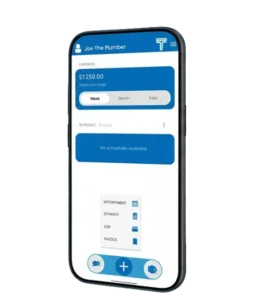
This is where a dedicated field service management (FSM) platform changes the entire game. Instead of juggling a separate, disconnected time-tracking tool, an FSM like TackonFSM weaves time tracking directly into your technician's daily workflow.
Using a mobile app, your techs can effortlessly:
- Clock in and out for their shift to track total paid hours.
- Start and stop job timers with a single tap the moment they arrive and leave a customer’s site.
- Log time against specific tasks within a job, such as "Diagnostics" or "Part Installation."
- Pause the job timer for non-billable activities like a lunch break or an unplanned run to the supply house.
By building time tracking directly into the job itself, you remove the burden of memory from your technicians. The app becomes the single source of truth, ensuring every minute spent working for a customer is recorded accurately and automatically.
This automated process delivers much more than just accurate billing. It feeds precise labor data straight into your job costing reports, giving you a live look at profitability. You can see instantly if a job is creeping over its estimated hours, allowing you to make smart decisions on the fly. This level of precision, found in tools like our field service scheduling software that saves time, is the real key to mastering your billable hours.
Handling Tricky Scenarios Like Travel, Admin, and Overtime
Once you move past the straightforward work done on-site, calculating billable hours gets a lot murkier. Things like travel, paperwork, and overtime are where profits can quietly bleed out if you don't have a firm, consistent policy. Nailing down the rules for these situations is one of the most important things you can do to protect your margins.
Travel time is probably the biggest headache for any field service contractor. Without a clear billing strategy, you’re essentially letting your technicians give away valuable hours just sitting behind the wheel. I've seen it happen time and again. The good news is, you have a few solid models to choose from.
Smart Strategies for Billing Travel Time
A popular approach is to charge a flat-rate trip fee. This is just a single, upfront charge to cover the cost of getting a technician to the job, no matter where they're coming from. It's simple for customers to understand and ensures you cover your basic costs for every single truck roll.
Another way to go is portal-to-portal billing. Here, the clock starts the moment a tech leaves the shop (or their last job) and only stops when they get back. This is the most precise way to bill for every minute spent, but it demands total transparency. You have to make sure the customer knows what that labor charge actually includes.
A third option is to simply absorb travel costs by baking them into a slightly higher hourly rate. While this definitely simplifies your invoices, it can make your rates look a little steep on paper. You also run the risk of losing money on jobs that are farther out than usual.
Key Takeaway: How you handle travel directly hits your bottom line. Whether it's a trip fee, portal-to-portal, or absorbed costs, the real key is consistency. Pick a method, write it down, and stick to it for every job.
Of course, the best travel time is no travel time. Modern software can make a huge dent in the hours you even need to bill for. Route optimization research has shown that smart scheduling can slash drive time by around 16 percent. That efficiency boost means less time driving and more time working, often freeing up a tech to squeeze in another service call each day. You can explore the full research on how field service metrics like travel time impact productivity.
Accounting for Admin Tasks and Overtime
It’s not just driving that can eat into your day. Technicians often have to handle necessary admin tasks right there in the field—filling out digital work orders, snapping photos of the job, or putting together a quote for future work on a tablet.
Here's a good rule of thumb: while time spent creating a new quote is usually non-billable, the time spent documenting the completed job is a required part of the service. That time should absolutely be captured as billable. The best practice is to have techs keep the job timer running until all their on-site documentation is wrapped up.
Finally, you absolutely must have a clear policy for overtime. This really comes down to two things:
- Compliance: You need to know your local and federal labor laws inside and out when it comes to paying your employees for overtime.
- Billing: You have to decide how you're going to pass that extra cost on to the customer. Many contractors bill overtime at a premium rate (like 1.5x the standard) to cover the higher labor expense.
Defining these policies isn't just about crunching numbers correctly. It's about staying compliant and, most importantly, protecting your company's profitability on every single job you do.
Turning Tracked Hours into Profitable Invoices

Getting your time tracking down to a science is a huge win. But that’s only half the job. The real challenge is turning those carefully logged hours into professional, easy-to-understand invoices that clients actually pay on time.
Your invoicing process is the final, crucial link between finishing a job and seeing the money hit your bank account. It’s where your billable hours system really proves its value. In fact, mastering a few simple strategies to improve cash flow is a game-changer, and it all starts with the invoice. A clear, accurate bill can be the difference between getting paid next week and chasing a payment for the next month.
Crafting the Perfect Labor Charge
So, how should you actually present labor charges on an invoice? This is a common sticking point for contractors. Do you just list one lump sum for labor, or do you break it down? The best answer really depends on your pricing model for that specific job.
- Single Line Item: This approach is perfect for flat-rate jobs. The customer already agreed to a total price upfront, so the invoice can simply state "Labor for water heater installation" with a single amount. It’s clean, simple, and gives the client exactly what they expected.
- Detailed Breakdown: For time-and-materials work, transparency is your best friend. Listing "Diagnostic Time: 1.0 hr" and "Repair & Installation: 2.5 hrs" separately shows the customer exactly what they're paying for. It builds trust and stops questions before they even start.
The goal of any invoice is to be so clear and logical that the customer never has a reason to question it. Vague descriptions like "Labor" invite disputes, while specific entries like "Time to replace faulty capacitor" build trust.
From Tracked Time to Paid Invoice Automatically
Let's be honest—doing all of this by hand is a massive administrative headache. Manually pulling hours from a technician's timesheet, cross-referencing parts used, and building each invoice from scratch is painfully slow. It's also a process that’s wide open to expensive mistakes.
It’s just too easy to forget to bill for a small part or miscalculate the total labor by 15 minutes. Those little errors add up fast and eat directly into your profit margin.
This is exactly where an integrated Field Service Management (FSM) platform like TackonFSM becomes essential. It’s designed to connect all the dots for you, automatically.
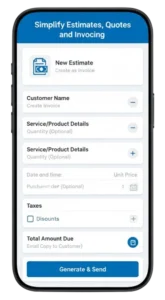
When your technician tracks time and logs parts on their mobile app right from the job site, that information is instantly synced back to the office. With just a few clicks, all those billable hours and materials are pulled directly into a professional invoice. No more manual data entry. No risk of forgetting a part. No more second-guessing your labor calculations. For an in-depth look, see how you can simplify estimates, quotes, and invoicing with the right tools.
This level of automation ensures your final bill perfectly matches the work performed, guaranteeing you get paid for every single billable minute and every part you used. It turns invoicing from a time-consuming chore into a streamlined, profitable part of your daily operations.
Automating and Enforcing Your Billing Rules
Relying on memory, handwritten notes, and a patchwork of company policies to calculate billable hours is a sure-fire way to leave money on the table. It creates inconsistencies, frustrates your office staff, and ultimately hurts your bottom line. I’ve seen it happen time and again.
This is exactly why modern field service management software was developed. It’s designed to take all those unwritten rules and fuzzy guidelines and bake them directly into your workflow. The goal is to build an automated, enforceable system that removes the guesswork for everyone involved.
Setting Up Your Digital Billing Policies
Think about finally standardizing all the tricky parts of your billing. With a platform like TackonFSM, you can set your rules once and trust they'll be applied correctly to every single job, every single time.
You're essentially building your company's billing logic right into the software. This typically involves a few key settings:
- Defining Your Rounding Rules: Do you bill to the exact minute? Or do you round up? Many professional service businesses round to the nearest 15 minutes (0.25 hours). You can set this as a default so you're fairly compensated for your time without having to manually adjust every timecard.
- Establishing Minimum Service Charges: To make sure every truck roll is profitable, you can set a minimum charge—like one hour of labor—even if a job only takes 20 minutes. The system will automatically apply this to the invoice, no questions asked.
- Automating Travel Time: How you bill for travel can be configured, too. Whether you charge a flat trip fee or bill portal-to-portal, the software does the math for you and adds it to the final invoice.
Once these rules are locked in, your team is free from the burden of remembering them. A technician doesn't have to second-guess whether a job needs a minimum charge or how to log their drive time. The system just handles it, ensuring consistency across your entire operation.
Turning that tracked time into actual revenue is the end game. For some trades, specialized tools make a huge difference; for instance, good HVAC service business software can be instrumental in tightening up operations and boosting profit margins.
From Time Tracking to Instant Job Costing
When your billing rules are set, the magic happens in the field. Technicians simply use their mobile app to clock in and out of different job statuses—like "Traveling," "On-Site Diagnosis," or "Completing Repair."
As they tap their screen, the software is working in the background, logging every minute and applying your billing rules automatically. This isn't just about tracking time; it's about feeding live data directly into your job costing reports. You get an immediate, real-time look at a job's profitability instead of waiting for a weekly report to discover you lost money. It shifts your billing from a reactive administrative headache to a proactive tool for managing profit.
Industry benchmarks show that top-performing field service companies achieve a technician utilization rate—the percentage of paid hours spent on billable work—between 60% and 80%. Automating your rules is a critical step to hitting that target by plugging the small leaks that drain your revenue. For a deeper dive into these metrics, you can learn how to calculate this crucial productivity metric and see how you stack up.
Common Questions We Hear About Billable Hours
Even with rock-solid policies, some billing questions pop up constantly. These gray areas can cause confusion for your team and your customers if they aren't handled with a clear, consistent approach. Let's tackle a few of the most common ones we see from HVAC, plumbing, and electrical business owners.
What About a Technician's Lunch Break?
This one's simple: No, you should not be billing customers for a technician's lunch break. This is universally considered non-billable time.
Federal and state labor laws often require you to provide unpaid breaks anyway, so trying to pass that cost to a customer is a definite no-go. The real challenge is making sure this time doesn't accidentally slip onto an invoice. Your time tracking system needs to make it dead simple for a tech to pause their timer for a break and restart it when they're back to work.
How Should We Bill for Parts Runs?
Handling parts runs is a classic "it depends" scenario, but you’ve got a couple of great options. Most contractors bill for this time at their standard hourly rate, as it's a necessary part of getting that specific customer's job done.
Our Take: If your tech has to make a special run for a part you don't typically stock, that time is a direct cost of that job. Your policy should treat it that way, whether it's through your standard hourly rate or a specific trip fee. The key is consistency—your team and your customers should know what to expect every time.
Another approach is to charge a flat trip fee for any parts run, which can simplify billing and feel more transparent to the customer. Just be sure the fee is high enough to cover the actual cost of the tech's time and vehicle expenses.
What If a Job Finishes Way Faster Than Expected?
First off, congrats on the efficient work! If you're billing purely by the hour, you charge for the actual time spent. That's the core of time and materials billing.
But this exact situation is why so many successful contractors implement a minimum service charge—often a one-hour minimum.
This policy is your safety net. It ensures that every time you roll a truck, the trip is profitable. It covers the non-billable prep time, the drive over, and the initial diagnosis, even if the actual fix—like resetting a tripped breaker or replacing a simple valve—only takes 15 minutes. It’s a fair way to protect your business from losing money on small, quick jobs.
Ready to stop revenue leaks and make your billing rules stick? TackonFSM is the platform where you can track every billable minute, automatically enforce your policies, and turn that tracked time into accurate, profitable invoices. See how much time and money you can save by visiting https://www.tackonfsm.com.