

Contractor Estimating Software: How Pricebooks and Change Orders Protect Every Dollar You Earn
Why Contractor Estimating Software Matters More Than You Think
If you run an HVAC, plumbing, or electrical business, you’re probably aiming for a net profit margin somewhere between 10% and 20%. That’s the target most healthy trade businesses shoot for. But the reality? The average net profit margin for HVAC companies sits around 5% to 8%, and plenty of contractors are stuck even lower than that.
The gap between what you should be earning and what actually hits your bank account usually isn’t a labor problem. It’s a pricing and documentation problem. Sloppy estimates, outdated material costs, and undocumented scope changes quietly bleed profit from every job — and most of it happens before anyone picks up a wrench.
That’s where contractor estimating software changes the game. Not the basic “send a quote” feature bolted onto a scheduling app — real estimating tools with digital pricebooks, margin protection, and change order workflows that keep your numbers locked from the first customer call to the final invoice. If you’re still exploring what field service management software does at a higher level, start with our Complete Buyer’s Guide to FSM Software.
The Real Cost of Old-School Quoting
Time-and-materials pricing and mental math estimates are how most contractors start out. They’re also how most contractors lose money without realizing it. Here’s what happens when your estimating process runs on habit instead of systems:
Inconsistent pricing across your team. Two technicians quote the same water heater install at different prices. The customer talks to their neighbor who got a different number. Now you’re defending your pricing instead of doing the work. Every inconsistent quote chips away at customer trust and makes your business look disorganized.
Forgotten costs that eat your margin. The big-ticket items are easy to remember — the unit itself, the major labor hours. It’s the small stuff that gets missed: isolation valves, wiring connectors, permit fees, disposal charges. A $15 valve here and a $30 adapter there doesn’t sound like much until you multiply it across 200 jobs a year. That’s thousands in unbilled materials walking out the door.
Your best technicians get penalized. Time-and-materials pricing punishes efficiency. Your most experienced tech finishes a job in half the time — and the customer expects to pay less because the clock ran shorter. That’s backwards. Your expertise should be worth more, not less.
For HVAC contractors, plumbing businesses, and electrical companies, these aren’t occasional problems. They’re daily profit leaks that compound over months and years.
How Digital Pricebooks Lock In Your Margins
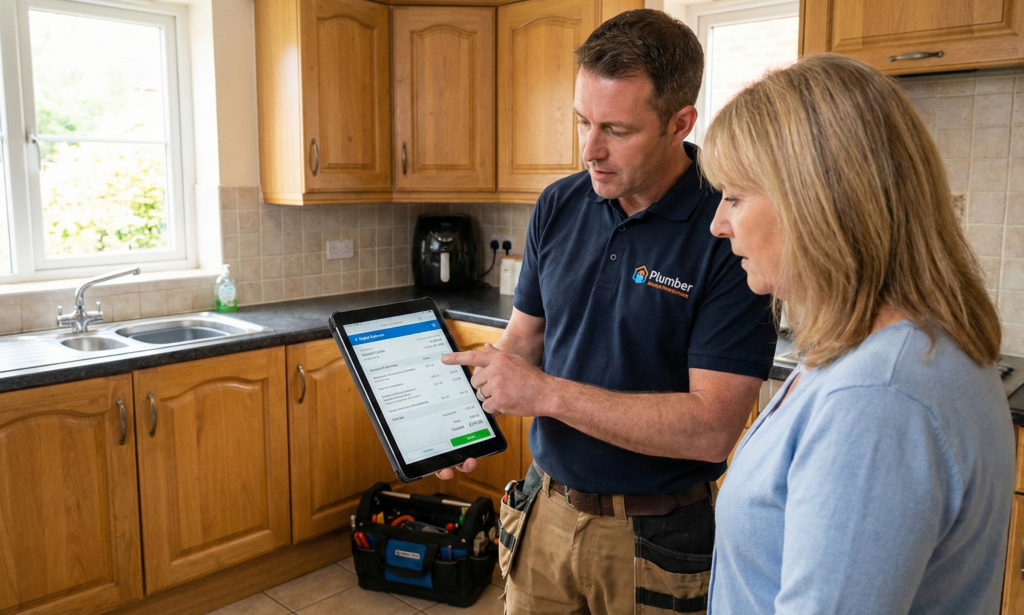
The foundation of any serious contractor estimating software is the digital pricebook — a flat-rate catalog your technicians pull up on their phone or tablet at the job site. Every service code has your labor, materials, overhead, and target profit margin calculated into a single, clean price. No mental math. No calculator apps. No guessing.
When your technician builds a quote from the pricebook, the software handles the math, and your margin is protected on every line item. The customer sees a clear, professional price. Your tech doesn’t have to play salesperson. And your office doesn’t have to audit every estimate for errors.
The “Good, Better, Best” effect. Modern pricebooks let technicians present tiered options — a basic repair, a mid-range solution, and a premium option. This isn’t a gimmick. A survey of over 1,000 contractors by the Air Conditioning Contractors of America (ACCA) found that contractors presenting multiple options saw their close rates jump by 10 percentage points compared to those offering a single quote. The psychology is straightforward: instead of deciding whether to buy, customers decide which level they want. Most land in the middle or higher — lifting your average ticket without a single hard sell.
Change Orders: The Silent Profit Killer
You can build a perfect estimate, nail every line item, and still lose money on a job. It happens every time the scope changes and nobody updates the paperwork.
Here’s how it plays out: your electrician is halfway through a panel upgrade when the homeowner asks, “Hey, can you add a couple of GFCI outlets in the garage while you’re at it?” Your tech says sure — grabs parts off the truck, does the work, and moves on. No updated quote. No revised signature. No record that the scope expanded.
That’s free labor and free materials you just gave away. One forgotten change order might cost you $150. But across a crew running 5 to 10 jobs per day, undocumented scope changes can bleed thousands per month in unbilled work.
Digital change order management fixes this. When the scope changes mid-job, the technician documents the additional work in the app, adds the new materials to the ticket, and captures a digital customer signature for the revised total — all before the extra work begins. The customer knows exactly what they’re agreeing to, and your margin is protected on the expanded scope.
No awkward “surprise bill” conversations. No he-said-she-said disputes. Just documented, signed, billable work.
What to Look for in Contractor Estimating Software
Not all estimating features are built equally. Basic scheduling apps let you send quotes, but they don’t connect your estimates to what’s actually happening in your warehouse and on your trucks. Here’s what separates real contractor estimating software from a glorified PDF generator:
Margin-protected pricebooks. Every service code should have your labor, materials, overhead, and profit margin baked in. When a technician selects a line item, the price should be right — automatically.
Tiered quoting. The ability to present good-better-best options from the pricebook, on-site, from a mobile device. If your techs can’t show options in under 60 seconds, the tool is too slow.
Change order workflows. In-app scope change documentation with digital customer signatures. If the only way to handle a mid-job change is a phone call to the office, you’re leaking profit.
Inventory visibility. Technicians should know what parts they actually have on their truck before quoting a same-day repair. Quoting work you can’t complete today means a return trip, a frustrated customer, and wasted hours. Use our FSM Savings Calculator to see how much unbilled parts and return trips are costing your operation.
Estimate-to-invoice automation. When the customer signs the estimate, it should convert into a work order and eventually an invoice without double entry. Every manual step between approval and billing is a chance for something to fall through the cracks.
If you’re comparing platforms on these criteria, our ServiceTitan vs Jobber vs Housecall Pro comparison guide breaks down how the top FSM platforms handle estimating, pricing, and invoicing.
How TackOn FSM Connects Estimates to Inventory
Most FSM platforms treat estimating and inventory as separate systems. You build a quote in one module, and somewhere else there’s a parts list that may or may not be up to date. TackOn FSM connects them.
Because TackOn FSM includes dynamic, real-time inventory tracking, your estimating process is tied directly to what’s actually in your warehouse and on your trucks.
Accurate costing from your pricebook. When a technician adds an AC condenser or a water heater to a quote, the price pulls from your pricebook with your costs and margins already calculated. You control the pricebook, you set the margins, and every estimate reflects your actual numbers — not outdated supplier catalogs or last year’s pricing.
Truck-level parts visibility. Before quoting a same-day repair, your technician can see exactly what’s on their specific truck. No more quoting work and then discovering the part is back at the warehouse. Fewer return trips, fewer rescheduled jobs, fewer frustrated customers.
Signed estimate to invoice — no double entry. When the customer signs the digital estimate in the mobile app, TackOn FSM converts it into an active work order, reserves the required inventory, and prepares the final invoice. One signature kicks off the entire workflow.
Change orders with digital signatures. When scope changes mid-job, the technician documents the additional work, adds materials, and captures a customer signature for the revised total — all inside the same app, on the same job ticket.
Pricing that fits growing teams. TackOn FSM plans start at $69 per month (Duo Team), $139 (Crew), and $179 (Command), with Fleet pricing for larger operations. No per-technician pricing that punishes you for hiring. See full plan details on the TackOn FSM pricing page.
Curious how TackOn FSM stacks up against enterprise platforms? See our TackOn FSM vs ServiceTitan comparison for a detailed feature and pricing breakdown.
The Profit Framework: Estimate → Execute → Bill → Track
Good contractor estimating software isn’t just about sending better quotes. It’s about creating a closed loop where every dollar is accounted for from the first estimate to the final payment. Here’s the framework:
1. Estimate with real numbers. Build quotes from a pricebook that reflects your actual costs and target margins — not what you charged last year or what a competitor quoted on Google.
2. Execute with documentation. When scope changes happen (and they will), capture them in real time with digital change orders and customer signatures. No undocumented work leaves the job site.
3. Bill completely. Every part used, every hour worked, every scope change approved — all of it flows into the final invoice automatically. No forgotten line items, no manual reconciliation.
4. Track and adjust. Review job-level profitability to see which types of work are hitting your margin targets and which ones are falling short. Adjust your pricebook based on real data, not gut feeling.
Contractors who run this loop consistently don’t just protect their margins — they compound them. Each cycle of accurate data makes the next round of estimates tighter and more profitable.
Stop Losing Margin on Every Job
See how TackOn FSM's integrated pricebooks, inventory tracking, and change order workflows protect your profit from estimate to invoice.
Start Your Free 14-Day Trial →Frequently Asked Questions
What is a flat-rate digital pricebook?
A flat-rate digital pricebook is an electronic catalog built into your contractor estimating software that gives technicians pre-calculated prices for specific repairs and installations. Each service code combines labor, materials, overhead, and your target profit margin into one clean price. Technicians select line items on their mobile device, and the software handles the math — ensuring consistent, margin-protected quotes on every job.
How do undocumented change orders hurt my profit margins?
When additional work happens mid-job without formal documentation, you're giving away free labor and free materials. A technician adds two outlets during a panel upgrade, doesn't update the ticket, and your business absorbs the cost. Across a crew running multiple jobs daily, undocumented scope changes can cost thousands per month in unbilled work. Digital change order management captures these changes with customer signatures before the extra work begins.
Why is time-and-materials pricing risky for contractors?
Time-and-materials pricing relies on accurate manual time tracking and perfect material recall by the technician. It also caps your revenue potential — as technicians get faster and more efficient, you bill fewer hours for the same quality of work. Flat-rate pricing through a digital pricebook rewards efficiency, provides customers with price certainty upfront, and protects your margins regardless of how quickly the job gets done.
What's the difference between contractor estimating software and a basic quoting tool?
Basic quoting tools let you create and send a price to a customer. Contractor estimating software goes further by connecting your estimates to a margin-protected pricebook, tying quotes to real-time inventory on your trucks, supporting tiered good-better-best presentations, and automating the flow from signed estimate to work order to invoice. The difference is whether your estimating process protects your profit or just produces a document.
Does TackOn FSM support digital signatures on estimates and change orders?
Yes. TackOn FSM's mobile app allows customers to sign estimates and change orders digitally on the technician's device. When a customer signs an estimate, it automatically converts into an active work order. When scope changes mid-job, the technician captures a revised signature before the additional work begins — protecting both your business and the customer relationship.
How does presenting good-better-best options increase revenue?
A survey of over 1,000 contractors by the Air Conditioning Contractors of America (ACCA) found that presenting multiple options increased close rates by 10 percentage points compared to single-option quotes. Instead of deciding whether to buy, customers decide which level they want — and most choose the middle or premium tier. This lifts your average ticket value without requiring a hard sell or additional marketing spend.