A Contractor’s Guide to Purchase Ordering Systems
Trying to track parts with paper slips and messy spreadsheets is like trying to fix a major leak with duct tape. It’s a temporary fix for a problem that needs a real solution. You're constantly fighting a frustrating battle against missing materials, surprise invoices from suppliers, and jobs that somehow end up costing way more than you quoted.
A purchase ordering system is the professional tool that finally replaces that duct tape. It gives you a structured, trackable workflow to get a grip on your spending and start protecting your profits on every job.
Why Manual Purchasing Is Costing Your Business Money
For any trade contractor, managing parts without a proper system is like working out of a completely disorganized toolbox. You know the right tool is in there somewhere, but you waste precious time and energy rummaging through clutter just to find it. That daily chaos hits your bottom line harder than you think.
purchase-ordering-systems-money-management.jpg” alt=”A cluttered workbench with an open toolbox, various papers, tools, and a 'STOP LOSING MONEY' sign.” title=”Best Field Management Software in”>
Manual purchasing relies on memory, handwritten notes, and spreadsheets that never seem to be up-to-date. This approach is a breeding ground for human error and creates significant financial leaks that are impossible to trace until the money is already gone.
The Hidden Costs of Disorganization
Without a central process, you’re basically flying blind and exposing your business to all kinds of unnecessary risks. Every single part that isn’t properly tracked is a potential loss.
Here are a few of the biggest money pits with manual purchasing:
- Lost or Unbilled Parts: A tech grabs a part from the van but forgets to write it down. Just like that, the material never makes it onto the final invoice, directly cutting into your profit margin.
- Unauthorized Spending: A team member makes an "emergency" run to the supply house without getting approval, leading to surprise invoices that completely throw your job costing off balance.
- Wasted Technician Time: Your techs spend valuable, billable hours driving around town for parts they thought were in stock, delaying job completion and frustrating customers in the process.
A purchase order (PO) system acts as a master organizer. It creates a clear, trackable workflow for every single part—from request and approval to receiving and final invoicing—and puts an end to the daily chaos.
Creating a System of Record
A purchase ordering system gives you a single source of truth for all your parts and materials. Instead of chasing down paper trails or trying to decipher scribbled notes, you have a clean digital record of every single transaction. It formalizes your procurement process, ensuring everyone is accountable.
This move toward structured digital systems is a major trend in the industry for a reason. The global Order Management Systems market grew from $2,189.8 million in 2021 and is projected to hit $3,510 million by the end of 2025. That’s a massive 60.3% increase, which shows just how essential these tools have become for contractors trying to manage complex operations.
Think about it this way: a PO system is just one piece of the puzzle. When you pair it with other tools, like paperless accounting software, you start to eliminate manual data entry and automate expense tracking across the board. By formalizing your purchasing, you stop reacting to financial surprises and start proactively managing your profitability.
The Must-Have Features of a Purchase Order System
Not all software is created equal. When you're looking at purchase ordering systems, you have to cut through the marketing noise and zero in on the features that actually solve the messy, real-world problems trade contractors face every day. The right tool doesn't just put your old paper process on a screen; it completely overhauls it for the better.
A modern system should feel less like another piece of office software and more like a smart assistant that’s always one step ahead. It should seamlessly connect your techs in the field with your team in the office, kill off mind-numbing data entry, and give you a firm grip on your spending.
Automated Purchase Order Creation
Let’s be honest, the biggest time-suck is manually creating POs. Imagine this: your tech builds a quote on their tablet, the customer gives the thumbs-up, and with one tap, the system instantly generates a perfect purchase order for every single part on that quote. That’s not a nice-to-have; it's a game-changer.
This kind of automation gives you back hours of administrative time. No more squinting at a handwritten estimate and typing part numbers into a spreadsheet. It guarantees that every part needed for the job actually gets ordered, stopping those painful delays caused by a single missed component.
- Estimate-to-PO Conversion: The ability to flip an approved estimate or work order straight into a PO is non-negotiable.
- Drastically Reduced Data Entry: This is huge. It slashes the human errors that lead to wrong parts or incorrect quantities being ordered. In fact, 61% of businesses blame manual processes for operational headaches—a problem this feature solves head-on.
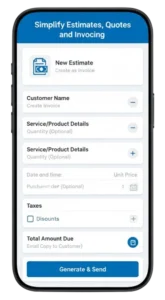
- Pinpoint Job Costing: By linking parts directly from the estimate to the PO, your job costs are captured accurately from the very start. To see how this flows through to your finances, you can explore our guide to simplifying estimates and invoicing with the right tools.
Centralized Supplier Management
How much time do you and your team waste digging through emails or calling around for supplier info? A solid purchase ordering system puts an end to that chaos by giving you a central vendor database. All your supplier contacts, special pricing, and order history live in one clean, easy-to-search place.
This lets you make smarter buying decisions on the spot. You can instantly compare who has the best price on a specific part or check what you paid last time to make sure you aren't being overcharged. It also acts as a perfect record, logging every PO ever sent to a supplier.
Think of it as a super-powered digital Rolodex for your vendors. It's always current, accessible to your entire team, and helps you build stronger supplier relationships while keeping a tight rein on costs.
Mobile Approval Workflows
Rogue spending can bleed a business dry. A system with mobile approval workflows gives you ultimate control over every purchase, even when you're not in the office. If a technician needs to buy a part from a local supply house, they can shoot a purchase request right from their phone.
You or your office manager get an instant notification. You can review the request, see how it fits into the job's budget, and approve or deny it in seconds. This simple check-and-balance puts a hard stop to surprise invoices and ensures every single dollar spent is approved and accounted for.
Real-Time Inventory Tracking
Finally, your purchasing system has to talk to your inventory. This is the glue that holds everything together. Real-time inventory tracking connects your warehouse, your fleet of service vans, and all your active jobs into one unified view.
When a PO is issued, the system knows those parts are inbound. The moment they arrive and are checked in, your inventory levels update automatically. Then, when a tech uses a part on a job, it's immediately deducted from their van's stock. It creates a perfect loop, so you always know exactly what you have, where it is, and when it’s time to reorder.
Weaving Purchase Orders into Your Daily Workflow
The real magic of a purchase ordering system isn't just creating a digital paper trail. It's how that trail connects every single part of your operation, from the field to the office and back again. A standalone purchasing tool is one thing, but a fully integrated system can completely change how you work, eliminating guesswork and stopping the profit leaks that always seem to spring from manual processes.
To really get it, let's follow the journey of a single part—say, a specific HVAC capacitor—from the moment a customer calls to the final, paid invoice. This little story shows how a good system turns chaos into a predictable, and much more profitable, process.
From Estimate to Automated Purchase Order
It all starts with your technician on-site. Using a tablet, they diagnose the problem and pull up your company's digital pricebook to build a clean, professional estimate. They add the capacitor and the labor, and the correct pricing and markup are applied instantly.
The customer loves it and gives a digital signature right on the spot. This is where the old way breaks down and the new way shines. Instead of your tech scribbling a note or trying to remember to call the office, the system takes over.
- Flagging Needed Parts: The moment the estimate is approved, the system flags that capacitor as a required part for the job.
- Automated PO Generation: Back at the office, a single click generates a purchase order for that capacitor, automatically filling in the part number, description, and your go-to supplier.
- Inventory Check: Before hitting "send," the system can even do a quick check to see if that same part is already sitting in the shop or on another tech's van, preventing you from buying something you already own.
Just this first step alone can shave hours off your admin time and makes sure nothing falls through the cracks between the field and the office. It's a key reason why field service scheduling software saves so much time when it works hand-in-hand with purchasing.
This simple, three-step flow shows the core of what a good purchase order process looks like.

When you look at it this way, you can see how a structured system creates a clear, accountable path for every dollar you spend.
Receiving Parts and Tying Them to the Job
Okay, so the PO is approved and sent. The system keeps working. When the capacitor arrives at your shop, the receiving process is surprisingly simple but incredibly powerful.
Your warehouse manager scans the part or the packing slip, and the system instantly updates its status from "ordered" to "received." Right away, your inventory count is adjusted, giving you a live, accurate view of what's actually on your shelves.
But here's the most important part: that capacitor is now digitally tied to the specific job it was ordered for. It’s no longer just another part in a bin; it's a specific asset allocated to a specific customer's repair.
This digital link is the secret to dead-on job costing. It forges an unbreakable chain from the initial estimate to the physical part, guaranteeing that every single material cost is captured and accounted for.
Closing the Loop with Automated Invoicing
With the capacitor received and logged, the system can notify the technician that the part is in, and they can head out to finish the repair. Once the job is done, this last step is almost effortless.
Because that capacitor was linked to the work order from the very beginning, it automatically populates on the final customer invoice.
The correct price, with the markup you set in the original estimate, is already there. Nobody has to remember to add it, and you completely eliminate the risk of accidentally giving away a part for free because of a simple oversight. This is where an integrated system really pays for itself.
Companies that put these kinds of automated solutions in place see some incredible results, including a 25% bump in overall efficiency and a 60% reduction in manual processes. For a contractor, that means less time pushing paper and more time on billable work. Making sure everyone on your team can follow the new process is key, which is why clear documentation like interactive step-by-step guides can make the transition so much smoother.
By tracing the journey of just one small part, you can see how an integrated system gives you a crystal-clear view of every job's profitability, from start to finish.
How to Measure the ROI of Your New System
So, you're thinking about investing in new software. That’s a big step, and you need to be sure it's going to pay off. Going beyond vague promises of "efficiency" is crucial. To really justify the cost of a purchase ordering system, you have to track specific numbers—Key Performance Indicators (KPIs)—that connect directly to your bank account.
Measuring the return on investment (ROI) doesn't require a finance degree. It’s about seeing real, measurable improvements in the areas that used to bleed money. Are you actually billing for every single part your techs use? Is your cash locked up in inventory that's just collecting dust? Answering these questions with cold, hard data is how you prove the system is worth every penny.

Pinpoint Profit Leaks with Parts Usage Variance
One of the most eye-opening metrics you can finally track is Parts Usage Variance. This KPI simply measures the gap between the parts you buy for jobs and the parts that actually end up on a customer's invoice. Before, this gap was a black hole where profits disappeared. Now, it's a number you can control.
Your goal is to get this variance as close to zero as you possibly can. A high number is a major red flag, telling you that parts are being installed but never billed—a classic symptom of sloppy manual tracking. A good purchase ordering system makes this calculation effortless by tying materials directly to work orders, shining a spotlight on those costly oversights.
Optimize Cash Flow with Inventory Turnover Rate
How fast are you turning your pile of parts into actual cash? That's what the Inventory Turnover Rate tells you. It calculates how many times you sell and replace your entire inventory over a given period. A low turnover rate means your money is sitting idle on a shelf instead of working for you.
- Before: You probably had a gut feeling that some parts were slow-movers, but you didn't have the data to act on it with confidence.
- After: Your system gives you a clear report card on every part, showing you the hot sellers and the dust-collectors.
This insight lets you stock smarter, slash your carrying costs, and free up cash to grow the business. A healthy turnover rate is a sign of a lean, well-oiled operation.
By automating routine procurement tasks and providing better data, businesses can cut their purchasing costs by up to 30%. This isn't just about saving a few minutes here and there; it's about making smarter financial moves that directly fatten your bottom line.
Sharpen Your Bidding with Job Costing Accuracy
For any contractor, accurate job costing is the bedrock of profitability. When you can't precisely track the cost of every part and every hour, your estimates are nothing more than educated guesses. An integrated purchase ordering system changes the game, turning those guesses into data-backed certainties.
By automatically tagging every purchased part to a specific job, the system gives you a crystal-clear view of your true costs. This lets you tighten up your estimates, protect your profit margins, and bid more competitively without gambling with your profitability. That level of precision can be the difference between a 5% and a 15% net profit on a single job.
A Practical Checklist for Choosing the Right System
Ready to pull the trigger on a purchase ordering system but feeling a bit overwhelmed by the options? It’s a common spot to be in. The key isn't finding the software with the most bells and whistles; it's about finding the one that plugs the biggest, most expensive holes in your business.
This buyer’s guide is a straightforward checklist to help you cut through the noise and find the right fit for your trade contracting business. Before you even agree to a demo, you need to do a little homework.
Start by figuring out your biggest pain points. Is sloppy job costing eating into your margins? Are your techs spending more time at the supply house than on billable jobs? Nailing these issues down first will make you a much sharper buyer.
First, Figure Out Your Core Needs
The first move is always a quick self-audit. You have to know where your current process is falling apart before you can find a system to fix it. Without that clarity, every software platform will start to look and sound the same.
Get your team in a room and ask some tough questions:
- Where are we leaking money? Is it from parts that never get billed to the customer, rogue purchases made without approval, or estimates that miss the mark on material costs?
- Where are we wasting time? Think about technicians making multiple supply runs for one job, office staff drowning in manual PO entry, or the hours spent trying to match invoices to the right orders.
- What information is a black hole? Do you have any real idea what parts are in stock, which van they’re on, or what a job actually cost you in the end?
Once you have honest answers, you'll be armed with a powerful list of questions for any vendor you talk to. Your mission is to find a partner whose system directly solves these problems, not just one with a flashy feature list.
Key Questions to Ask Potential Vendors
Now you’re ready to start evaluating specific purchase ordering systems. Use this checklist to get past the sales pitch and see if the software can handle the reality of your day-to-day operations.
-
Does it talk to my accounting software? A smooth, two-way sync with tools like QuickBooks is non-negotiable. This is what stops the soul-crushing double-entry of data and keeps your job costs accurate.
-
Can my techs request parts from the field? The system absolutely must have a mobile app that lets technicians submit purchase requests right from the job site. This one feature alone can slash wasted drive time and keep projects on schedule.
-
Does it handle inventory in multiple places? If you have more than one service van on the road, you’re managing multi-location inventory. You need to know exactly what’s on each truck and what’s back at the shop, in real time.
-
How does it manage supplier catalogs and pricing? Can you easily import and update price lists from your main suppliers? A good system helps you maintain a current pricebook so your estimates and orders are always based on today's costs, not last year's.
Choosing the right system is more like hiring a key partner than buying a product. Look for a company that gets the trades and offers solid, reliable support to get you up and running.
There's a reason this is becoming so important. The market for procurement analytics is expected to explode from $6.49 billion in 2025 to a massive $50.92 billion by 2035, according to market analysis from Precedence Research. This incredible growth highlights why FSM platforms with smart parts tracking are no longer a luxury—they're a competitive necessity.
Making sure the system can grow with your business is one of the most critical parts of this decision. To get a better handle on how this fits into the larger picture, it's worth understanding why field service management software matters for your business and the long-term value it brings.
Common Mistakes to Avoid When Going Digital
Switching to a new purchase ordering system can be a huge win for your business, but a few common missteps can turn a great investment into a massive headache. Adopting new software isn't just about the technology—it's about changing how your team operates day-to-day. Sidestepping these classic blunders will ensure your rollout is smooth and actually delivers the results you’re paying for.
The biggest mistake often happens right at the start: importing bad data. It’s like moving into a brand-new, state-of-the-art workshop but bringing all the old junk, broken tools, and mystery boxes with you. If your current parts list is a tangled mess of spreadsheets with duplicate items, old pricing, and cryptic names, pulling it straight into your shiny new system will only recreate the chaos.
You'll have a powerful tool that's clogged with useless information from day one. Good luck trying to track inventory, build accurate estimates, or trust any report it spits out.
Clean Your Data Before You Move In
Before you even think about importing anything, you have to do some digital spring cleaning. This part is non-negotiable. Take the time to consolidate your parts list, get rid of all the duplicates, and create a standard way to name things (e.g., "1/2-inch Copper Fitting," not "half inch cpr ftg" or "½ Cop Ftg"). While you're at it, double-check that your supplier pricing is current.
A clean, accurate parts database is the bedrock of a successful system. A few hours spent organizing your data now will save you hundreds of hours of frustration and expensive mistakes down the line.
Taking this step ensures your new purchase ordering system starts with a clean slate. It means every feature, from job costing to inventory management, will be more reliable and valuable right out of the gate.
Get Your Team on Board from the Beginning
Another classic mistake is dropping a new system on your team without getting their input first. Your field technicians are the ones who will be using this tool every single day. If they see it as just another annoying task being pushed on them by the office, they won't use it correctly—or at all—and your entire investment goes down the drain.
The fix is surprisingly simple: involve them early. Bring your lead techs into the decision-making process. Let them sit in on demos and ask the tough questions. Once they realize how a mobile app can save them from wasted trips to the supply house, they’ll become the biggest advocates for the change, not obstacles.
Set the Rules and Train Your People
Finally, two smaller but equally damaging mistakes are failing to set clear rules and skipping proper training. If you don't create clear approval workflows, you haven't solved the problem of uncontrolled spending; you've just moved it online.
Take the time to hash out the details:
- Establish Approval Tiers: Define who can approve what. Maybe a tech can request parts, but only an office manager can approve a purchase order over $500. Set clear spending limits.
- Invest in Training: Don't just hand everyone a login and hope for the best. A good software partner will offer onboarding and support. Make sure every single person on your team knows exactly how to request parts, track an order, and receive inventory correctly in the new system.
By getting ahead of these common issues—data quality, team adoption, and clear processes—you can avoid the usual frustrations of going digital and make sure your new system starts boosting your bottom line from day one.
Your Top Questions About Purchase Ordering Systems, Answered
Jumping into any new software is going to bring up questions. Let's tackle some of the most common ones we hear from HVAC, plumbing, and electrical contractors. We'll skip the jargon and get straight to the practical answers you need.
How Long Does It Take to Get Set Up?
Honestly, it’s probably faster than you think. The biggest factor is the state of your current data. If you have a clean list of your most-used parts and trusted suppliers, you could be up and running in just a few hours.
A good software provider will help you with data migration, pulling your lists directly from old spreadsheets or your accounting software. That part alone is a massive time-saver. While you'll need to invest a little time in showing your team the ropes, the hours you get back from automating your purchasing process pay for that investment almost immediately.
Can My Techs Create POs from the Field?
Yes, and this is where you'll see one of the biggest jumps in efficiency. Modern systems come with a mobile app that lets your technicians check inventory levels right from their phone or tablet at the job site.
If they realize they need a part that isn't on the truck, they can fire off a purchase request right then and there. This instantly pings the office for approval, getting the ball rolling on ordering the part and tying it to the correct job. No more wasted trips to the supply house, and no more jobs getting stalled for hours.
The ability for techs to kick off the purchasing process from the field is a game-changer. It directly links what’s happening on-site with your financial controls, which means fewer delays and more first-time fixes.
Will This System Work with My Accounting Software?
It absolutely has to. Any purchase ordering system worth its salt—especially one built into a full field service platform—is designed to integrate seamlessly with accounting software like QuickBooks. This isn't just a "nice-to-have" feature; it's essential.
When a PO is approved or a supplier invoice gets paid, the information automatically syncs over. This kills double data entry, cuts down on human error, and gives you an accurate, real-time look at your job costs without having to manually match everything up.
Is This Kind of System Only for Big Companies?
Not a chance. While big operations can't live without them, these systems deliver huge value for small and mid-sized shops, too. Think about it: for a smaller business, preventing just one unbilled part or stopping one unauthorized credit card purchase at the supply house can make or break the profit on a job.
Today's purchase ordering systems are built to scale and are surprisingly affordable. They give smaller contractors the same organizational tools and financial controls that help the big guys stay profitable and competitive.
Ready to stop profit leaks and get a firm grip on your parts and materials? The all-in-one TackonFSM platform includes a powerful, easy-to-use purchase order and inventory management system designed specifically for the trades. Start your free 14-day trial today!