
Your Essential Electricians Pricing Guide to Maximize Profits

A solid electricians pricing guide comes down to one simple truth: you have to know your local market inside and out before you can price your services for profit. If you're just guessing at your rates, you're almost certainly leaving money on the table.
Let’s walk through how to really dig into your local market and build a pricing strategy that holds up.
Getting a Feel for the Local Market

Setting the right price for electrical work is a lot like laying a foundation. If you get it wrong, everything you build on top of it will be shaky. Your pricing has to be grounded in the reality of your service area, not just some national average you found online.
First things first, you have to accept that every market is different. A master electrician working in a booming city with a high cost of living is going to charge a whole lot more than an apprentice in a quiet, rural town. That's not just random—it's driven by real economic forces you need to get a handle on.
What Really Drives Electrical Service Rates?
There are a few key things that dictate what you can—and should—be charging. If you ignore them, you’ll end up with prices that don't cover your actual costs, and your profit margins will get squeezed thin.
Here are the big market drivers to watch:
- Experience and Certification: A master electrician who can troubleshoot a complex industrial system has earned the right to charge more than a journeyman doing a simple panel swap. Your rate should reflect your expertise.
- Job Complexity: Replacing a light switch isn't the same as wiring a custom smart home or installing a backup generator for a business. The more skill and risk involved, the higher the price.
- Geographic Location: It just costs more to run a business in a major city. Higher rent, fuel, and wages all mean your service rates need to be higher to compensate.
- Labor Supply and Demand: When there aren't enough good electricians to go around, wages go up. That cost has to be passed on to the customer through your service prices.
Your pricing shouldn't be a shot in the dark. It needs to be a thoughtful calculation based on your skills, your overhead, and what your local market can support. Undercharging doesn't just hurt your bank account; it devalues the entire trade.
A Look at National and Regional Price Benchmarks
On top of market forces, you have the regulatory side of things. All electricians have to follow strict safety standards, like those in the NFPA 70E Electrical Safety Guidance, and the cost of compliance has to be baked into your pricing.
Right now, the market is seeing a major spike in rates. This is happening for a couple of reasons: a persistent shortage of skilled labor and a huge demand for specialized electrical work.
For a quick reference, here are some typical hourly rate ranges you might see in the current market, broken down by experience.
Electrician Hourly Rates by Experience Level
| Experience Level | Typical Hourly Rate Range (USD) |
|---|---|
| Apprentice Electrician | $20 – $40 |
| Journeyman Electrician | $45 – $75 |
| Master Electrician | $75 – $120+ |
As of 2026, it's common to see electrician hourly rates across major US markets fall anywhere between $40 to $100. This trend is part of a bigger picture where material costs are up, and contractors have to offer better pay and benefits to attract top talent.
This all points to one thing: you need a flexible pricing model that can keep up with a changing market. By staying on top of these trends, you can adjust your rates to protect your profit without scaring away customers. And if you're looking for a way to manage all these moving pieces, modern tools can be a game-changer. Learn more about how Field Service Management Software Matters for keeping your operations and pricing sharp.
Choosing Your Pricing Model
Deciding whether to charge by the hour or give a firm, flat price upfront is one of the biggest calls you'll make in your business. This isn't just about billing—it shapes your customer's perception of you and hits your bottom line directly. Each model has its place, and the smartest contractors know which one to use for which job.
Think of hourly billing like a taxi meter. The customer pays for the exact time and materials used, which makes it feel transparent. This is your go-to for jobs where you just don't know what you're getting into, like hunting down a mysterious power outage or untangling a rat's nest of old wiring.
Flat-rate pricing, on the other hand, is more like buying an airline ticket. Your customer knows the full cost before you even start the "trip," no matter what happens along the way. This is a massive trust-builder and works perfectly for standard, repeatable jobs—think service panel upgrades or ceiling fan installations. Mastering the art of valuing and pricing goods and services is the key to making this work without losing your shirt.
The Hourly Rate Method
Charging an hourly rate, what many call "time and materials," is the old-school way of doing things. It's simple and guarantees you get paid for every single minute you're on-site, especially when a "quick fix" turns into an all-day affair. This approach protects you from underbidding a job that spirals out of control.
But here's the catch: it can make customers nervous. They're left wondering what the final bill will look like, sometimes watching the clock and questioning your every move. That uncertainty can create friction and make it tougher to get a "yes," since the total cost is a big question mark until you're done.
Best suited for:
- Diagnostic and troubleshooting work
- Complex repairs with unknown variables
- Service calls where the scope isn't clear upfront
The Flat-Rate Pricing Advantage
Flat-rate pricing completely changes the game. It shifts the focus from the hours you put in to the value you deliver. You give the customer one single, upfront price for the entire job. This erases their anxiety about a running clock and lets them make a decision based on a fixed, predictable cost.
With this model, the risk of a job running long is on you, not the customer. If it takes more time than you planned, your profit margin shrinks. But when your guys are fast and efficient, your margin grows. It's a powerful incentive for your team to work smarter and faster, rewarding your top-performing techs.
Flat-rate pricing transforms the conversation from "How much do you charge per hour?" to "What is the total investment to solve my problem?" This positions you as a professional solutions provider, not just a hired hand renting out your time.
To pull this off, you absolutely need a well-organized digital pricebook. This isn't just a list of prices; it's a catalog of every service you offer, with costs pre-calculated to include labor, materials, overhead, and the profit you need to thrive. It's how you ensure every tech quotes the same profitable price, every single time.
Finding a Hybrid Approach
The good news is, you don't have to be married to one method. The most successful contractors use a hybrid approach, picking the right strategy for the situation. For instance, you could charge a flat-rate diagnostic fee just to show up and figure out what's wrong.
Once you’ve pinpointed the issue, you can pull out your tablet and show them a flat-rate price for the actual repair, right from your digital pricebook. This gives the customer clarity and control over the cost, while making sure you're paid for your diagnostic expertise. It's a win-win that builds serious trust and locks in profitable work.
How to Create Accurate Electrical Estimates
A solid estimate is the bedrock of any profitable electrical job. It's not just a number you give the customer; it's a promise. It promises them a fair price and promises your business that you’ll actually make money. A well-built estimate accounts for every wire, screw, and minute of your team's time, so you never end up working for free.
Think of it like a recipe for a successful project. If you forget a key ingredient—like your overhead costs—or miscalculate the prep time (your labor), the whole thing falls flat. That's why having a repeatable, step-by-step process is the only way to get it right every single time.
This visual below lays out the strategic choice between hourly and flat-rate models, a core decision that shapes how you build every estimate from the ground up.
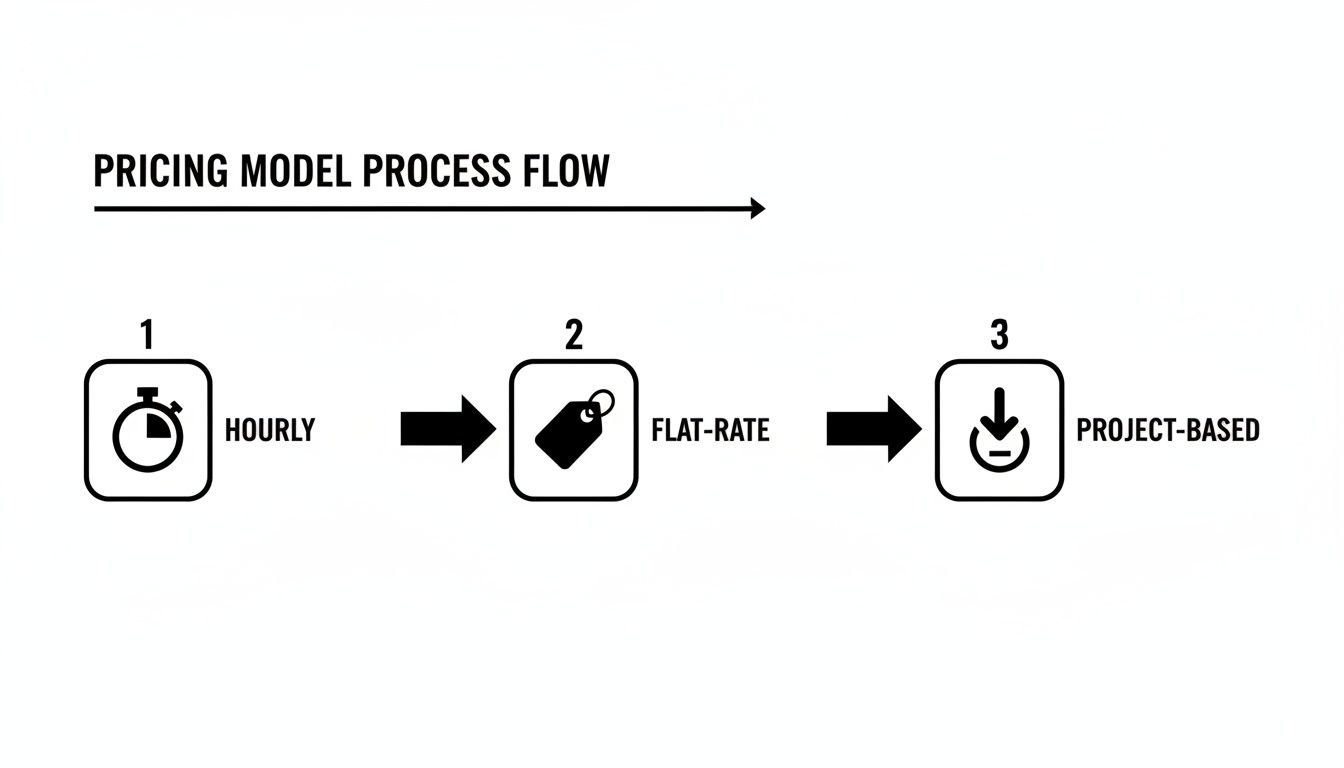
Moving from a simple hourly rate to a more structured flat-rate system is often a sign of a maturing business—one that's focused on building client trust and running more efficiently.
Deconstructing the Perfect Estimate
Every professional estimate has a few non-negotiable parts. If you leave any of them out, you’re basically giving away your profit. Breaking the job down into these core pieces creates transparency for the customer and gives you a clear financial roadmap.
Let's get into the essential building blocks:
- Precise Labor Calculations: This goes way beyond just your hourly rate. You have to factor in drive time to and from the site, the time it takes to set up your tools and protect the area, and even the minutes spent picking up specialty parts.
- Detailed Material Costs: You need to list everything. From the main panel and breakers right down to the last wire nut and fastener. It's absolutely critical to keep an updated price list from your suppliers, because material costs can change overnight and catch you off guard.
- Overhead Expenses: This is the silent profit killer for so many contractors. Overhead covers all the background costs of just keeping the lights on—your truck insurance, fuel, software subscriptions, shop rent, and marketing.
- Profit Margin: After every single cost is accounted for, you have to add a margin that lets your business grow. A healthy profit isn't greedy; it’s the fuel you need to reinvest in better tools, ongoing training, and attracting top-notch electricians.
A Real-World Example Breaker Replacement
Let's put this into practice with a job you've probably done a hundred times: replacing a faulty 20-amp circuit breaker. A rookie move is to just charge for the breaker itself and maybe 30 minutes of labor. A pro knows there's a lot more to it.
Here’s a quick look at a simplified breakdown:
| Item/Task | Quantity | Cost Each | Total Cost |
|---|---|---|---|
| Material | |||
| 20A Single-Pole Breaker | 1 | $12.00 | $12.00 |
| Wire Connectors | 2 | $0.25 | $0.50 |
| Labor | 1.5 hours | $100.00 | $150.00 |
| Subtotal | $162.50 | ||
| Overhead (20%) | $32.50 | ||
| Profit Margin (15%) | $24.38 | ||
| Final Price to Customer | $219.38 |
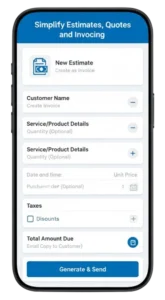
This detailed approach is what a proper electricians pricing guide is all about. By following a structured process, you make sure even the smallest jobs are actually contributing to your bottom line. You might also want to look into how to Simplify Estimates Quotes and Invoicing with modern software that can automate a lot of this tedious work for you.
Avoiding Common Estimating Blunders
Even seasoned electricians can make mistakes that cost them dearly. Things like underestimating the nightmare of working in an old house with crumbling wiring, forgetting to include permit fees, or failing to add a little cushion for unexpected problems can completely wipe out your profit on a job.
An estimate is a promise. It promises the customer a solution at a fair price, and it promises your business a profitable outcome. When you rush the estimate, you risk breaking both promises.
The numbers don't lie. In 2026, the average cost to hire an electrician in the US was $349, but that figure sits within a massive range of $163–$536. A simple light fixture installation can run from $150 to $6,000, while a generator install could be anywhere from $1,540 to $8,740.
These huge swings show exactly why you can't just rely on generic averages. You have to build detailed, job-specific estimates every time. A solid, repeatable estimating process is your best defense against all these variables, ensuring you stay consistent and profitable on every single job you quote.
Mastering Markups and Service Fees
Getting an estimate right is one thing, but making real money on a job? That comes down to what you do after you’ve tallied up your basic costs. Just covering your parts and labor is a surefire way to run your business into the ground. To actually build a company that lasts, you have to be smart about applying markups and service fees to protect your bottom line.
This is exactly where I see a lot of electricians stumble. They get two critical terms mixed up: markup and margin. They sound alike, but they give you two completely different pictures of your company's financial health. Nailing this difference is a cornerstone of pricing your work properly.
The Difference Between Markup and Margin
Think of markup as the amount you add on top of what an item costs you. It's a simple, look-ahead calculation. Let’s say a breaker costs you $10 from the supplier. If you apply a 50% markup, you just add $5 to that cost and sell it to the customer for $15. Easy enough.
Profit margin, on the other hand, looks backward from the final sale price. It tells you what slice of that total price was actual profit. It's the true measure of a sale's profitability.
Let's run the numbers with a quick example:
- Your Cost: $100
- Customer Price: $150
- Your Profit: $50
Here’s the markup calculation:
(Profit / Cost) x 100 = Markup %
($50 / $100) x 100 = 50% Markup
And here’s the margin calculation:
(Profit / Customer Price) x 100 = Margin %
($50 / $150) x 100 = 33.3% Profit Margin
See that? A 50% markup did not get you a 50% profit margin. This is a huge deal. If your business needs a 30% profit margin to cover overhead, pay your team, and grow, you can't just slap a 30% markup on your costs. You'll come up short every single time.
One of the most common pricing mistakes is using a target margin number as the markup percentage. This fundamentally misunderstands the math and is a guaranteed way to underprice jobs and bleed profit.
Setting Minimum Service Fees and Trip Charges
Not every call is a panel upgrade or a full rewire. A ton of your work will be small troubleshooting jobs that might only take an hour. If you don't have a minimum charge, these small jobs will kill you financially once you add up the real cost of rolling a truck.
A minimum service fee—sometimes called a trip charge or dispatch fee—is your financial safety net. It’s a baseline charge that ensures you cover your fixed costs before a single tool comes out of the van.
So, what should this fee actually cover?
- Fuel and Van Upkeep: The real cost of getting your fully-stocked workshop-on-wheels to the customer's door.
- Technician's Drive Time: This isn't free time. You're paying your tech to sit in traffic, and that has to be accounted for.
- Insurance, Licenses, and Overhead: All the background costs of running a legitimate, professional business.
- Initial Diagnostic Time: The first 15-30 minutes of an expert assessment on-site.
Setting a standard fee, typically somewhere between $75 and $150, makes sure that even a five-minute fix contributes to your business instead of costing you money. It protects you from those calls that eat up time and resources but don't turn into major work.
By mastering both your markups and implementing a non-negotiable service fee, you create a solid financial foundation. This two-pronged approach ensures every job is built for profit, from the biggest installation to the smallest repair. This isn't just about making a quick buck; it's about building a stable company that can handle tough times, invest in new gear and training, and offer real careers for your crew. It’s what separates the struggling contractors from the true business owners.
How FSM Software Ties Your Pricing Strategy Together

It's one thing to craft the perfect pricing strategy, but it’s a whole different challenge to execute it flawlessly on every single job. This is where modern Field Service Management (FSM) software becomes an essential tool in any electricians pricing guide. It's the bridge between the numbers on your spreadsheet and the quotes your technicians deliver in the field.
Think of FSM software as the central nervous system for your pricing. It takes all the rules, costs, and markups you’ve carefully figured out and puts them into a system your entire team can access from anywhere. This completely eliminates the guesswork and “clipboard math” that so often leads to inconsistent quotes and shrinking profit margins.
When you move your pricing from a dusty binder or a messy spreadsheet into a dynamic software platform, you guarantee every quote is built on the same profitable foundation. This isn’t just about saving time—it’s about actively protecting your business from the costly errors that creep in with manual entry.
The Power of a Centralized Digital Pricebook
A digital pricebook is the heart of a modern pricing strategy. Instead of relying on outdated paper catalogs or just plain memory, your techs have a full, up-to-the-minute list of every part and service you offer, right on their phone or tablet. This is the key to true pricing consistency, no matter which technician is on the call.
But this is way more than just a list of items. A solid pricebook inside an FSM system does all the heavy lifting for you, automatically calculating the final customer price by factoring in:
- Your Real-Time Material Cost: It pulls the latest cost from your inventory, so you're never caught off guard by a supplier's price hike.
- Pre-Set Labor Rates: It applies the correct labor time and rate for that specific task, every time.
- Your Required Markup: It automatically adds your target markup to every line item without anyone having to think about it.
- Built-in Profit Margin: It ensures your desired profit is baked into every single quote, protecting your bottom line.
This system populates parts, labor, and markups in an instant, turning a complex calculation into a simple, error-free process that any technician can execute perfectly on-site.
A digital pricebook transforms every technician into your best salesperson. It gives them the confidence to present professional, accurate, and profitable options to the customer without ever having to call the office for a price check.
From Estimate to Invoice in a Single Click
The real magic of FSM software is how it connects the entire workflow, from the initial quote to the final payment. This seamless process gets rid of administrative headaches and helps you get paid a whole lot faster.
Once a customer approves an estimate on your technician's tablet, that approved quote instantly converts into a work order with a single tap. All the parts, labor details, and customer information carry over automatically, so there’s no need for anyone back at the office to re-enter a thing. This move alone drastically cuts down on human error and frees up your admin staff for more valuable work.
After the job is done, that same work order flips directly into a final invoice. The tech can take payment right on the spot, or the office can email a payment link. This isn't just about convenience; it's a powerful way to improve your cash flow. If you're interested in how this works, check out how Field Service Scheduling Software That Saves Time can integrate these features.
This level of automation is how you maintain pricing integrity from start to finish. It guarantees the price you quoted is the price you bill, protecting your margins and building serious trust with your customers. By removing manual steps, you create a pricing engine that works for you, not against you.
Common Electrical Pricing Mistakes to Avoid
Even the sharpest electricians can fall into pricing traps that quietly eat away at their profits. Nailing down a solid pricing strategy is half the battle. The other half is dodging the common blunders that can sink your business, one job at a time.
Think of these mistakes like slow leaks in your financial plumbing. A single drip doesn't seem like much, but over a year, you're looking at a major flood of lost revenue. Let's find those leaks and patch them up for good.
Overlooking Your True Overhead Costs
Probably the most common and damaging mistake I see is underestimating—or completely forgetting—overhead. This happens when you price a job based only on the parts you can hold in your hand and the hours your tech is on-site, completely ignoring what it costs just to open your doors each day.
These aren't optional expenses. They’re the foundation of your entire operation. Forgetting them is like a restaurant owner charging only for the cost of the steak and potatoes, but forgetting about the rent, the electricity for the ovens, and the dishwasher's salary.
A price that only covers parts and labor isn't a profitable price—it's just a break-even price on the most visible costs. You're still losing money on everything else. Real profit only starts after every single business expense is covered.
Inconsistent Pricing Across Your Team
Another huge profit killer? Letting different techs charge different prices for the same work. When one of your guys charges $250 to install a ceiling fan on Tuesday, and another charges $350 for the exact same job on Wednesday, you've got a problem. It creates confusion for customers and makes your cash flow completely unpredictable.
This usually happens when there's no standardized system, like a digital pricebook, for everyone to follow. Without that single source of truth, your techs are left to pull numbers out of thin air, which leads to a few headaches:
- Undercharging: Techs who lack confidence might lowball a price just to avoid a discussion, which cuts directly into your bottom line.
- Overcharging: This can wreck your reputation in a hurry. A customer who feels they got ripped off isn't just a lost customer; they're a bad review waiting to happen.
- Customer Confusion: Nothing erodes trust faster than a customer getting two different quotes for the same work from the same company.
Putting a clear, consistent pricing structure in place—and making sure every single person on your team uses it—is crucial. It ensures every job is quoted profitably and professionally, which builds stability inside your business and trust with your customers.
Frequently Asked Questions About Pricing Electrical Work
Even with a solid pricing guide in hand, some specific questions always seem to pop up. Let's tackle a few of the most common ones that electricians run into in the field, so you can build your quotes with more confidence.
Should I Show Material Markup on an Invoice?
This is a classic dilemma, but my advice is almost always no. While being transparent is good, breaking out your material markup as a separate line item is just asking for a headache.
Most customers get that parts aren't free, but seeing a specific percentage slapped on top can make them feel nickel-and-dimed. It invites haggling and shifts the focus away from the quality of your work. A much cleaner way to handle this is to roll your material costs, overhead, and profit into a single flat-rate price. That way, the conversation is about the total value you're delivering, not the cost of a single outlet.
How Much Should Electricians Charge per Hour?
The honest answer? It depends. Rates can be all over the map based on where you are, your experience level, and the type of work you’re doing. You'll typically see a range anywhere from $50 to over $120 per hour.
Just to give you a ballpark idea, here's how it often breaks down:
- Apprentice Electrician: $40 – $60 per hour
- Journeyman Electrician: $60 – $90 per hour
- Master Electrician: $90 – $120+ per hour
Remember, those numbers are just the raw labor rate. You still need to factor in your parts, overhead costs, and, of course, your profit. The best thing you can do is check out what other reputable contractors in your area are charging to make sure your numbers are in the right ballpark.
How Do I Price a Job I Have Never Done Before?
Taking on a new type of job can be nerve-wracking, especially when it comes to pricing. The key is to be methodical and not guess. Start by breaking the entire project down into the smallest, most manageable steps you can think of.
Next, get on the phone with your supplier and price out every single component you'll need. Then, carefully estimate how many hours each of those small steps will take. And here’s the most important part: add a contingency buffer of 15-20% to your labor estimate. Trust me, something unexpected will always come up.
When you're quoting a job you've never done before, being thorough is your best defense against losing money. Build your estimate from the ground up, account for every wire and switch, and always give yourself a cushion for the unknown. It’s how you protect your profit while you learn the ropes.
Ready to stop guessing and start pricing for profit? TackonFSM gives you a central digital pricebook and powerful estimating tools to make sure every quote you send is accurate, consistent, and built to make you money. Learn more at https://www.tackonfsm.com.