
Hvac Invoice Template: hvac invoice template to speed up payments
Think of an HVAC invoice template as more than just a bill. It's a professional, pre-designed document that lets you bill clients for repairs, maintenance, and installations with total accuracy. Using a template standardizes your whole billing process, cuts out the guesswork, and helps you get paid faster by clearly breaking down labor, parts, and total costs.
How Outdated Invoicing Is Hurting Your HVAC Business
If you're still scribbling on carbon-copy pads or wrestling with generic spreadsheets, you're almost certainly leaving money on the table. The gap between finishing a great repair and actually seeing that money in your bank account gets a lot wider when your billing is stuck in the past. These old-school methods don't just look unprofessional—they create real, tangible problems for your business.
A handwritten invoice can be a nightmare to decipher, leading to confused customers and delayed payments. A basic spreadsheet just doesn't have the professional branding or clear structure that builds a client's trust. Worse, these manual processes are magnets for errors. One mistyped part number or a wrong sales tax calculation can snowball into disputes and administrative headaches, pulling you away from the actual work that makes you money.

The True Cost of Inefficient Billing
The financial hit from clunky invoicing is surprisingly big, especially in such a competitive field. The HVAC industry is booming, with total contractor revenue hitting an incredible $156.2 billion. In this market, getting your billing right is a massive advantage.
Consider this: with annual U.S. spending on repairs topping $10 billion, even minor delays from messy paper invoices can chip away at the typical 8% net profit margin most contractors operate on. You can dig deeper into these HVAC industry statistics to see just how critical every dollar is.
At the end of the day, a professional HVAC invoice template isn't just a piece of paper. It's a vital business tool that accomplishes several key things at once:
- Projects a Polished Image: A branded, well-organized invoice instantly tells clients they're dealing with a serious professional.
- Builds Client Trust: When billing is clear and itemized, it removes all confusion and proves you're transparent.
- Improves Cash Flow: Clear terms and easy payment options on a professional invoice mean you get paid faster. Simple as that.
- Reduces Administrative Work: A solid template saves you a ton of time and cuts down on the risk of costly manual errors.
By getting this final, crucial step of the service call right, you're directly boosting your company's financial health and setting a standard of excellence that keeps customers calling you back.
The Anatomy of a Perfect HVAC Invoice
A truly effective HVAC invoice does more than just ask for money—it tells the complete story of the value you provided, heading off any confusion before it even starts. Think of it as the final, professional handshake of a job well done. When your invoice is clear and detailed, it builds client confidence and makes getting paid a smooth, painless process for everyone involved.
Let's break down the essential components that transform a simple bill into a powerful business tool that gets you paid faster.

It all begins with the non-negotiables—the basic information that's critical for professionalism and your own records. Your company's name, logo, address, and phone number need to be front and center, typically right at the top. Just as important is having the customer's full name and the correct service address. This simple step prevents mix-ups, which is especially vital when you're dealing with rental properties or property management companies.
Every single invoice also needs its own unique invoice number and a clear invoice date. These two details are your best friends when it comes to tracking payments and looking up job histories down the road. You'll also want to include the service date(s) so the customer can instantly connect the bill to the day your tech was at their home.
Itemizing Services and Parts for Total Transparency
This is where so many invoices miss the mark, and it’s your chance to really shine. A vague line item like "Furnace Repair" is practically an invitation for questions and payment delays. The best defense against disputes is radical transparency. You need to break down every single charge so the customer understands precisely what they’re paying for.
Instead of hitting them with a single lump sum, create distinct, easy-to-read line items for each part of the job.
- Labor Charges: Clearly outline your labor rate and the number of hours worked. If you use flat-rate pricing, describe the specific service package, like "Annual Furnace Maintenance & Safety Inspection."
- Parts and Materials: List every part you used. Don't be shy with the details—include the part name and number if you have it (e.g., "Ignition Control Module, Part #ICM282"). This level of detail instantly justifies the cost and signals your professionalism.
- Diagnostic Fees: If you have a separate trip charge or diagnostic fee, list it on its own line. Something like "System Diagnostic Fee" clearly separates the cost of troubleshooting from the actual repair work.
This approach turns your invoice from a demand for money into a detailed service record. A customer who understands their bill is far more likely to pay it quickly and without a fuss.
Pro Tip: For warranty jobs, always create a line item for the covered part showing a $0.00 cost. This confirms for the customer that the part was free under their warranty, while clearly justifying the separate billable charge for your labor.
The Essential HVAC Invoice Fields
Every field on your invoice has a purpose. From basic contact info to the final total, each piece of information works together to create a clear, professional, and legally sound document. Here's a detailed breakdown of what to include and why it matters.
HVAC Invoice Template Field Breakdown
| Invoice Section | Required Information | Why It's Important |
|---|---|---|
| Header | Your Company Name, Logo, Address, Phone, Email, Website, License Number | Establishes your brand identity and makes it easy for customers to contact you. The license number builds trust and confirms your credentials. |
| Customer Information | Customer's Full Name, Billing Address, Service Address (if different) | Ensures the invoice goes to the right person at the right place, preventing delays. Crucial for clients with multiple properties. |
| Invoice Details | Unique Invoice Number, Invoice Date, Service Date(s), Technician's Name | Essential for your internal record-keeping, tracking payments, and referencing specific jobs. Helps the customer recall the service. |
| Service Breakdown | Detailed line items for labor (hours x rate), parts (name, part #, quantity, price), and any diagnostic or service fees. | Provides complete transparency, justifies the total cost, and minimizes the risk of payment disputes. This is the core of the invoice. |
| Financial Summary | Subtotal (sum of all line items), Sales Tax (with rate), Other Fees (e.g., disposal), Total Amount Due | Clearly calculates the final amount owed. Separating tax is often a legal requirement and shows professionalism. The total should be bold and prominent. |
| Payment Information | Payment Terms (e.g., "Due on Receipt," "Net 30"), Accepted Payment Methods (Credit Card, Check, ACH, etc.), Link to Online Payment Portal | Sets clear expectations for when payment is due and makes it easy for the customer to pay you. Offering multiple options speeds up payments. |
| Footer/Notes | Warranty Information (e.g., "1-year labor warranty"), A Thank-You Note | Adds value, reinforces the quality of your work, and ends the interaction on a positive, appreciative note. |
Getting these fields right isn't just about good bookkeeping; it's about creating a seamless customer experience that encourages prompt payment and repeat business.
Finalizing the Details That Get You Paid
The bottom of your invoice is your call to action—it’s where you guide the customer through the final step of the transaction. Leave no room for interpretation here.
First, clearly present the financial summary: the subtotal for all parts and labor, any applicable sales tax, and a bold, impossible-to-miss Total Amount Due.
Next, spell out your payment terms. Simple phrases like "Due on Receipt" or "Net 30" set clear expectations. To make paying you as easy as possible, list all accepted payment methods—credit cards, checks, an online payment link, etc. Industry data consistently shows that offering more ways to pay significantly reduces the time it takes to get paid.
Finally, consider adding a brief note about any warranties on the parts or labor. A simple sentence like, "All work is covered by a 1-year labor warranty," adds a ton of value, reinforces the quality of your service, and wraps up the job on a high note of trust and professionalism.
Tailoring Your Invoice for Different HVAC Services
Not all HVAC jobs are the same, so your invoices shouldn't be either. A quick filter change for a homeowner doesn't need the same detailed breakdown as a week-long rooftop unit installation for a commercial client. Thinking through these differences and adapting your invoice template is crucial for looking professional, being clear, and ultimately, getting paid on time.
The basic rule of thumb is to match the invoice's complexity to the job's complexity. For a homeowner, a straightforward, jargon-free description is always your best bet. Instead of listing a cryptic part number, try something like, "Replaced furnace ignitor." This small change answers their questions before they even have to ask, which builds trust and cuts down on follow-up calls.
Residential vs. Commercial Invoicing
The biggest divide in HVAC invoicing is between residential and commercial customers. While a homeowner values simplicity, a commercial client’s accounting department has a completely different set of needs. They require specific details to process payments, and a vague invoice will get kicked back almost immediately.
For Residential Clients, focus on:
- Simple Language: Ditch the technical terms. Think "fixed the pilot light," not "recalibrated thermocouple assembly."
- Clear Value: Briefly explain the benefit, like "Annual tune-up to improve efficiency and prevent breakdowns."
- Warranty Information: Add a quick note about any warranties on the parts or labor you provided.
For Commercial Clients, you absolutely must include:
- Purchase Order (PO) Number: For many businesses, this is non-negotiable. No PO number, no payment.
- Service Report or Work Order Number: This connects your invoice directly to the work they approved.
- Detailed Parts and Labor Breakdown: Get granular. List specific part numbers, quantities, and different hourly rates if you had a senior tech and an apprentice on site.
- Site Contact Person: Note the name of the manager or employee who authorized the work.
Forgetting a PO number is probably the single most common reason commercial invoices get stuck in limbo. Make it a habit to get this number before you even schedule the job.
Invoicing for Specific Scenarios
Beyond the residential and commercial split, certain jobs require their own unique invoicing approach. Having templates ready for these situations shows you’re on top of your game.
Take an emergency after-hours call, for example. You need a separate line item for that premium rate. Don't just quietly inflate your standard labor cost; list it clearly as an "Emergency Service Call Fee" or "After-Hours Labor Rate." This transparency explains the higher cost right away and prevents sticker shock.
Key Takeaway: For ongoing maintenance contracts, get into a rhythm of issuing invoices on a predictable schedule—like the first of the month or the beginning of each quarter. Always reference the service agreement number on the bill. This links the payment directly to the contract and makes billing feel almost automatic.
For large installation projects, progress billing is the way to go. Instead of sending one huge bill at the very end, break it down into stages tied to project milestones. You could bill "30% due on equipment delivery" and "40% due upon system commissioning." Each invoice should clearly state which milestone it covers. This dramatically improves your cash flow and makes the total cost easier for the client to manage.
By tailoring your approach, you can significantly improve your entire workflow. Want to learn more? See how field service scheduling software can save you time and streamline these processes even further.
Billing Strategies That Actually Speed Up Payments
Having a sharp-looking HVAC invoice template is a great start, but it's only half the battle. The real secret to getting paid on time lies in the billing process you build around that template. A few smart adjustments can be the difference between waiting 60 days for a check and getting paid before your tech even leaves the driveway.
It all begins with setting clear expectations right from the jump. When you discuss payment terms during the estimate phase, you head off any awkward conversations later. It's a simple bit of communication that gets everyone on the same page.
Set Clear and Actionable Payment Terms
The terms you list on your invoice are more than just fine print; they're a direct instruction to your customer. While "Net 30" might feel like a business standard, for most residential service calls, it’s basically an invitation for delays.
Think about the message these common terms send:
- Due on Receipt: This should be your go-to for residential repair and maintenance. It's direct, professional, and clearly communicates that payment is expected as soon as the work is done. It's incredibly effective at speeding up your cash flow.
- Net 15 / Net 30: Save these terms for your commercial clients or large-scale installation projects where you have an established contract. Using them for smaller, one-off residential jobs just adds unnecessary age to your accounts receivable.
Whatever terms you choose, make them impossible to miss. Put them front and center on your invoice, not buried at the bottom. This clarity removes any wiggle room and gives you a solid foundation if you do need to follow up. You can simplify this entire part of your business by exploring tools that streamline estimates and invoicing.
Make Paying You Effortless
Want to know the single best way to get paid faster? Make it ridiculously easy for customers to give you their money. If their only option is to find their checkbook and a stamp, you're intentionally adding days, or even weeks, of friction to the process.
By offering multiple payment options, you meet customers where they are and tear down common payment barriers. The goal is to let them pay you in 60 seconds, right from their phone.
It's time to embrace modern payment methods:
- Credit and Debit Cards: Equip your technicians with mobile card readers so they can accept payments on-site. For most homeowners, this is the quickest and most convenient way to settle up.
- Online Payment Links: Include a secure link in your invoice email or text. It takes the customer straight to a payment portal where they can pay instantly without having to read a card number over the phone.
- ACH Bank Transfers: This is a fantastic option for those larger commercial jobs, as the processing fees are often much lower than credit cards.
As the global HVAC market races toward $228.74 billion, running an efficient operation is non-negotiable. Digital payments are the standard now, reducing costly data entry errors by as much as 50% and tightening up your record-keeping. For contractors navigating the $14 billion spent annually on HVAC repairs in the U.S., this shift is critical for protecting your margins.
Manage Overdue Invoices Professionally
Even with the best system in place, some invoices will slip past their due date. How you handle these situations says a lot about your professionalism. Instead of letting frustration take over, build a systematic, firm, and consistent follow-up process.
You can take a lot of the manual work out of this by implementing smart tools, like AI invoice reminders that actually work. A simple, automated sequence of reminders—say, at 7, 15, and 30 days past due—often prompts payment without you ever having to pick up the phone.
How to Automate Your Invoicing with TackonFSM
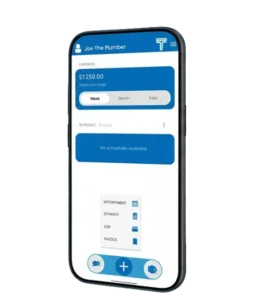
If there’s one upgrade that can truly change your HVAC business, it’s getting rid of manual data entry. Using a field service management (FSM) tool like TackonFSM isn't just a small tweak—it connects every piece of a job, from the first estimate to the final payment, into one seamless flow.
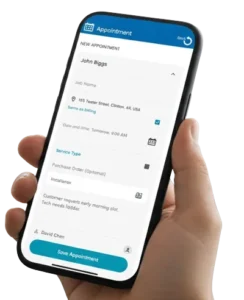
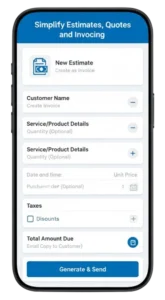
Let’s walk through a common scenario. Your tech is on-site and finds a bad capacitor. Instead of scribbling on a notepad, they open TackonFSM on their phone, find the part in your pre-loaded database, add the flat-rate labor, and generate a professional estimate right then and there. The customer sees it, signs off digitally, and the job is a go.
That approved estimate instantly becomes a work order. As soon as the repair is done, that work order turns into a polished, branded hvac invoice template with a single click. Every detail—the parts, labor, and customer info—is already populated. No duplicate work, no forgotten charges, and no typos.
From Job Completion to Instant Payment
This is where the real magic happens. Rather than waiting to get back to the office to create and mail an invoice, your technician can take payment right in the field with a mobile card reader. Better yet, they can text or email a secure payment link directly to the customer, who can pay online before the van even leaves their driveway.
Getting paid faster often comes down to having a clear process. The moment the job is done, you should be ready to collect.
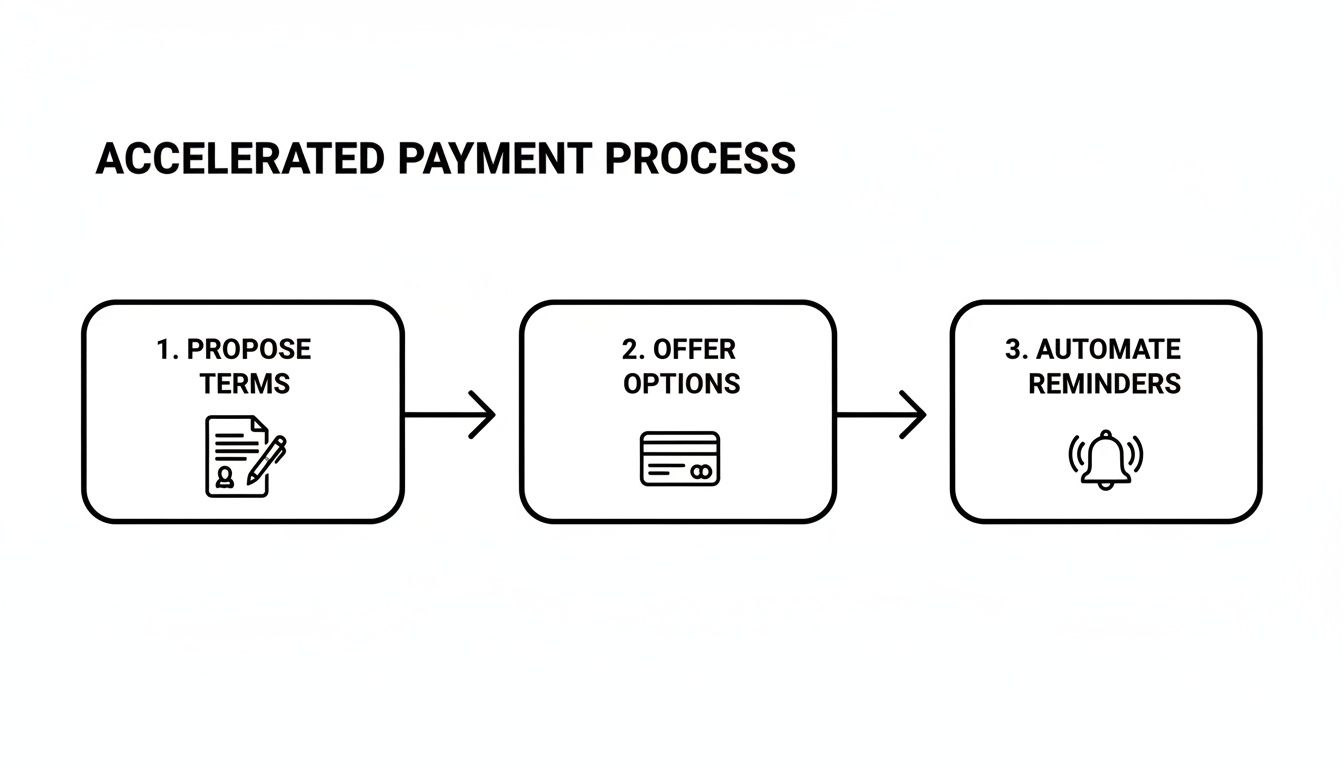
This simple flow of setting clear terms, giving flexible payment options, and using automated follow-ups knocks out the most common reasons for late payments. If you want to dig deeper into the nuts and bolts, this guide can show you how to automate invoice processing from start to finish.
But what about the invoices that don't get paid on the spot? TackonFSM has you covered. You can set up automatic, professional payment reminders for any outstanding balance. These friendly nudges go out on a schedule you control, which means your admin staff isn't stuck making those awkward collection calls. That feature alone is a massive win for your cash flow.
Key Insight: Automation does more than just save time. It gets rid of the tiny errors and delays that add up across hundreds of jobs, giving you a crystal-clear, real-time picture of your company's financial health.
This kind of system gives you complete visibility. From one dashboard, you can see every invoice that's been sent, opened, and paid. It's a huge step up from tracking down paper copies or hunting through messy spreadsheets. Truly understanding why field service management software matters is the first step toward getting your time back so you can focus on growing the business.
Got Questions About HVAC Invoicing? We’ve Got Answers.
Even with the perfect template, real-world HVAC jobs can throw you a curveball. You’ll inevitably run into situations that make you pause and wonder about the right way to bill. Knowing how to handle these common scenarios isn't just about getting paid—it's about keeping your cash flow steady and your customers happy.
Let's dive into some of the most frequent questions we see from HVAC contractors.
How Should I Bill for Big Installation Projects?
When you're looking at a large-scale installation, waiting until the very end to send a single bill just isn't practical. The cash you need for equipment and labor is tied up for weeks or even months. Instead of one massive invoice, the industry standard is to break it down into progress payments.
For any job of significant size, always start with a deposit. Requiring 30-50% upfront is a completely normal and smart business practice. It covers your initial outlay for equipment and materials, protecting your business if a client gets cold feet.
From there, you’ll want to map out a clear payment schedule tied to major project milestones. Here's a structure that works really well for most big jobs:
- 50% Deposit: This is due when the contract is signed. It locks in the job and lets you order the primary equipment.
- 40% Progress Payment: Bill for this chunk once the system is installed and you’ve completed the start-up and commissioning.
- 10% Final Payment: The final amount is due after the job is 100% complete and you've done the final walkthrough with the client.
Make sure you issue a separate, professional invoice for each stage. A crucial tip: always reference the original proposal or contract number on every single invoice. This creates a clean, easy-to-follow paper trail that both you and your client (especially their accounting department) will appreciate.
How Much Detail Is Too Much for Parts and Labor?
When it comes to avoiding disputes, transparency is your best friend. Vague descriptions like "parts" or "service call" just invite questions and suspicion. Detailed line items, on the other hand, build trust.
My advice is to always itemize parts with specific names and part numbers whenever you can, listing their individual costs.
For labor, you've got a couple of solid options. You can either list a flat rate for a specific service (like an "Annual Furnace Tune-Up Package") or bill by the hour. If you’re billing hourly, be sure to clearly state your rate and the total hours worked.
Try to avoid generic catch-alls like "shop supplies." If you need to account for things like fuel or consumables, a more professional approach is to use a clear line item like "Service Vehicle & Supply Charge." Just be prepared to explain what that covers if a customer asks.
A Quick Note on Digital Invoices: Don't forget, a digital invoice is every bit as legally binding as a paper one, as long as it contains all the necessary business and service information. Using a system that logs when an invoice is sent, opened, and paid gives you a rock-solid digital record.
What Should I Include in My Payment Terms?
Think of your payment terms as the rules of the game—they need to be crystal clear. This little section on your invoice can save you major headaches down the road by leaving no room for misunderstanding.
Be sure to include these four things:
- Payment Due Date: Be direct. Use terms like "Due on Receipt" for most service work or "Net 30" for commercial clients you have a history with.
- Accepted Payment Methods: Clearly list all the ways a customer can pay you—credit card, check, ACH, online payment link, etc.
- Late Fee Policy: A simple, professional statement works best. Something like, "A late fee of 1.5% per month will be applied to balances over 30 days past due," is standard and enforceable.
- Warranty Info: Briefly mention any warranties on parts or your labor. It’s a small touch that reinforces the quality and value you’re providing.
Ready to put these common headaches behind you and get your billing process on autopilot? With a tool like TackonFSM, you can manage everything from creating the initial estimate to sending the final invoice and collecting payment, all in one spot.