Software for Electrical Contractors That Boosts Profit

Still trying to run your electrical business on spreadsheets and stacks of paper? That’s a bit like trying to wire a new smart home with nothing but a roll of electrical tape and crossed fingers. It might hold for a minute, but you’re setting yourself up for a costly breakdown. Good software for electrical contractors isn't a luxury item anymore; it's the main circuit breaker that keeps your operations from overloading and powers your company's growth.
Why Spreadsheets Are Costing Your Electrical Business Money

If you’re still juggling jobs with a maze of spreadsheet tabs and a constant stream of phone calls, you're not just dealing with a headache—you're actively losing money. The hidden costs of doing things by hand pile up fast, creating small leaks in your revenue that you won’t notice until they've become a flood.
Every minute your office staff spends typing in data, trying to line up schedules, or building invoices from scratch is a minute they aren't spending on high-value tasks like customer follow-ups or finding new business. These little inefficiencies are more than just frustrating; they're a serious drain on your bottom line.
The Real-World Impact of Manual Operations
Think about the daily scramble. A customer calls to reschedule, sending your dispatcher on a wild goose chase through multiple calendars and a flurry of calls to see which tech is free. Or, a big installation wraps up, but someone forgets to add one critical part to the invoice, instantly wiping out the profit on that job.
These aren't just one-off mistakes. They expose the fundamental problems of using outdated tools:
- Lost Revenue: Forgetting to bill for parts, underestimating labor, and making quoting errors directly hit your bank account.
- Wasted Time: Techs burn expensive fuel and billable hours driving zigzag routes because no one has a clear, real-time view of where everyone is.
- Poor Customer Experience: Disorganized scheduling, missed appointments, and slow invoicing create frustrated customers who probably won't call you for the next job.
Relying on manual systems in the electrical trade is a high-risk gamble. It puts you in a constant state of putting out fires, forcing you to solve problems that the right software would have prevented in the first place.
The Shift to Purpose-Built Software
The industry is finally moving on from these old-school methods. Over the last decade, specialized software has gone from a "nice-to-have" for big companies to an essential tool for shops of all sizes. In fact, the global market for electrical contractor software is expected to hit around $3.2 billion by 2033, all because the efficiency gains are real and measurable.
When a dispatcher has a live, bird's-eye view of every job and every technician, companies report completing 10–20% more jobs per tech each week. You can get a much deeper look into the electrical contractor software market trends and see how other businesses are making this technology work for them.
At the end of the day, sticking with spreadsheets isn't just about being old-fashioned. It's about choosing a system that actively limits your ability to grow, control your costs, and provide the kind of professional service that earns repeat business. Specialized software plugs those financial leaks and turns operational chaos into predictable, controlled profit.
The Core Features That Directly Impact Your Bottom Line
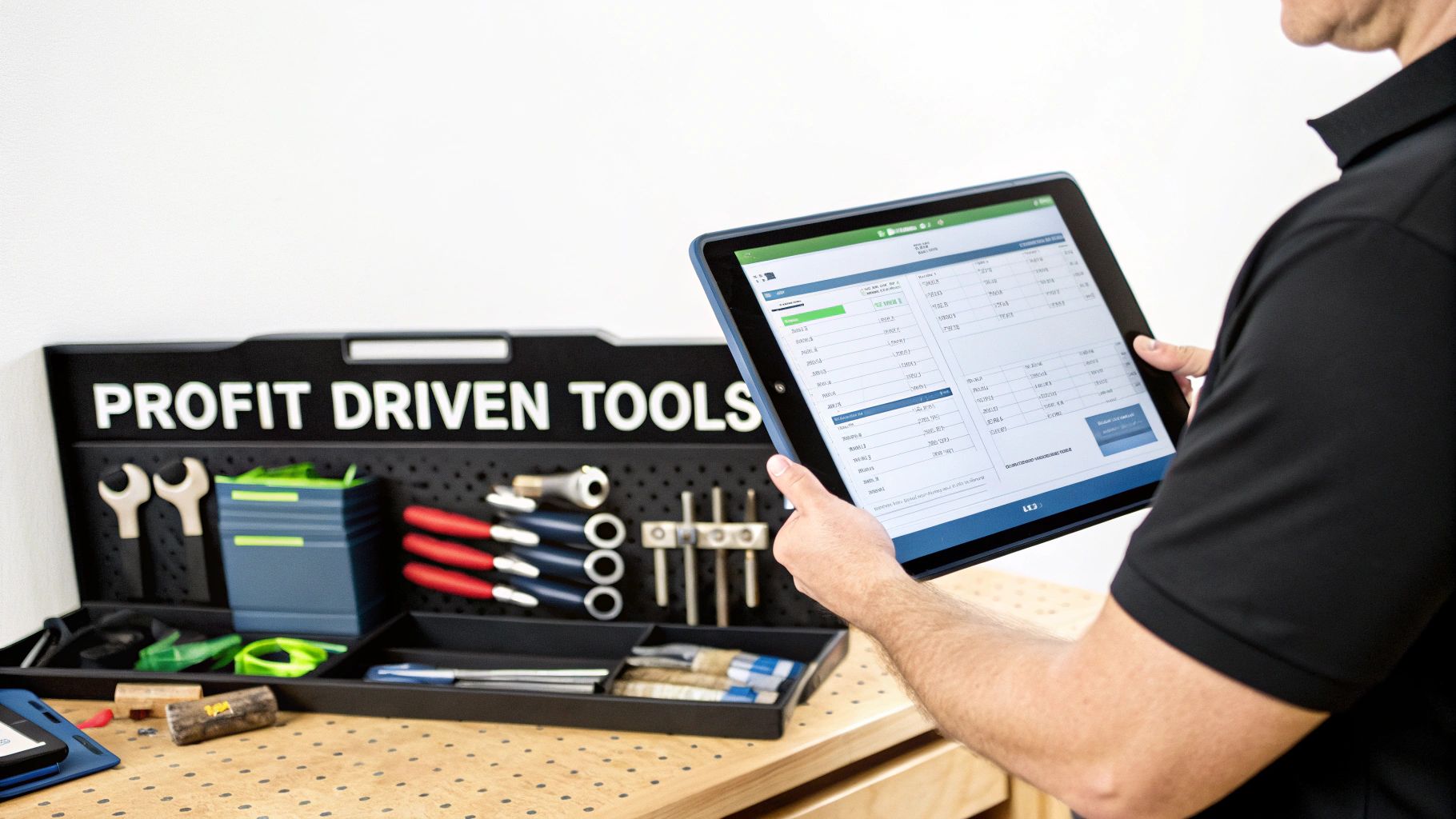
While every software platform tries to dazzle you with a long list of bells and whistles, only a handful of features truly make a difference for an electrical contracting business. These are the tools that cut through the daily chaos, stop revenue from leaking out, and turn operational tweaks into real, measurable profit.
It helps to think of these features not as separate apps, but as interconnected gears in a machine built for growth.
When you're looking at software for electrical contractors, zero in on the tools that solve your biggest and most expensive headaches first. For most shops, the real pain points fall into a few key areas: getting the right tech to the right job without wasting time, empowering your team in the field, making sure every minute and part gets billed for, and wrangling the materials that make your work possible.
Here's a closer look at the features that really matter, and why they’re so critical for running a smarter, more profitable electrical business.
Essential Software Features for Electrical Contractors
This table breaks down the must-have features and explains the specific, real-world problems they solve day-in and day-out.
| Feature | What It Does | Why It's Critical |
|---|---|---|
| Scheduling & Dispatch | Provides a central, real-time view of all jobs and technicians, often with drag-and-drop functionality. | Eliminates wasted drive time, simplifies handling emergency calls, and maximizes billable hours for your entire team. |
| All-in-One Mobile App | Gives technicians access to job history, estimating tools, and payment processing on their phone or tablet. | Turns techs into problem-solvers who can upsell, get paid on-site, and provide a better customer experience. |
| Integrated Invoicing | Automatically creates invoices from work orders, pulling in parts, labor, and flat-rate items. | Drastically reduces billing errors, gets invoices to customers faster, and ensures you get paid for everything you do. |
| Payments Processing | Allows for on-site credit card payments and provides online payment portals for customers. | Slashes the time between job completion and getting paid, dramatically improving your cash flow. |
| Inventory & Parts Mgmt. | Tracks material stock levels across multiple locations (like vans and a warehouse) and ties parts to jobs. | Prevents lost revenue from unbilled parts, reduces unnecessary trips to the supply house, and gives you accurate job costing. |
Ultimately, these core functions work together to give you total control over your business, from the initial customer call to the final payment. Let's dig into each one.
Intelligent Scheduling and Dispatch
Your dispatch board is the command center of your entire operation. A messy whiteboard or a tangled spreadsheet is a recipe for daily friction, leading to wasted drive time, missed appointments, and techs who are completely burned out.
Modern software throws that old system out the window. It gives you a dynamic, drag-and-drop digital board that shows you exactly what’s happening, right now. Imagine seeing every technician’s schedule, their job status, and their location in real time, all on a single screen.
An emergency call comes in. Instead of making a dozen frantic phone calls, you just glance at the map, find the nearest available tech, and drag the new job onto their schedule. The system instantly pings them with all the details. This isn't just about making life easier; it's about squeezing every possible billable hour out of the day.
The All-In-One Mobile App for Technicians
Your technicians are the face of your company and your main revenue drivers. Giving them a powerful mobile app is like giving each one a personal assistant who rides shotgun. It gets rid of paper work orders, constant calls back to the office, and that dreaded end-of-day scramble to make sense of handwritten notes.
With a solid mobile app, your techs can:
- See the full job history: They show up on-site already knowing what work was done before, what equipment is installed, and any special notes from the customer. No more guesswork.
- Build professional estimates on the spot: They can create multi-option quotes with accurate pricing from your pricebook, get a digital signature for approval, and schedule the follow-up work right then and there.
- Process payments instantly: As soon as the job is done, they can generate an invoice and take a credit card payment on their phone or tablet. This single action can radically shorten the time it takes to get that cash in your bank account.
A mobile app transforms your technicians from just installers into true field-based business managers. It empowers them to solve problems, close sales, and improve cash flow without ever leaving the job site.
Integrated Invoicing and Payments
The gap between finishing a job and actually getting paid is where countless electrical businesses bleed money. Manual invoicing is painfully slow and full of opportunities for mistakes. A forgotten part, a wrong labor rate, or a simple typo can delay a payment for weeks or completely wipe out your profit on a job.
Integrated invoicing fixes this by tying every part of the job directly to the final bill. When a tech adds a breaker to the work order from their app, that breaker automatically appears on the invoice. When they log their hours, the labor is calculated and billed correctly. It's that simple.
This seamless connection means invoices can be generated and emailed to the customer the second a job is marked complete. Many systems also include online payment portals or secure payment links sent via text, making it incredibly easy for customers to pay you right away. This feature alone is a game-changer for improving cash flow and slashing your accounts receivable.
Robust Inventory and Parts Management
For any electrical contractor, parts are money. Every single breaker, switch, and spool of wire sitting in a van or on a warehouse shelf is cash tied up in inventory. Without a good system to track it, you’re practically guaranteed to lose profit to shrinkage, unbilled materials, or poor purchasing.
Any serious software for electrical contractors has to have strong inventory management. This is about more than just counting what you have; it's about knowing where it is and making sure it gets billed for. The key features you need are:
- Multi-location tracking: See real-time stock levels across every van, the shop, and any other storage units.
- Low-stock alerts: Get automatic notifications when you're running low on critical parts, preventing those last-minute, profit-killing runs to the supply house.
- Purchase ordering: Create and send POs directly from the software to keep your procurement process clean and organized.
- Job costing: Assign specific parts to specific jobs so you know every single component is accounted for on the final invoice.
This level of control stops you from over-ordering, cuts down on material waste, and ensures that the $20,000 of stock you have on hand—as one contractor mentioned—is a profitable asset, not a costly mystery.
How to Calculate the Real ROI of Your Software
Thinking about new software for electrical contractors as just another monthly bill is a common mistake. It’s like looking at a top-of-the-line circuit tester and only seeing the price, ignoring the countless hours and headaches it saves you on the job. The right software isn't a cost—it's an engine for growth. You just need to know how to measure its real return on investment (ROI).
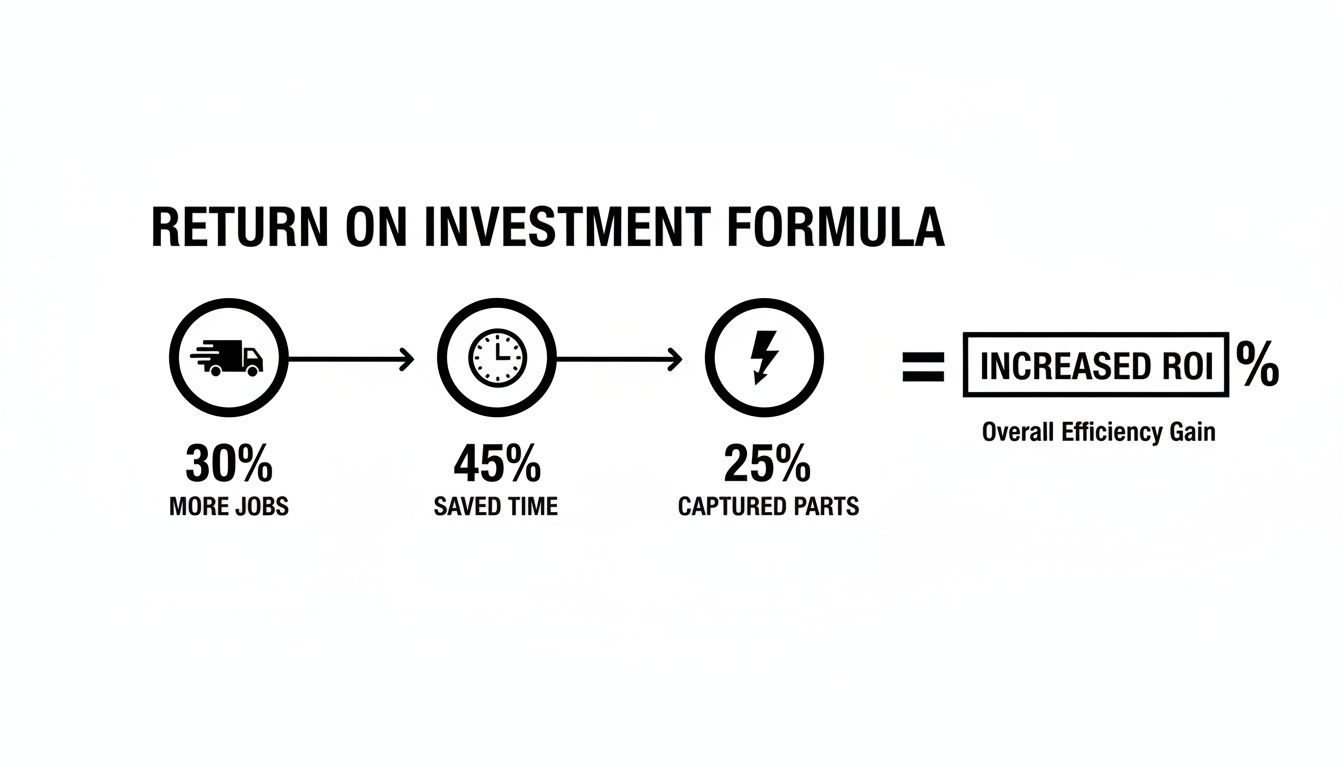
You don't need a complicated financial spreadsheet for this. You can figure out the real value with some quick, back-of-the-napkin math. Just focus on the three places where this software makes the biggest difference: getting more out of your techs, cutting down on office busywork, and plugging revenue leaks.
More Billable Hours from Your Technicians
The most obvious payback comes from helping your techs complete more billable work. Think about all the time wasted on inefficient routes, digging for job details, or driving back to the office for paperwork. Good software gives them everything they need on their phone or tablet, letting them finish faster and fit more jobs into the same workday.
Let’s break it down with a simple example:
- Value of one extra job: First, figure out your average profit on a typical service call. For this example, let's say it's $300.
- Weekly gain per tech: Now, let's be conservative and assume the software helps each tech squeeze in just one extra job per week.
- Multiply across the team: If you have a crew of four technicians, that's four extra jobs every single week.
The ROI Math:
1 extra job/week x $300 profit/job x 4 technicians = $1,200 in new weekly profit.
That’s an extra $4,800 in your pocket every month—an amount that almost certainly blows away the software's subscription cost.
Less Time Wasted on Administrative Tasks
Next, think about your office. How many hours are burned on manual data entry, playing phone tag to schedule jobs, or chasing down unpaid invoices? All that administrative overhead adds up to a serious operational drag. Software automates these repetitive tasks, freeing up your office staff to focus on things that actually move the needle, like customer service and marketing.
Take invoicing, for example. If your office manager spends five hours a week building invoices by hand and you value their time at $25/hour, you’re spending $125 every week (or $500 a month) on a task that good software can handle in minutes. That time saved is a direct, immediate financial win.
Plugging the Leaks and Capturing Lost Revenue
Finally, what about all the little things that fall through the cracks? A forgotten part that never makes it to the invoice, a slight miscalculation on labor, an estimate that gets lost in a pile of paper—these small leaks drain your profits over time. Software with built-in inventory and quoting tools turns these losses back into profit.
The electrical services market is getting more complex and is projected to grow to over $228.98 billion by 2035. Trying to keep up with pen and paper just isn't going to cut it anymore. With the software service segment expected to account for 75% of that market, digital tools are becoming non-negotiable for contractors who want to grow. You can learn more about these growth trends in the electrical services market and see how software is at the center of it all.
By tracking every single part from the van stock to the final invoice, platforms like TackonFSM make sure you get paid for everything you use. It’s not about finding new customers; it’s about capturing all the revenue you’ve already earned but were accidentally letting slip away.
When you add it all up—more completed jobs, reclaimed administrative hours, and captured revenue—the financial case for investing in the right software becomes crystal clear.
A Day in the Life with Modern Electrical Software
It’s one thing to talk about features, but it's another thing entirely to see how the right tool can fundamentally change your day-to-day operations. If you're an electrical contractor, you’ve probably gotten so used to the daily chaos that you just accept it as part of the job. But what if all those frantic phone calls, missed opportunities, and frustrating delays just… stopped?
Let's walk through what a typical day looks like when you swap the old-school spreadsheets and whiteboards for a dedicated software for electrical contractors. This isn't about adding more tech to complicate your life; it's about removing the friction from the moments that make or break your business.
Here are a few scenarios every contractor knows all too well.
The 9 AM Emergency Call
Before Software: The phone rings. It's a high-value commercial client, and their point-of-sale system is down because a circuit keeps tripping. Your dispatcher promises to get someone there ASAP, and the scramble begins. They stare at a messy whiteboard, trying to figure out which tech is closest and who can be pulled from a non-urgent job. This kicks off a chain reaction of phone calls, texts, and back-and-forth confusion. Just getting a tech rerouted easily burns 20 minutes.
After Software: The same call comes in. This time, the dispatcher pulls up a live digital map showing every tech's real-time location. With a quick glance, they see Mark is just ten minutes away and wrapping up a simple outlet installation. They click on the new emergency job, drag it onto Mark’s schedule, and the system instantly pushes the address, client history, and job notes straight to his phone.
The entire process takes less than 60 seconds. The client is blown away by the speedy response, and Mark shows up fully prepared. A potential crisis is turned into a smooth, professional save.
The Quote That Went Cold
Before Software: Your tech finishes a diagnostic visit and spots the need for a panel upgrade. He scribbles some notes on a paper form, tells the customer someone from the office will send a quote, and moves on. Back at the shop, that piece of paper gets buried. The quote finally goes out two days later, but the customer’s urgency is gone. The lead goes cold, and you lose a profitable job.
After Software: The tech identifies the need for the panel upgrade on the spot. He grabs his tablet, opens the quoting tool in his mobile app, and builds a professional estimate right there in front of the customer. He uses the company’s pre-loaded price book to create two clear options: a standard replacement and a premium upgrade that includes whole-home surge protection.
The customer can see everything clearly, compare their options, and digitally sign off on their choice right then and there. The job is won and scheduled before your tech even leaves the driveway.
The Hunt for the Missing Breaker
Before Software: A tech is knee-deep in a commercial rewiring project and realizes he needs a specific 20-amp dual-function breaker. He swears he has one in the van but can't find it. A call to the office is useless—they have no idea what’s in the shop. He ends up driving to the supply house, wasting an hour of billable time and pushing back the project timeline. Of course, he later finds the breaker under a seat. The new one he bought gets tossed in the van, never to be tracked or billed for.
After Software: Same situation, but this time, the tech just pulls out his phone. He opens the inventory app, sees he has one of the needed breakers assigned to his van, and the app even tells him which bin it’s in. He finds it in seconds and gets back to work. He then marks the part as "used" on the work order, which automatically deducts it from his van’s inventory and adds it to the customer's final invoice. No guesswork, no wasted time, no lost revenue.
These small, daily wins—the saved minutes, the captured parts, the jobs won on the spot—are what it’s all about. Modern software doesn’t change the work you do. It just gives you a smarter, faster, and far more profitable way to do it.
Your Guide to a Painless Software Implementation
Making a big operational change can feel like rewiring an entire building while the power is still on. It’s intimidating, but with a solid plan, it’s a smooth and incredibly rewarding process. Switching to new software for electrical contractors isn’t just about flipping a switch; it’s about carefully upgrading your company's entire nervous system.
A successful rollout comes down to four key stages: cleaning up your data before moving it, getting your team excited about the new tools, tailoring the software to your unique workflows, and launching with a smart, phased approach. Think of it like a job site: you prep the area, pull the right wires, make the connections, and then energize the circuit one section at a time.
Tidy Up Your Data First
Before you can import a single file, you need to clean house. Migrating messy, outdated, or duplicate data into a new system is like moving a pile of junk from an old garage into a brand-new one. You haven’t solved the problem; you’ve just given it a new home.
Start by auditing your most critical information. This means getting your hands dirty and reviewing your:
- Customer Lists: Get rid of duplicate entries, update phone numbers and emails, and make sure customer names are standardized. A clean list ensures your team has the right info from day one.
- Price Books: Now is the perfect time to review your pricing. Ditch obsolete parts, update your costs and markups, and organize your services and materials in a way that actually makes sense.
- Job History: You have to decide what historical data is truly essential. While some history is useful for repeat customers, importing every job from the last 10 years might be overkill and just slow things down.
A clean data import is the foundation of a successful launch. It ensures your new system starts off with accurate, reliable information, which builds immediate trust with your team.
Get Your Team Onboard
The most powerful software on the planet is useless if your electricians won't use it. Resistance to change is totally normal, especially for seasoned pros who have their own way of doing things. The key is to frame the new software not as a top-down mandate, but as a tool that makes their jobs easier.
To get everyone on the same page, you need good change management in digital transformation that guides your team through the transition. Be sure to highlight the direct benefits for them: no more hunting for paper work orders, instant access to a customer’s job history right on their phone, and faster invoicing that leads to more stable work.
Pro Tip: Identify a "tech champion" on your team—someone who is respected and open to new technology. Train them first and get them excited. They’ll become your best advocate, helping to win over their more skeptical colleagues.
Customize Your New Setup
Your electrical business isn't a generic template, and your software shouldn't be either. The best platforms, like TackonFSM, allow for deep customization so the system works the way you do, not the other way around. This is where you make the software feel like it was built just for your shop.
Focus on configuring these key areas:
- Job Types and Checklists: Build out specific templates for your most common jobs, like "Panel Upgrade," "EV Charger Install," or "Troubleshooting Service Call." Include checklists to guarantee quality and consistency every single time.
- Invoice and Estimate Templates: Customize your documents with your company logo, terms and conditions, and a professional layout. It’s a small touch that reinforces your brand and makes you look polished.
- User Roles and Permissions: Set up different access levels for owners, office managers, and technicians. This ensures team members only see the information they need to do their jobs, keeping everything secure and simple.
Launch with Confidence
Whatever you do, avoid a chaotic "big bang" launch where everyone switches over at once. A phased rollout is much safer and way less stressful.
Start with a small group of users or a specific type of job. Let them work out the kinks and give you honest feedback. Once they’re comfortable and you’ve made adjustments, you can gradually roll the software out to the rest of the team.
This is where choosing a software provider that acts as a true partner becomes critical. Look for a company that offers hands-on support for data migration and provides comprehensive training. A good partner doesn't just sell you software; they stick with you through every step to make sure your team is successful from day one.
How to Choose the Right Software Partner for Your Business
Picking the right software for electrical contractors is a lot more than just ticking boxes on a feature list. You’re not just buying a tool; you're bringing on a long-term partner that will become the central nervous system of your entire operation. The wrong choice can lead to a mess of frustrating workarounds, surprise fees, and a system you’ll outgrow before you know it.
The trick is to look past the polished sales pitch and start asking the hard questions that reveal a provider’s real commitment. Think about where your business is going, not just where it is right now. A platform that feels great when you have two vans needs to run just as smoothly when you have ten.
Look Beyond the Feature List
Sure, any software company can give you a slick demo of a drag-and-drop calendar or a cool mobile invoicing feature. But to find a true partner, you have to dig into the things that aren't so obvious—the things that really matter down the road.
As you start looking, it's a good idea to evaluate custom vs. off-the-shelf options to figure out what truly fits your unique business needs. This initial decision frames everything that follows.
From there, zero in on three core areas that really tell you if a provider is built for the long haul.
- Scalability: Can this system actually grow with you? Ask them straight up about user limits, data storage, and if the platform gets sluggish once you have a ton of technicians and years of job history bogging it down.
- Support: What happens when a tech is stuck on a job site at 7 PM and can't get a payment to go through? You need to know the support team's hours, their typical response times, and whether you’ll get a real human who actually understands the trades.
- Pricing Model: Get out your magnifying glass and really examine the fee structure. Is it a simple flat fee, or are there hidden per-user charges that will punish you for hiring more people? Be very skeptical of long-term contracts with massive cancellation fees—they're designed to trap you.
A genuine software partner offers clear, flexible pricing that scales right alongside your business. Their success should be tied to your growth, not to locking you into an ironclad contract you can't escape.
Key Questions for Your Potential Partner
Before you even think about signing a contract, make sure you get solid answers to these questions. A provider who is confident in their product and service won't have any problem answering them.
- What does your onboarding and data migration process actually look like, step-by-step?
- How do you handle feature requests from customers like us?
- Can you connect me with a few electrical contractors of a similar size who are using your software?
- What new features or improvements are on your development roadmap for the next 12 months?
Choosing the right software is one of the biggest business decisions you'll make. Take your time, do the research, and pick a partner who is genuinely invested in helping you build a smarter, more profitable company.
Answering Your Top Questions About Electrical Contractor Software
Jumping into new software always brings up a few questions. As an electrical contractor, you’re not just buying a tool; you're investing in a new way to run your business. Here are some honest answers to the questions we hear most often from owners like you.
Will My Less Tech-Savvy Electricians Actually Use It?
Absolutely. We get it—not everyone on your crew is a tech wizard. The good news is that modern field service apps are built to be dead simple. If your techs can use a banking or social media app on their phone, they can use this.
Think big, clear buttons, logical workflows, and prompts that guide them through everything from building a quote to taking a payment. Most electricians get the hang of it in less than a day because they see it makes their job easier, not more complicated.
How Much Time Do I Really Need to Set This Up?
It's a lot faster than you probably think. A good software partner doesn't just hand you the keys and walk away. They'll do the heavy lifting, like importing your customer database and your flat-rate price book. For your team, the actual training is usually just a couple of hours.
A solid rule of thumb is to plan for one to two weeks from the day you sign up to the day you're fully up and running. This gives you breathing room for importing your data, training the team, and tweaking your invoice templates without feeling rushed.
Can This Software Handle Both Small and Large Jobs?
Yes, flexibility is the whole point. The best platforms are designed to manage a quick 30-minute residential service call just as easily as a massive, multi-week commercial installation.
You can set up different job types, attach detailed plans and photos, assign multiple techs over several days, and keep a close eye on your materials and labor costs, no matter how big or small the project is.
What Happens to All My Existing Customer Data?
Your data is your gold, and it comes with you. Any reputable software provider will have a clear process for data migration. They'll walk you through exporting your customer lists, price books, and job histories from your old spreadsheets or software and get it all imported correctly. This ensures you're not starting from scratch and can hit the ground running from day one.
Ready to see how one platform can cut through the daily chaos and boost your bottom line? TackonFSM gives electrical contractors the tools they need to schedule smarter, get paid faster, and finally get a handle on inventory. Start your free trial and feel the difference at https://www.tackonfsm.com.