

A Pro’s Guide to the Duct Size CFM Calculator

A duct size CFM calculator is a must-have tool for any serious HVAC pro. It takes the guesswork out of matching the required airflow (CFM) to the right duct diameter, which is key for hitting optimal velocity and efficiency. You just plug in your target CFM, and it gives you a solid duct size to start with. It's hands-down the fastest way to get a reliable baseline for your ductwork layout.
Why Accurate Duct Sizing Matters
Getting your duct sizing right from the start is the bedrock of a high-performing HVAC system. This isn't just about connecting a furnace to a vent; it's about delivering the exact amount of conditioned air to every single room quietly and without wasting energy. When the ductwork is sized properly, the whole system just works better.
I like to compare it to a home's plumbing. If the main water line is too small, you're left with frustratingly weak pressure at the faucets. If it's way too big, the water just sort of trickles along. Air behaves the same way in a duct system. Our job is to maintain a specific air velocity—the speed at which air moves through the duct.
The Balancing Act of Airflow
This is where the relationship between duct size, CFM, and velocity gets really important. A correctly sized duct maintains that ideal air velocity, which means you get an efficient and quiet system.
Here's what goes wrong when that balance is off:
- Undersized Ducts: Shoving a high volume of air through a duct that's too small cranks up the velocity. That's what causes that annoying whistling noise at the registers. It also puts a ton of strain on the blower motor, which can lead to it burning out way too soon.
- Oversized Ducts: On the flip side, using a duct that's too large for the CFM makes the air velocity drop. The air moves so sluggishly that it can't push into the room effectively. You end up with poor air mixing, hot and cold spots, and unhappy customers.
Key Takeaway: The whole point of using a duct sizer is to find that "Goldilocks" zone. You want a duct diameter that's just right for the airflow, keeping the velocity in that sweet spot for quiet, efficient performance.
Standard Velocity and System Efficiency
Thankfully, the industry has standardized Cubic Feet Per Minute (CFM) calculations, which makes our lives a lot easier. We have clear guidelines for target velocity ranges. For instance, main supply trunks should be moving air between 1,000-2,000 feet per minute (FPM), while the smaller branch runs feeding individual rooms are usually designed for 800-1,500 FPM.
Mess this up, and the system's efficiency tanks. In fact, studies show that improper duct sizing is responsible for roughly 30-40% of all HVAC system inefficiencies in homes. It's a huge number. You can dig deeper into these established HVAC standards to make sure your designs are always on point.
For a quick reference on the job, a simple chart can be incredibly helpful.
Quick Reference Duct Size and CFM Capacity Chart
This table shows the approximate CFM capacity for common round duct sizes, based on standard air velocity ranges you'd typically see in residential jobs.
| Round Duct Diameter (Inches) | Recommended CFM Range |
|---|---|
| 6" | 100 – 150 CFM |
| 7" | 150 – 225 CFM |
| 8" | 225 – 325 CFM |
| 10" | 400 – 600 CFM |
| 12" | 600 – 900 CFM |
| 14" | 900 – 1,300 CFM |
| 16" | 1,300 – 1,800 CFM |
Keep in mind, this is a starting point. The exact capacity can change based on the total length of the duct run and the number of turns, but for quick estimates, it's a solid guide.
The Physics Behind Flawless Airflow
Using a duct size CFM calculator is one thing, but truly understanding what's happening inside the ductwork is another. To go from simply following a chart to designing systems that actually work in the real world, you need a solid grasp of the physics. This is what separates the pros from the rookies—knowing the why behind the numbers.
It all starts with the single most important metric in airflow: Cubic Feet per Minute, or CFM. This is just a way of measuring how much air volume is moving past a certain point every minute. You can think of it as the system's heartbeat, pushing conditioned air where it needs to go.
CFM and Tonnage: The Starting Point
In HVAC, your total CFM is locked to the system's capacity, which we measure in tons. The go-to rule of thumb, one that’s been drilled into every experienced tech, is the 400 CFM per ton standard. So, if you're installing a 3-ton air conditioner, you know right off the bat you need to design a system capable of moving 1,200 CFM of air. Simple as that.
This number is the foundation for every other calculation you'll make. If that 3-ton unit is paired with ductwork that can only handle 900 CFM, you're setting it up for failure. The unit will be starved for air, which leads to a whole cascade of problems—frozen coils, sky-high energy bills, and a compressor that will burn out years before its time.
Every single design choice, from sizing the main trunk line down to the last branch run, hinges on that initial CFM requirement. If you get this wrong, the rest of the system is compromised before you even start.
The Balancing Act of Air Velocity
Okay, so you know the volume of air you need (CFM). Next up is the speed of that air, which we call Air Velocity, measured in Feet per Minute (FPM). The duct's diameter is what controls this speed.
Think about a garden hose. When you partially cover the end with your thumb, the water shoots out much faster. You haven't changed the amount of water coming through, but by making the opening smaller, you've cranked up the velocity. Ducts are no different. Squeezing 150 CFM through a little 6-inch duct creates a much higher velocity than letting it flow through a roomier 8-inch duct.
Getting the velocity right is a balancing act:
- Too Fast: This is what makes registers noisy. If you hear a high-pitched whistle coming from a vent, it's almost always because the velocity is too high (usually over 900 FPM in a residential run). The duct is simply too small for the amount of air being forced through it.
- Too Slow: Air that moves too slowly loses its momentum. It won't have enough "throw" to properly circulate and mix with the room's air. This is what causes drafts, stuffy corners, and those annoying hot and cold spots that customers always complain about.
A good duct size CFM calculator is designed to find that sweet spot, keeping the air moving efficiently without making a racket.
The Invisible Force of Static Pressure
Finally, you have to account for all the things that push back against your system's blower. This resistance is a combination of two things: static pressure and friction loss. Static pressure is the force the air exerts on the inside walls of the duct, like air in a balloon. Friction loss is the drag created as that air scrapes against the duct's inner surfaces and tumbles through elbows, dampers, and other fittings.
Every single foot of duct and every turn you add creates a little more friction that the blower has to fight against. The sum of all this resistance is called Total External Static Pressure (TESP), and it's a make-or-break metric for performance. If the TESP is too high, the blower physically can't move the CFM it was designed for, and airflow across the entire house will suffer.
This is exactly why we use the Equal Friction Method for design. The goal is to size every duct run so that it has the same rate of friction loss—typically a target of 0.08 to 0.10 inches of water column per 100 feet of duct. By keeping the resistance consistent throughout the system, you ensure balanced and predictable airflow to every single room. No more guesswork.
Getting Your Hands Dirty with Manual Duct Calculations
While software and apps are fast, knowing how to run the numbers yourself is what really separates the pros from the pack. This is where you connect the dots between theory and what actually happens in the field. Walking through the calculations builds an instinct for design and gives you the confidence to build a system from the ground up, ensuring every piece works together perfectly. It’s about understanding why a calculator spits out a certain number, not just taking its word for it.
The entire process kicks off with the HVAC unit itself. A system's total CFM is tied directly to its tonnage. The rule of thumb we all live by is 400 CFM per ton. So, if you're installing a 3-ton system, you’re designing for 1,200 CFM. A 4-ton unit? That's 1,600 CFM. This is the big number, the starting point for your entire layout.
From there, you zoom in from the whole house to individual rooms. A proper room-by-room load calculation—think Manual J—is what tells you how to slice up that total CFM. A big, open-concept living room with a wall of west-facing windows is going to demand a lot more air than a small, shaded powder room.
A Practical, Real-World Example
Let's walk through a common scenario. Say you’re mapping out the ductwork for a new addition that needs a total of 800 CFM for its main supply trunk. You also need to spec a smaller branch duct feeding a bedroom that requires 150 CFM.
For this design, you're aiming to maintain a friction rate of 0.10 inches of water column (iwc) per 100 feet of duct. This is a solid target for most residential jobs, as it strikes a great balance between airflow performance and energy efficiency.
This simple diagram helps visualize how these different metrics—CFM, velocity, and pressure—all relate to one another.
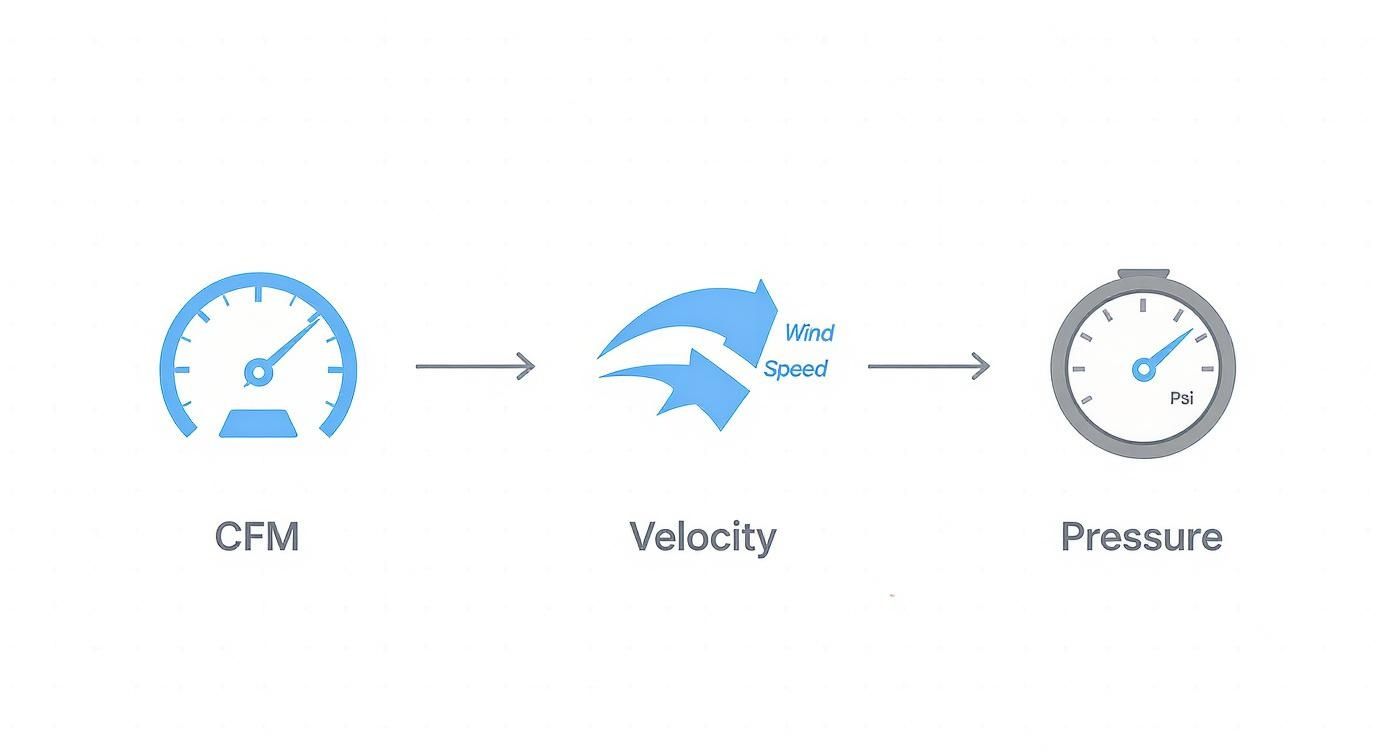
You start with the air you need to move (CFM), which tells you how fast it needs to move (velocity), which in turn determines the pressure inside the system.
Sizing the Main Supply Trunk
With your CFM values and target friction rate locked in, it's time to break out a ductulator (or a standard duct friction loss chart). These charts are the foundation of manual sizing.
Here's how you'd find the size for that 800 CFM trunk line:
- First, find the 800 CFM line on the chart.
- Next, locate the diagonal line for your target friction rate, 0.10 iwc.
- Follow the CFM and friction rate lines until they cross.
- From that intersection point, read the corresponding round duct diameter.
In this case, the lines meet right at a 12-inch round duct. The chart also gives you the air velocity, which would be around 1,020 FPM—a great speed for a main trunk that moves air effectively without creating a racket.
Sizing the Bedroom Branch Run
Now, let's do the same thing for the smaller bedroom branch that needs 150 CFM.
- Find the 150 CFM line on your ductulator.
- Stick with that same 0.10 iwc friction rate line.
- Trace them to where they intersect.
- At that point, the chart will point you to a 6-inch round duct.
The velocity here comes out to about 765 FPM. That's a fantastic, quiet speed for a branch run delivering air directly into a living space.
A Pro's Perspective: Always design the entire system using the same friction rate. Sticking to a consistent rate like 0.10 iwc is the key to a balanced system. It prevents you from blasting one room with air while another one feels stuffy.
What if Round Ducts Don't Fit? Converting to Rectangular
Let’s be honest—round ducts don't always work with the framing. You’ll inevitably run into tight joist bays or shallow soffits where a rectangular duct is the only way to go. Thankfully, converting from round to an equivalent rectangular size is simple with an equivalent diameter chart.
The whole point is to find a rectangular duct that can handle the same amount of air as its round counterpart without messing up your friction loss. Let's take our 12-inch round main trunk.
A quick look at an equivalent duct size chart shows you have a few options:
- 10" x 14"
- 8" x 18"
- 6" x 26"
Which one do you pick? It all depends on the space you have. If height is tight but you've got width to spare, the 6" x 26" is your answer. If you have more vertical room, the 10" x 14" is a more practical fit. This is exactly the kind of on-the-fly adjustment you have to make in the real world.
Following that same logic for our 6-inch round bedroom branch, you might find equivalents like:
- 4" x 10"
- 5" x 7"
The secret is to maintain the same effective cross-sectional area to keep your velocity and friction loss right where you designed them to be. When you master these manual steps, you develop a much deeper feel for how air moves, making you better at everything from design and installation to troubleshooting tough problems down the road.
How to Use Digital Duct Sizing Tools
While doing the math by hand is the best way to really get a feel for the physics of airflow, digital tools are where you gain serious speed and accuracy on the job. A good duct size CFM calculator can take a whole mess of steps and boil it down to a single answer, letting you game out different design ideas in minutes instead of hours.
Think of these tools as the modern version of the old-school ductulator slide rule. Instead of physically lining up numbers and squinting at a chart, you just punch in your variables. The software does all the heavy lifting in the background, freeing you up to think about the bigger picture of the system design instead of getting lost in the weeds of manual formulas.
Today's online calculators are surprisingly powerful. Many are built on the same complex algorithms found in the ASHRAE Fundamentals Handbook, and some studies suggest they can cut design errors by as much as 40% compared to reading off a chart. This lets you quickly optimize a layout for quiet operation, better efficiency, and the right pressure balance. If you want to get into the nitty-gritty, you can explore the technical standards behind modern duct sizing to see just how they get such reliable results.
Plugging in Your Design Numbers
Any calculator is only as good as the information you feed it. Garbage in, garbage out. To get a useful result, you have to give the tool the right ingredients to work with.
You’ll always need these three key pieces of information:
- Required Airflow (CFM): This is the target air volume for the space, which comes directly from your room-by-room load calculation.
- Target Friction Rate: This is the resistance you’re designing the system for, typically something like 0.10 inches of water column (iwc) per 100 feet of duct.
- Duct Material: The calculator has to know if you're running smooth sheet metal, duct board, or that ribbed flex duct. Each one has a totally different friction coefficient.
Forgetting to set the right duct material is a rookie mistake I see all the time. A run of flex duct has way more resistance than a smooth metal pipe, and the tool needs to account for that to give you the correct size.
Making Sense of the Results
After you punch in your numbers, the calculator will spit out several key metrics. Your job is to know what they mean for the real-world performance of your system. It's not just one magic number; it’s a complete picture of how that duct run will perform.
A solid duct size cfm calculator will give you:
- Recommended Duct Diameter: This is the main event—the ideal round duct size in inches needed to hit your targets.
- Resulting Air Velocity: The tool will also show you the air speed (in FPM) you'll get with your CFM in that duct size. This is your check to make sure it won't be too noisy.
- Friction Loss: Finally, it confirms the friction loss per 100 feet, making sure it lines up with your design target for a balanced system.
Pro Tip: Don't just take the first number the calculator gives you and run with it. Play around a bit. What happens to the velocity if you go up one duct size? How much does it change if you have to use flex instead of hard pipe for the last few feet? This is the real power of digital tools—they let you test "what-if" scenarios in seconds to find the absolute best design.
By running these quick comparisons, you can dial in a design that perfectly balances material cost, how easy it is to install, and whether it will run quiet and efficient for the homeowner. It’s what separates a "good enough" job from one that’s truly optimized for the long haul.
Common Duct Sizing Mistakes to Avoid

Even the most seasoned pros can fall into old habits, and when it comes to duct design, those habits can lead to costly callbacks. Getting the numbers right with a duct size CFM calculator is only half the battle. The real trick is avoiding the critical field mistakes that sabotage a system's performance.
These aren't just theoretical problems—they're the real-world issues I see all the time that lead to noisy vents, uncomfortable rooms, and overworked equipment. Let's walk through the big ones.
The most common trap is oversizing the ductwork. It feels like a "safer" choice, but in HVAC, bigger is definitely not better. When a duct is too large for the required CFM, air velocity absolutely plummets. Instead of a steady stream of conditioned air, you get a lazy, sluggish flow that can’t mix properly with the air in the room.
This leads directly to stratification, where hot air hangs near the ceiling and cool air pools on the floor. Suddenly, the customer is complaining about hot and cold spots, and no amount of thermostat fiddling can fix a fundamental airflow problem.
The Problem With Undersized Ducts
On the flip side, you have undersized ducts, which create an even more immediate and noticeable headache. Forcing too much air through a duct that's too small jacks up both air velocity and static pressure. The most obvious symptom is noise—that awful whistling or whooshing from the registers that drives homeowners nuts.
Beyond the racket, undersized ducts put a tremendous strain on the system's blower motor. The motor has to work way harder to overcome the high resistance, which spikes energy bills and dramatically shortens its lifespan. Think of it like redlining a car engine all day, every day. It's only a matter of time before it fails.
A properly used duct size CFM calculator is your best defense against both oversizing and undersizing. It helps you find that sweet spot for quiet, efficient operation.
Forgetting About Fittings and Flex Duct
Another major blind spot is underestimating the friction loss from fittings and flexible ductwork. A straight run of smooth sheet metal is easy to calculate, but the real world is full of twists, turns, and transitions.
Every 90-degree elbow, tee, and register box adds resistance that the blower has to fight against. Sharp, un-vaned elbows are particularly bad; they act like a bottleneck. Swapping those out for long, sweeping turns or vaned elbows can make a huge difference in the system's pressure drop.
Flex duct is an even bigger culprit. Its corrugated interior creates far more friction than smooth metal. A good rule of thumb is that a fully extended run of flex duct has roughly twice the friction loss of a comparable metal duct.
Here's where it gets really bad: a compressed or kinked section of flex duct can have a friction loss 10 times higher than a straight metal pipe. Overlooking this is one of the fastest ways to kill a system's performance, even if your main trunk lines were sized perfectly.
The Cardinal Sin: Ignoring Return Air
This might be the most damaging mistake of all: neglecting the return air side of the system. I’ve seen countless jobs where technicians focus all their energy on sizing the supply ducts perfectly but treat the return as an afterthought. This is a critical, system-killing error.
The return duct is the lungs of the HVAC system; if it can't breathe in, it can't breathe out.
An undersized return effectively chokes the entire system. It starves the air handler for air, leading to a cascade of failures:
- Reduced Efficiency: The system can't deliver its rated CFM, so your heating and cooling capacity tanks.
- Component Strain: The blower motor works overtime against a vacuum, leading to premature burnout.
- Coil Freeze-Ups: In cooling mode, low airflow across the evaporator coil can cause it to freeze into a solid block of ice, shutting everything down.
Your return air capacity must always be equal to or greater than your supply capacity. A well-designed system isn't just about pushing air out; it's about creating a balanced, continuous loop. Avoiding these common pitfalls is what separates a basic installer from someone who designs truly high-performance comfort systems.
Duct Sizing Questions We Hear All The Time
Even with a good duct size CFM calculator, some questions always come up on the job. These are the details that can make or break a system's performance, and getting them right is what separates a good-enough installation from a great one.
Here are some clear, no-nonsense answers to the questions we hear most often from other HVAC pros. Understanding the nuances of materials, velocity, and duct shapes will give you the confidence to tackle just about any design challenge.
How Does Duct Material Affect Sizing?
The material you choose for your ductwork is a huge factor because it directly impacts the friction rate. Just think of it like water flowing through a pipe. A smooth copper pipe offers very little resistance, but a rough, bumpy one will slow the water down. Air acts the exact same way.
- Sheet Metal: Smooth-walled metal ducts have low friction loss. Air glides through them easily, which means you can sometimes get away with slightly smaller ducts to move the same amount of air.
- Flex Duct: With its corrugated, spring-like interior, flex duct creates a ton of drag. All that turbulence seriously increases resistance and static pressure.
Pro Tip: To get the same airflow through a flex duct as a metal one, you almost always have to upsize it. For a run that calls for a 6-inch metal duct, you'll likely need a 7-inch or even 8-inch flex duct to deliver the same CFM without putting extra strain on the blower.
What Is the Ideal Air Velocity?
There’s no single "perfect" air velocity. The ideal speed really depends on where the duct is in the system. It's a constant balancing act between moving air effectively and keeping the system quiet.
For most residential jobs, here are the standard targets we aim for:
- Main Supply Trunks: A common range is 1,000 to 2,000 FPM. You need enough push here to get air to the furthest parts of the house.
- Branch Runs: For the ducts feeding individual rooms, 800 to 1,500 FPM is a solid target. This delivers enough air without that annoying whistling sound coming from the registers.
- Return Ducts: These should always be slower, typically between 600 to 1,000 FPM, so the system can pull air back in smoothly and quietly.
Can I Use a Rectangular Duct Instead of a Round One?
Yes, absolutely. Out in the real world, you’re constantly dealing with floor joists, plumbing, and other framing that gets in the way. Sometimes a round duct just won't fit, and that's okay.
The key is to find the equivalent diameter. This makes sure the rectangular duct has the same airflow capacity as the round one you originally sized. For instance, if your duct size CFM calculator specifies a 10-inch round duct, you can’t just wing it and guess a rectangular replacement. You need to consult a conversion chart or use a tool to find its equivalent, which might be something like a 12×8 inch rectangular duct. This swap keeps the cross-sectional area correct, holding your velocity and friction loss right where they need to be.
Why Is Sizing the Return Air Duct So Important?
The return duct is essentially the lungs of the entire HVAC system. If it’s too small, it can't pull enough air back to the air handler to be conditioned. We call this "starving" the system, and it's a critical, system-killing mistake.
An undersized return chokes off airflow and kicks off a nasty chain reaction of problems. It tanks the system's efficiency, puts a ton of strain on the blower motor, and can easily lead to premature—and very expensive—equipment failure. Always, always make sure your total return capacity meets or exceeds your total supply capacity. It’s the foundation of a balanced, healthy system.
Ready to stop juggling spreadsheets and start building more profitable, accurate quotes? TackonFSM integrates your duct sizing and parts lists directly into your estimates and inventory. Schedule a demo and see how you can streamline your workflow.