Difference between invoice and receipt: A Quick Guide
At its core, the difference between an invoice and a receipt is all about timing. An invoice is a request for payment that you send before the customer pays you. On the other hand, a receipt is proof of payment issued after the money has hit your account.
Think of it like going out to eat. The bill the waiter brings to your table is the invoice. The little slip you get back after you've paid with your card? That's the receipt.

Breaking Down the Core Differences
Even though both documents are vital for keeping your books straight, they serve completely different purposes. The invoice officially kicks off the payment process. It's a formal, itemized bill that lays out exactly what services you provided or what parts you sold, how much is owed, and when it’s due. For your business, this is how you manage your accounts receivable—the money people owe you.
A receipt, however, is the final step. It’s the official handshake that confirms a debt has been paid and the transaction is closed. For you, it proves cash has come in and helps you balance your books. For your customer, it's their proof of purchase, which they'll need for any warranties, returns, or even just for their own accounting.
Key Takeaway: An invoice essentially says, "Here's what you owe me." A receipt confirms, "Thanks, you've paid me." Getting this distinction right is fundamental to good bookkeeping and clear customer communication.
To put it all into perspective, here's a quick rundown of the main differences you'll want to remember.
Quick Comparison Invoice vs Receipt At a Glance
The table below breaks down the key attributes of each document side-by-side, giving you an easy way to see how they differ at a glance.
| Attribute | Invoice | Receipt |
|---|---|---|
| Purpose | To request payment for goods or services | To confirm that payment has been received |
| Timing | Issued before payment is made | Issued after payment is complete |
| Function | Tracks accounts receivable (money owed to you) | Confirms cash received and completes the sale |
| Call to Action | Asks the customer to pay by a specific date | Serves as a record; no further action needed |
This simple breakdown highlights that while they are both part of the same transaction, they bookend the payment process, one starting it and the other closing it out.
Breaking Down the Anatomy of an Invoice
An invoice isn't just a bill. It’s your formal, itemized request for payment that lays out every single thing you did on a job. For any field service business, a solid invoice is the key to getting paid promptly and keeping your books straight. It officially kicks off the payment process, giving your customer a complete breakdown of the work.
Think of it as the official record of the transaction. A handshake or verbal agreement gets the job started, but the invoice is the professional, legally sound document that eliminates any confusion over what was done and what’s owed.
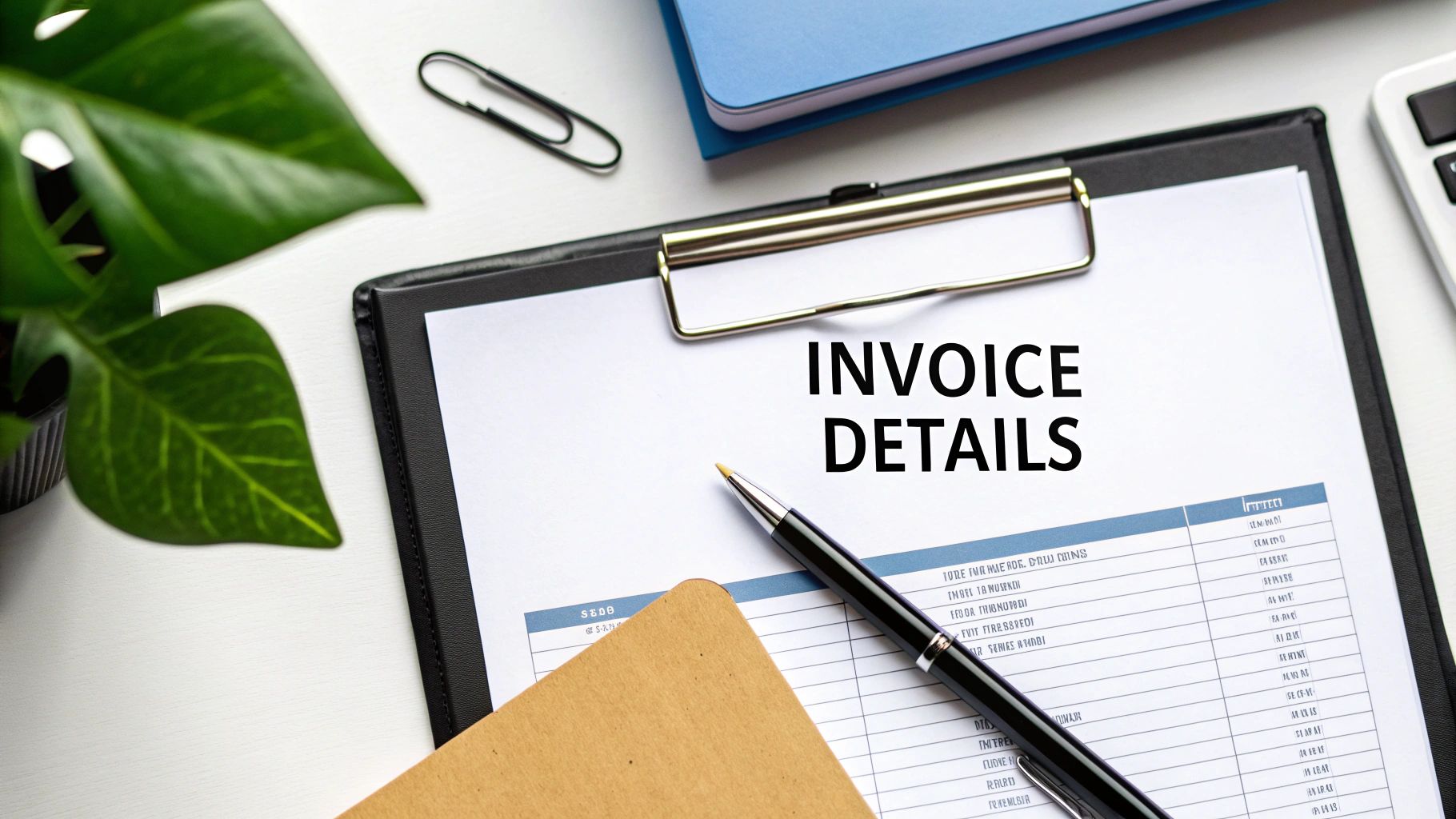
This document is absolutely essential for tracking your accounts receivable—the money your business is owed. Without a clear invoicing system, you're just guessing at your cash flow. It also creates a paper trail for both you and your client, which is priceless come tax time or if a payment dispute ever crops up.
Essential Components of Every Invoice
To look professional and actually get the job done, every invoice needs a few key pieces of information. If you leave any of these out, you’re just asking for payment delays, confused customers, and a bookkeeping mess later on.
A complete invoice must have:
- Your Business Information: Your company name, address, and phone number.
- Customer Information: The full name and address of the person or company you're billing.
- Unique Invoice Number: A simple, sequential number makes tracking and referencing so much easier.
- Dates: You need the date the invoice was created and, more importantly, the date the payment is due.
Beyond the basics, the real substance of the invoice is the line-by-line breakdown of charges. This is where you prove your value and build trust.
For any technician in the field, an itemized list is non-negotiable. You have to clearly separate labor costs from parts. List the quantities, give a short description of each part, and show the individual prices. This simple detail stops the "What am I even paying for?" phone call before it happens.
Payment Terms and Final Details
Lastly, your invoice has to give the customer clear instructions on how and when to pay you. This is where a lot of businesses stumble, and it’s a major reason for late payments. Clearly state which payment methods you accept, whether it's credit cards, checks, or an online payment portal.
You also need to include your payment terms, like "Due upon receipt" or "Net 30," to set clear expectations. If it was a big project, you might also want to reference the original contract number or add a quick note about warranties. Every little piece of information works together to create a professional document that helps you get paid faster and keeps your customers happy.
The Receipt: Your Proof of a Done Deal
Once your customer pays their invoice, the job isn't quite finished. The final, crucial step is issuing a receipt. Think of it as the official handshake that closes the loop on the transaction, turning a request for payment into a documented sale.
An invoice asks for money, but a receipt confirms you’ve received it. This distinction is vital for everyone involved. For your business, receipts are essential for clean bookkeeping. They let you officially move that money from "accounts receivable" to your cash balance, keeping your financial records accurate and up-to-date.
Without a solid receipting process, you're flying blind. You could end up chasing a customer who has already paid or struggling to reconcile your bank statements at the end of the month. It’s a simple document that prevents major accounting headaches.
Why Your Customers Need a Receipt
For your customer, that receipt is everything. It's their one and only proof that they paid you for the work you did. Whether they need to claim a warranty on a newly installed furnace, return a faulty part, or simply keep their own household budget in order, the receipt is their go-to document.
To be truly useful, a receipt has to include a few key details:
- The exact date the payment was made.
- The total amount paid.
- How they paid (credit card, check, cash, etc.).
- The remaining balance, which should clearly state $0.00.
A receipt isn't just a piece of paper; it's a legal document. For a homeowner who just spent thousands on a new HVAC system, that receipt is their peace of mind. It confirms their ownership, activates their warranty, and builds trust in your company.
From Open Invoice to Closed Book
At the end of the day, the difference between an invoice and a receipt boils down to timing and purpose. An invoice kicks off the payment process by outlining what's owed. A receipt wraps it all up by confirming the debt has been settled.
This final step allows both you and your customer to move on with confidence. You can accurately log your revenue, and they have the proof they need for their records. Sending a prompt, professional receipt isn't just good manners—it’s a core part of a transparent business process that protects both sides.
A Nuanced Comparison of Their Business Functions
On the surface, it’s simple: an invoice asks for money, and a receipt confirms you got it. But when you dig into your day-to-day business operations, their roles are far more distinct. Getting the hang of the difference between an invoice and a receipt is about more than just timing—it’s about understanding their legal weight, their impact on your accounting, and the specific information each one needs to carry.
Think of an invoice as an active, forward-looking document. The moment you send one, it kicks off your accounts receivable process and officially logs that a customer owes you money. This makes it your most important tool for managing cash flow, giving you a clear forecast of incoming revenue and a way to track down any overdue payments.
A receipt, on the other hand, is all about the past. It’s a historical record that closes the loop on a transaction, confirming that the funds have landed in your account and the corresponding invoice is settled. This proof of purchase is final, marking a clear end to that particular sales cycle.
Lifecycle Timing: Pre-Payment vs. Post-Payment
The most straightforward way to separate the two is by looking at where they fall in a transaction. An invoice belongs entirely in the pre-payment phase. It’s the bridge between finishing a job and getting paid for it, laying out what’s owed, how to pay, and when it’s due. It sets a formal expectation for the client.
Once that payment comes through, the invoice's job is over. That's when the receipt steps in, firmly in the post-payment phase. It serves as the official record that your customer held up their end of the bargain. This clear division of labor prevents any mix-ups—you’d never send a receipt before payment or an invoice after the fact.
An invoice is an open loop, a question awaiting an answer: "When will you pay?" A receipt is a closed loop, a definitive statement: "This has been paid." Managing them correctly ensures no financial questions are left unanswered.
Legal and Tax Implications
From a legal and tax standpoint, the distinction between an invoice and a receipt isn't just important—it's critical. Invoices are absolutely essential for figuring out and reporting your sales tax liability. That itemized list of services and materials lets you accurately track the taxes you owe, which is a non-negotiable part of staying compliant.
Receipts play a different, but just as vital, role. For your customer, a receipt is the official proof they need for their own tax deductions or to get reimbursed for expenses. For your business, it’s the primary evidence of your declared income if you ever face an audit. Without a proper receipt, a customer can’t prove they made a legitimate business purchase, and you’ll have a hard time verifying your revenue.
This is a great summary of the key roles a receipt plays in wrapping up a transaction.
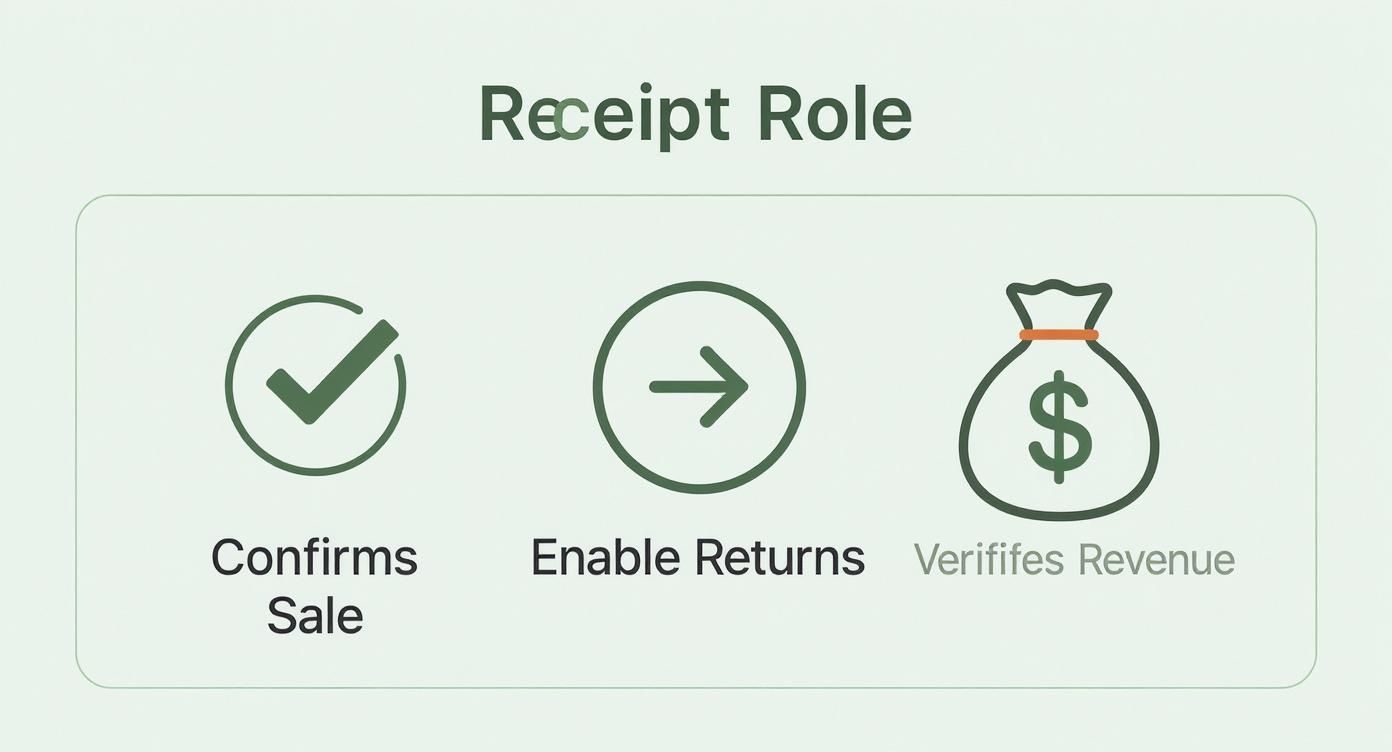
As you can see, a receipt isn't just a simple "thank you." It's a multi-purpose tool that confirms a sale, makes returns or warranty claims possible, and verifies your revenue for accurate bookkeeping.
The way you handle these documents has real financial consequences, too. Manual invoice processing is surprisingly costly, averaging around USD 22.75 per invoice. This is where automated systems are changing the game, with some reports showing that AI-driven invoice processing can cut both costs and processing time by over 60%.
Knowing When to Use an Invoice vs. a Receipt in the Field
It's one thing to know the definitions, but it’s the practical, in-the-moment decisions that keep your cash flow healthy and your customers happy. Let’s break down a few common scenarios you’ll run into out in the field.
Picture this: your HVAC tech just wrapped up a furnace repair. They replaced a bad ignitor and ran a full system diagnostic. Right then and there, before packing up the tools, is the time to generate an invoice. This document should clearly list the cost of the new part, the labor charges, and any service call fee. It's the official "here's what you owe me for the work I just did."
Once the homeowner pays—say, with a credit card on your tech’s tablet—a receipt is immediately created and emailed. This closes the loop, serving as the official proof that the payment was received and the invoice is now settled.
For Jobs with Multiple Payments
Bigger projects, like a full bathroom remodel for a plumbing company, have a different rhythm. You wouldn't wait until the very end to get paid. The process usually starts with an invoice for a deposit, often 50%, to cover the cost of materials and lock in the job on your schedule. As soon as that deposit hits your account, you issue a receipt for that specific payment.
When the last fixture is installed and the job is done, you’ll send a final invoice. This one details the remaining balance, factoring in all the labor and any extra materials that were needed along the way. After that final payment is made, a final receipt is sent. This provides a clean financial conclusion to the project, showing a zero balance and giving both you and the client peace of mind.
On projects with multiple payments, remember this: every single payment needs its own receipt. This creates an airtight paper trail, protecting you and the customer by showing exactly what was paid, when it was paid, and what balance is left.
Bringing Clarity to Complex Electrical Work
In electrical work, where a single job can have multiple moving parts, a detailed invoice isn't just helpful—it's essential. Imagine an electrician gets called out to upgrade a service panel but, while on-site, the homeowner asks them to troubleshoot a few dead outlets.
A good invoice separates these into different line items, making it easy for the customer to understand the charges:
- Project Work: One clear section for the panel upgrade, breaking down the cost of the panel itself, the breakers, and the hours dedicated to that specific installation.
- Service Work: A separate area detailing the time and materials used to diagnose and fix the faulty outlets.
This transparency prevents sticker shock and justifies the total cost. When the customer pays, the receipt becomes their proof of purchase, which is especially important for things like equipment warranties. It confirms precisely what they paid for, tying directly back to the itemized list on the invoice.
Streamlining Your Invoicing and Receipt Workflow
If you're still relying on paper, you know the drill. Chasing down invoices from the field, deciphering handwritten notes, and manually keying everything into your system—it’s a massive time sink. This kind of administrative drag doesn't just create chaos; it directly slows down your cash flow. Thankfully, modern field service software can completely overhaul this process.
Instead of your techs balancing a clipboard on a truck tailgate, imagine them generating a perfect, professional invoice right on their phone or tablet. All the crucial details—customer info, job notes, parts used, and labor hours—are pulled in automatically. It eliminates the guesswork and makes sure you get paid correctly for the work you did.
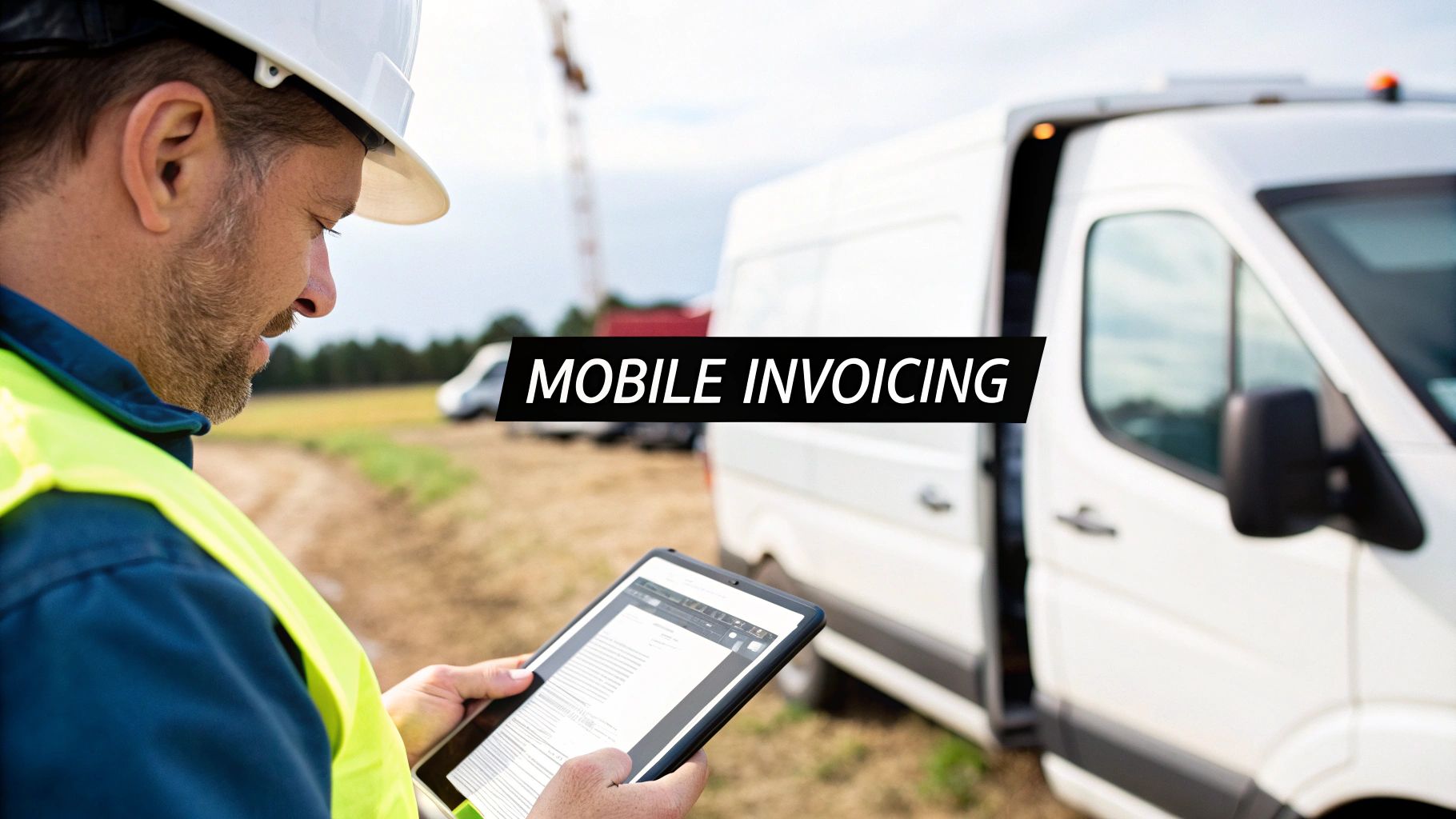
This isn’t just a small shift; it’s a fundamental change in how business gets done. The global e-invoicing market was valued at USD 6.00 billion in 2024 and is on track to hit USD 36.72 billion by 2032. That kind of explosive growth tells you everything you need to know about where the industry is heading. You can see the full breakdown of this market trend over at databridgemarketresearch.com.
The Power of Integrated Payments
The real magic happens when you integrate payments directly into this workflow. Once your tech sends the invoice, the customer can pay right then and there. They can swipe a card on a mobile reader or click a secure payment link you text them.
For any field service business, this is a total game-changer. It closes the gap between finishing the job and getting paid, which does wonders for your cash flow. No more waiting for a check to show up in the mail or making awkward phone calls to chase down overdue payments.
The moment a customer pays, the system automatically triggers the next step. A digital receipt is instantly generated and delivered to the customer's inbox, closing the loop on the transaction without any manual intervention from your office staff.
Business Impact of Automation
Automating your invoicing and receipt process does a lot more than just save a bit of time. When you give your field team the right tools, you’ll see real, measurable improvements across the board.
Here are a few of the biggest wins you can expect:
- Dramatically Improved Cash Flow: Getting paid on-site means money is in your account in days, not weeks. It’s that simple.
- Reduced Administrative Errors: When customer data and job details are automated, you kill the human errors that lead to frustrating billing disputes.
- A More Professional Customer Experience: Sending instant, branded invoices and receipts shows your customers you’re running a modern, buttoned-up operation. It builds trust.
Ultimately, by getting your team out from under a mountain of paperwork, you free them up to do what they do best: complete billable work. That’s a direct line to a healthier bottom line.
Common Questions About Invoices and Receipts
Even when you know the difference between an invoice and a receipt, questions pop up in the real world. Let's tackle a few of the most common mix-ups to keep your financial paperwork straight and your business looking professional.
Getting these details right solidifies the unique job each document has to do.
Can an Invoice Be Used as a Receipt?
This is probably the number one question we hear. The short answer is no, but there's a small exception. An invoice is a request for money. A receipt is proof that money has been received. Their purposes are fundamentally different.
That said, you can modify a paid invoice to act as a receipt in a pinch. You’d need to clearly mark the original document "Paid in Full," adding the payment date and how they paid. While this works, sending a separate, official receipt is always the cleaner, more professional route.
What Should I Do if a Customer Loses a Receipt?
Losing a paper receipt happens all the time, and it’s rarely a crisis anymore. If a customer needs another copy of their proof of purchase, you should be able to pull it from your records and send it over, especially if you're using field service software.
This is where digital record-keeping really shines. A good system logs every transaction and saves a digital copy of the receipt automatically. You can find and email it to your customer in moments, solving their problem and making your company look incredibly organized.
A lost receipt is a minor administrative task when your records are digital. For businesses still relying on paper, it can turn into a frustrating hunt through file cabinets, showing the real operational cost of sticking with outdated methods.
Does Every Single Job Need an Invoice?
Not every sale needs a formal invoice before you get paid. It all comes down to the context of the transaction.
- Point-of-Sale: When a customer pays immediately for something on the spot—like buying a filter or a small part from your shop—you can skip the invoice and go right to the receipt.
- Service Work: For almost any job you do in the field, from a simple electrical repair to a full HVAC install, an invoice is the standard. It gives the customer a clear, itemized breakdown of all the labor and materials, justifying the total cost before they're expected to pay.
Think of it this way: invoicing is essential anytime there's a gap between when the work is done and when you collect the payment.
Stop chasing paperwork and start getting paid faster. TackonFSM lets you create professional invoices, take payments in the field, and automatically send receipts, all from a single app. See how TackonFSM can streamline your workflow.