
How to Calculate Invoice Due Dates for Faster Payments
At its core, calculating an invoice due date is simple: you just add the number of days in your payment terms to the date the invoice was issued. An invoice sent on January 1st with “Net 30” terms, for example, is due on January 31st. This straightforward formula is the bedrock of managing your cash flow and making sure everyone is on the same page.
Why Accurate Due Dates Are Crucial for Your Cash Flow

It’s easy to dismiss an invoice due date as just another number on a form, but it’s actually the engine that drives your company’s financial health. Think of it less as a deadline and more as a crucial communication tool that turns ambiguity into predictable income. When a due date is clear, it sets a professional tone and tells your client exactly when you expect to be paid.
This clarity is what allows you to forecast and manage your cash flow effectively. Without it, you're left guessing when money will come in, making it nearly impossible to plan for essential business expenses.
- Pay your suppliers on time: When you know when revenue is coming, you can meet your own financial obligations without breaking a sweat.
- Manage payroll confidently: Predictable income means you can pay your team on time without dipping into savings or credit.
- Invest in business growth: Consistent cash flow gives you the freedom to budget for new equipment, marketing campaigns, or hiring new talent.
The Real Cost of Vague Due Dates
Vague or miscalculated due dates are a recipe for confusion and one of the biggest reasons for late payments. If a client has to guess when an invoice is due, they're far more likely to push it to the back of their to-do list, which throws your whole financial cycle out of whack.
This isn't a minor issue—it's a widespread problem. In the US, a staggering 39% of invoices are paid late, and 87% of businesses say they regularly receive payments after the due date. To dig deeper into this, you can find some great insights on invoice best practices.
An accurate due date isn't just about getting paid on time—it's about building trust. When clients see professional, clear, and consistent invoicing, they perceive your business as reliable and organized, strengthening your long-term relationship.
In the end, knowing how to calculate an invoice due date is a fundamental skill that protects your business. It helps you avoid the kind of payment delays that can bring operations to a halt and gives you the financial stability you need to grow.
Decoding Common Invoice Payment Terms
Before you can even think about calculating a due date, you have to speak the language of payment terms. These little phrases on your invoice are more than just suggestions; they’re the backbone of your payment agreement with a client, setting crystal-clear expectations for when you get paid.
Nailing these terms is fundamental to keeping your cash flow healthy and your client relationships on solid ground.
The most common term you'll see out in the wild is Net D. Don't let the letter throw you; "D" is just a placeholder for the number of days a client has to pay up after you issue the invoice. It's the most straightforward way to set a deadline.
- Net 15: Payment is due within 15 calendar days of the invoice date.
- Net 30: Payment is due within 30 calendar days. This is the unofficial standard in a ton of industries.
- Net 60: Payment is due within 60 calendar days, typically reserved for bigger projects or corporate clients who have longer, more rigid payment cycles.
Going Beyond the Basics
While Net D terms are your bread and butter, there are other options that give you more flexibility. Knowing when to use them can make a huge difference in how quickly you get paid.
Due Upon Receipt
This one sounds exactly like what it is: the payment is due the day your client receives the invoice. I use this to signal urgency, especially for quick, one-off jobs or when I’m working with a new client and we haven't built up a payment history yet. It's also a good way to get a chronically late payer back on track. Just be aware that "receipt" can be a bit vague in the age of email—did they see it right away, or did it land in a spam folder?
End of Month (EOM)
EOM terms mean the invoice is due by the last day of the month it was sent. So, an invoice sent on March 10th with EOM terms is due on March 31st. This is a lifesaver for clients whose accounting departments run payments in monthly batches.
You might also see a hybrid like Net 15 EOM. This means payment is due 15 days after the end of the month the invoice was issued. Using our March 10th invoice example, the clock wouldn't start until March 31st, making the actual due date April 15th.
Choosing the right payment terms is a strategic move. Net 30 is a safe bet, but using "Due Upon Receipt" for a new customer can protect you. On the flip side, offering Net 60 might just be the thing that helps you land a major corporate client.
Terms for Specific Situations
Sometimes, you need terms that do more than just set a deadline—you need them to protect your business or give clients a little nudge.
Here are a few powerful terms I’ve found incredibly useful:
| Payment Term | When It's a Good Idea | A Real-World Example |
|---|---|---|
| Payment In Advance (PIA) | For custom work, big material costs, or brand-new clients. | You're building custom cabinets and need to buy a specific, expensive type of lumber upfront. PIA ensures you're not out of pocket. |
| 2/10 Net 30 | To get clients to pay faster and boost your cash flow. | You offer a 2% discount on a $1,000 invoice if they pay within 10 days. If not, the full amount is still due in 30 days. |
| Cash on Delivery (COD) | For delivering physical goods where you can't take payment ahead of time. | Your tech installs a new water heater and collects the payment from the homeowner right then and there. |
That 2/10 Net 30 term is a personal favorite. It’s a simple psychological trick: the client feels like they're getting a deal, and you get your money weeks faster. It’s a small incentive that can have a huge impact on your payment cycle without costing you much. Once you get comfortable with these different terms, you'll have the power to set due dates that truly work for your business.
The Core Formula for Calculating Due Dates
At its heart, figuring out an invoice due date is just simple math. The formula you'll come back to time and again is straightforward:
Invoice Issue Date + Payment Term Days = Due Date
So, if you send an invoice on May 10th with Net 30 terms, you just add 30 calendar days to get your due date: June 9th. This basic calculation is the foundation of your accounts receivable, giving your client a clear and firm deadline.
Of course, the real world rarely fits into such a neat box. What happens when that due date falls on a Saturday or a big public holiday? This is precisely why having a clear, established policy is non-negotiable.
Handling Weekends and Public Holidays
One of the most common snags is a due date landing on a non-business day. Let's say your Net 30 invoice, issued May 10th, is due on June 9th—but June 9th is a Sunday. Does the client get an extra day, or do they need to pay up early?
There are a couple of ways to handle this, and the most important thing is to be consistent.
- Move it to the Next Business Day: This is the most popular and client-friendly option. In our scenario, the due date would simply shift to Monday, June 10th. It just feels fair and aligns with how most banks and businesses operate.
- Move it to the Previous Business Day: Some businesses prefer to have the money in the bank before the weekend hits. If that's your priority, you could move the due date back to Friday, June 7th. It's less common, but it's a valid strategy if your cash flow is particularly tight.
Whichever path you choose, spell it out in your terms and conditions. A simple sentence like, "If a due date falls on a weekend or public holiday, payment will be due on the following business day," can save you from future headaches and disputes.
This handy diagram shows how the most common payment terms work from the same starting point.
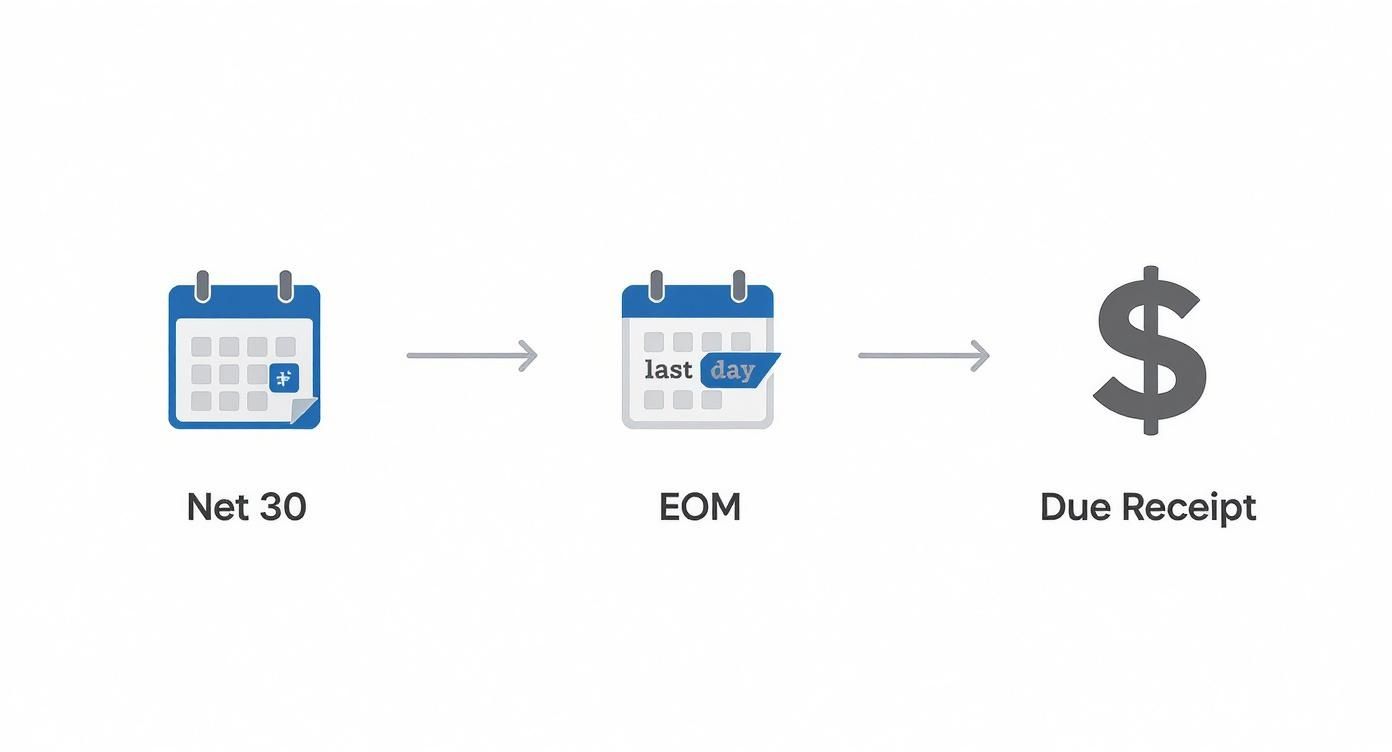
As you can see, terms like Net 30, EOM, and Due on Receipt create very different payment timelines, even when they start from the exact same invoice date.
The Strategic Use of Grace Periods
Another tool you can use is the grace period. Think of it as a short, defined window of time right after the official due date where a client can still pay without getting hit with a late fee. It’s a smart gesture of goodwill that shows you understand that, sometimes, things get delayed.
For instance, you might offer a 3-day grace period. If an invoice is due on the 15th, your client actually has until the 18th to get their payment in before any penalties kick in.
The trick is to communicate this clearly. You don't want the grace period to become the new due date in your client's mind. Frame it as a courtesy, not an extension. A good way to word this in your agreement might be: "A courtesy grace period of 3 business days is provided. Late fees will be applied to any payments received after this period."
This approach keeps the urgency of the original due date but adds a small buffer that can do wonders for your client relationships. It shows you’re firm but also reasonable—a balance that often leads to more consistent, on-time payments in the long run.
Navigating Special Invoicing Scenarios
While standard payment terms like Net 30 cover most of your bases, the real world of business is rarely that straightforward. You'll inevitably run into situations that need a bit more finesse, like clients who want to pay early for a discount, make partial payments, or unfortunately, pay late.
Knowing how to handle these exceptions isn't just about getting paid—it's about maintaining clear communication and keeping your cash flow healthy.
The Power of Early Payment Discounts
One of the best ways to encourage quick payment is to offer an early payment discount. It's a classic win-win. Your client saves a little money, and you get your cash faster.
A common industry standard is "2/10 Net 30" terms. This simply means you're offering a 2% discount if the invoice is paid within 10 days. If not, the full amount is due within the standard 30 days.
Let's see it in action. Imagine you send a $1,500 invoice on July 1st with 2/10 Net 30 terms.
- To get the discount: Your client needs to pay by July 11th. They'd get a $30 discount (2% of $1,500) and only owe $1,470.
- If they miss the window: No problem. The full $1,500 is simply due by the original July 31st deadline.
This effectively creates two different payment outcomes, so you need a good system for tracking which one applies.
Managing Partial Payments and Late Fees
What happens when a client pays part of an invoice? It’s a common question, and the answer is simple: the original due date still applies to the remaining balance.
If a $2,000 invoice is due on August 15th and the client pays $1,000 on August 1st, that's great! But the other $1,000 is still due on August 15th. Unless you've formally agreed—in writing—to a new payment plan, the deadline for the full amount doesn't change.
Your ability to charge a late fee all comes down to transparency. You must have your late fee policy clearly outlined in your initial contract or service agreement, and it should be restated on every invoice. This isn't about being punitive; it's about setting professional expectations from the start.
When a payment does run late, calculating the fee is usually pretty direct. A typical late fee might be 1.5% of the outstanding balance per month. So, for a $1,000 overdue invoice, that’s a $15 penalty.
A pro tip: Don't just tack this onto the old invoice. Issue a new, updated invoice that includes the original balance plus the late fee. This keeps your financial records clean and clear for both you and your client.
Calculating Early Payment Discounts vs Late Fees
It can be helpful to see these scenarios side-by-side. Here’s a quick comparison showing how a discount for promptness and a penalty for lateness would affect a standard $1,000 invoice.
| Scenario | Terms | Calculation | Final Amount Due |
|---|---|---|---|
| Early Payment | 2/10 Net 30 | Client pays within 10 days of the invoice date. | $980 ($1,000 – 2% discount) |
| On-Time Payment | Net 30 | Client pays between day 11 and day 30. | $1,000 (Full invoice amount) |
| Late Payment | 1.5% monthly fee | Client pays one month after the due date. | $1,015 ($1,000 + 1.5% fee) |
As you can see, the final amount owed can change based on when the client pays. Managing these variables for every invoice can become a real headache and is ripe for human error.
This is where automation becomes a lifesaver. Using a system like TackonFSM removes the guesswork by automatically applying the correct discounts or late fees based on the payment date. It helps you manage every invoice with confidence, ensuring your accounting stays accurate and professional.
How to Automate Due Date Calculations
Let's be honest: calculating due dates by hand is asking for trouble. It's a classic case of death by a thousand paper cuts. One wrong date, a forgotten holiday, or a miscalculation on a late fee can snowball into confusion, delayed payments, and hours of your life wasted on administrative cleanup. This is exactly where automation can change the game for your invoicing.
Forget spending your valuable time triple-checking dates on a calendar. The right technology can calculate invoice due dates with pinpoint accuracy every single time. Using a dedicated system just makes sense—it eliminates the risk of human error and lets you focus on growing your business, not just managing its paperwork.
Putting Your Invoicing on Autopilot
Modern field service software, like TackonFSM, is built to handle all these little details for you. The first thing you'll do is set up your default payment terms right in the system. Whether you usually work with Net 30, Net 15, or Due Upon Receipt, you can establish that as the standard for all your clients.
From there, the magic happens. Every time you create a new invoice, the system does the math instantly.
- It grabs the invoice issue date.
- It applies your default terms (say, adding 30 days for Net 30).
- It automatically stamps the correct due date right onto the invoice.
No more counting days on your fingers or second-guessing yourself. This simple step ensures every invoice you send is clear, professional, and consistent, which is a huge factor in getting paid on time.
You can see below how a typical invoicing dashboard presents this information, making it easy to see where everything stands at a glance.
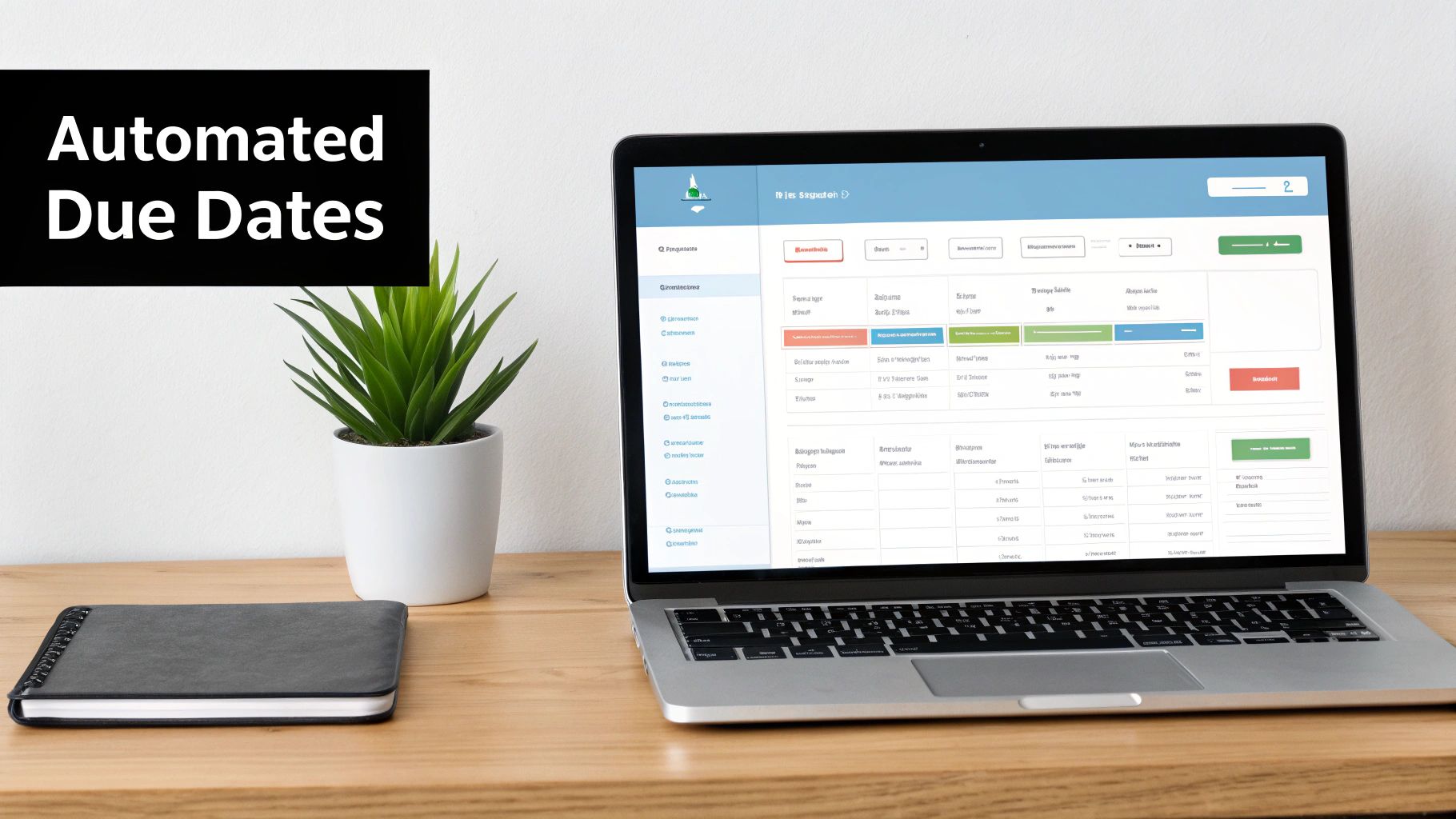
This kind of centralized view gives you an immediate snapshot of what’s paid, what's coming due, and what’s overdue—all powered by those automated calculations working behind the scenes.
Smart Rules for Real-World Scenarios
The true strength of automation shines when it handles the messy, real-world situations we've talked about. What if a Net 30 due date falls on a Sunday or a public holiday? A good system can be configured with rules to manage this automatically.
You can tell your system to always push weekend due dates to the next business day. This way, your policy is applied consistently across the board without you ever having to lift a finger. It gets rid of any gray area for both you and your client.
Automation is also a lifesaver when it comes to payment reminders. Instead of manually tracking who owes what and when, you can set up a sequence of automated reminders that are triggered based on the due date.
A typical workflow might look something like this:
- 3 Days Before Due: A friendly heads-up email goes out.
- On the Due Date: A quick notification reminds them payment is due today.
- 5 Days Past Due: A firm but professional follow-up is sent regarding the overdue balance.
This proactive, hands-off approach does wonders for improving your on-time payment rate. It also saves you from the awkward task of personally chasing down late payments, letting you maintain great client relationships while the system handles the heavy lifting.
Your Top Questions About Invoice Due Dates, Answered
Once you get the hang of calculating due dates, you'll find it's pretty straightforward. But real-world business isn't always so neat and tidy. Here are some of the most common questions I hear from business owners about handling payment deadlines.
What Are the Go-To Payment Terms for a Small Business?
If you look around, you'll see Net 30 everywhere. It’s become the default for many small and medium-sized businesses because it feels like a fair middle ground—it gives your clients a reasonable window to get their ducks in a row without making you wait forever to get paid.
But don't just copy what everyone else is doing. Think about your own cash flow. If you're a contractor who has to buy $5,000 in materials before a job even starts, waiting 30 days for payment can be a huge strain. In that case, shorter terms like Net 15 or requiring a deposit upfront might be a much smarter move for your business.
Can I Add a Late Fee If We Never Discussed It?
That’s a definite no. You can't just spring a late fee on a client out of the blue. Any penalties for late payments, whether it's a flat fee or an interest percentage, have to be spelled out in your initial contract or service agreement. The client has to agree to it from the start.
A pro tip? Don't just bury it in the contract. Restate your late fee policy right on every invoice. It acts as a clear, professional reminder of the terms they agreed to and helps avoid awkward conversations or disputes down the line.
Should I Calculate the Due Date from When I Send the Invoice or When They Get It?
Always, always calculate it from the invoice issue date. That's the day you actually create and send it. It's a concrete date that you control and can prove.
Relying on the "receipt date" is just asking for trouble. What if your email lands in their spam folder? What if their server is down? Using the issue date eliminates all that ambiguity and gives you a firm, non-negotiable start date for the payment countdown.
What Should I Do If a Client Disputes an Invoice?
When a client disputes a part of an invoice, the clock stops—but only for the disputed amount. The rest of the bill is still due by the original date.
Let's say you sent a $1,000 invoice and the client questions a specific $200 line item. They are still responsible for paying the undisputed $800 on time. Your job is to communicate clearly to sort out the $200 discrepancy while making sure the payment process for the rest of the invoice keeps moving. This is where good record-keeping really pays off.
Tired of crunching numbers and sending manual reminders? With TackonFSM, you can put your entire invoicing process on autopilot. Set your default terms, let the system calculate due dates, and schedule automatic payment reminders. See how you can get paid faster and slash errors by visiting https://www.tackonfsm.com.